Easy fan lash extensions can be a useful product category for professional lash brands, distributors, wholesalers and salon supply businesses that want to expand their volume lash range.
However, sourcing easy fan lashes wholesale requires more than selecting a diameter, curl and tray from a supplier catalog.
The terms “easy fan,” “easy fanning” and “self-fanning lashes” may be used differently by different suppliers. The actual fiber construction, base behavior, strip adhesive, fan formation and technician experience can vary significantly between products.
For this reason, professional buyers should evaluate physical samples and define the intended specifications before approving a commercial order.
This guide explains some of the main points buyers should check when developing or sourcing easy fan lash extensions for wholesale and private label use.
1. Confirm What the Supplier Means by Easy Fan Lashes
The first step is to confirm the actual product structure.
An easy fan lash is generally designed to help trained lash technicians create volume fans more efficiently, but the exact manufacturing method and strip behavior can differ between suppliers.
Buyers should not assume that every product labeled “easy fan” will perform in exactly the same way.
When requesting samples, confirm:
- The lash fiber arrangement on the strip
- The construction of the lash base
- How the fibers separate during fan creation
- How the strip adhesive affects pickup
- Whether the product matches the intended professional technique
Product names are useful for initial sourcing, but the approved physical sample should remain the main reference for commercial production.
2. Evaluate Fan Formation with Professional Technicians
Easy fan products should be tested by trained lash professionals before a larger wholesale order is approved.
A product may look consistent inside the tray but behave differently during pickup and fan creation.
Useful sample checks can include:
- How easily multiple fibers can be separated
- Whether the fan opens evenly
- Whether the base remains controlled
- Whether fibers move unexpectedly on the strip
- Whether neighboring fibers remain aligned
- Whether similar fans can be created repeatedly
For distributors and professional lash brands, technician feedback can be more useful than evaluating the tray only from product photography.
3. Compare Diameter Options Carefully
Diameter is an important specification when sourcing easy fan eyelash extensions.
Depending on supplier capability and the intended professional application, buyers may encounter target diameters such as 0.03mm, 0.05mm or 0.07mm.
These numbers should not be treated as interchangeable product options.
Before placing an order, buyers should confirm:
- The requested target diameter
- Actual fiber consistency
- Softness and flexibility
- Compatibility with the intended volume technique
- Whether the same construction can be maintained across required lengths and curls
The final diameter and application suitability should be verified through physical samples rather than assumed from catalog specifications alone. For a current product reference, buyers can review our 0.05mm C Curl Easy Fan Lashes – 8–15mm.
4. Confirm Curl and Length Configuration
Professional buyers may require different curl and length combinations depending on their existing lash extension range and target customers.
When developing easy fan lashes wholesale, buyers should confirm not only the names of the required curls but also the consistency of the curl across strips, lengths and trays.
For mixed-length products, define the tray structure clearly.
A specification such as “8–15mm mixed length” does not explain how many rows of each length are included.
A complete purchasing specification should identify:
- Total number of rows
- Included lengths
- Number of rows allocated to each length
- Curl
- Diameter
- Tray and strip layout
This information becomes especially important when the same SKU needs to be reordered later.
5. Check the Lash Base and Strip Performance
The lash strip is a functional part of an easy fan product.
Strip adhesive that is too strong, too weak or inconsistent may affect how technicians remove and manipulate the fibers.
During sample testing, buyers should evaluate:
- Ease of fiber pickup
- Strip adhesive consistency
- Whether fibers release cleanly
- Whether the lash base remains controlled during pickup
- Whether residue or deformation affects professional use
These details should be tested across several strips and trays rather than judged from a single sample area.
6. Understand Easy Fan Lashes vs Premade Fans
Easy fan lashes and premade lash fans should not be treated as the same product category.
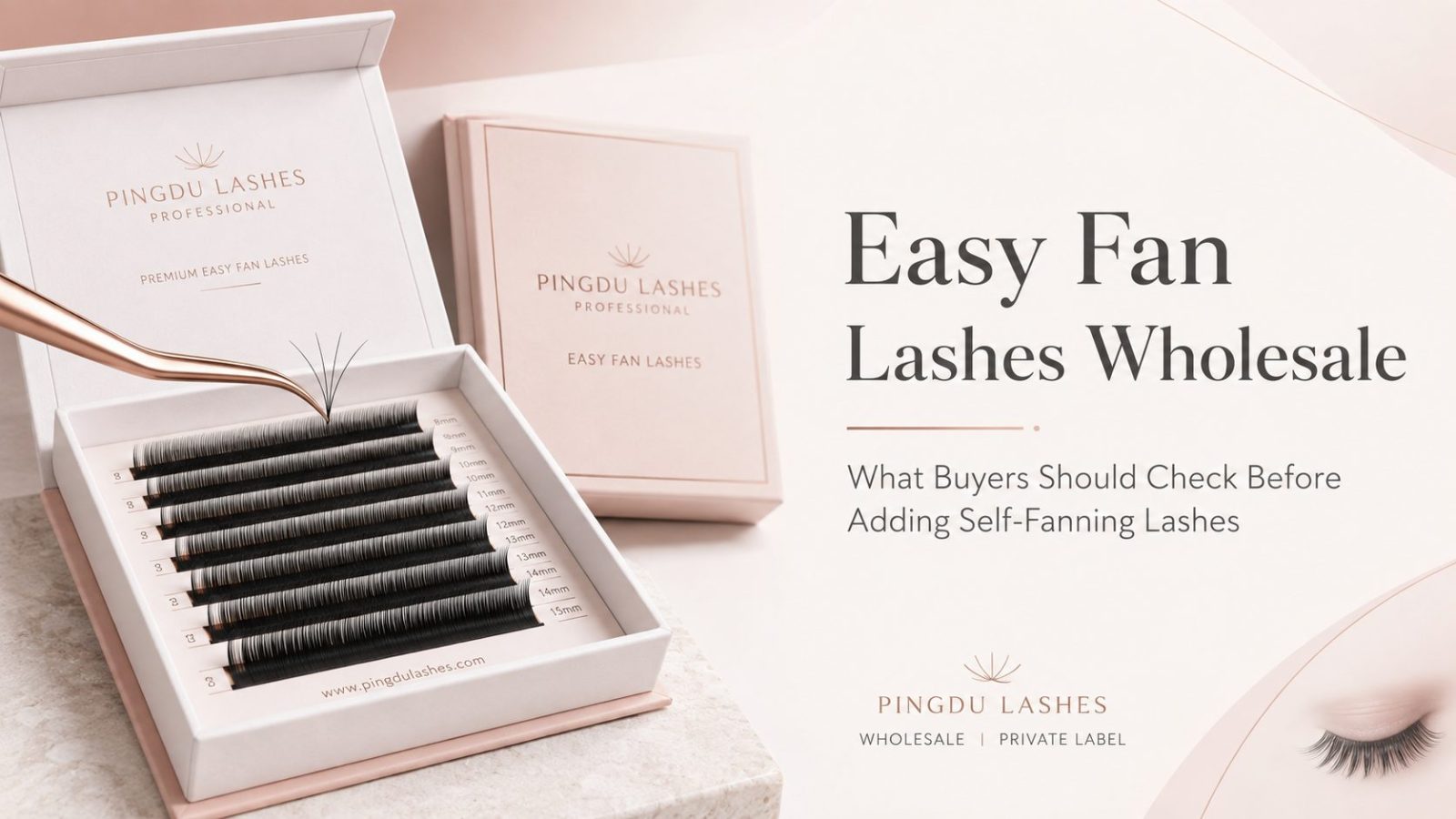
Easy fan lashes are supplied as fibers on a working strip and are intended to assist trained technicians in creating fans during the service.
Premade fans are supplied with the fan structure already formed before application.
For wholesale buyers, this difference affects product positioning, packaging, technician expectations and the specifications that need to be tested.
A brand that already sells premade fans should therefore evaluate easy fan products as a separate SKU category rather than simply replacing the product name.
When building a professional extension collection, both formats can serve different technician preferences and purchasing needs.
7. Test Consistency Across Multiple Trays
One good-looking tray is not enough for a professional wholesale product.
Buyers should compare multiple samples to determine whether the fiber construction and working behavior remain consistent.
Important checks include:
- Diameter consistency
- Curl consistency
- Length accuracy
- Fiber alignment
- Base behavior
- Strip release
- Fan formation
- Tray presentation
- Label accuracy
Any approved sample should be recorded with a product reference, specification sheet and photographs so it can be used for future production comparison.
8. Plan Private Label Easy Fan Lashes
Professional brands may want to sell private label easy fan lashes under their own product line.
Private label development can involve more than placing a logo on a standard box.
Depending on the project, buyers may need to coordinate:
- Brand logo
- Tray card design
- Outer packaging
- Product name
- Diameter information
- Curl information
- Length information
- Barcode area
- Product labels
- Market-specific packaging information
The packaging artwork should always match the actual approved product specifications.
More information about private label development is available through our Custom Service.
9. Build an Easy Fan Lash SKU Range Carefully
Distributors and established brands may eventually develop several easy fan lash SKUs using different diameters, curls and length combinations.
However, launching too many combinations at the beginning can increase inventory complexity and packaging costs.
A more controlled approach is to start with several clearly defined specifications, collect technician and sales feedback, and expand according to real demand.
Useful questions include:
- Which diameter is most relevant to the target technician group?
- Which curls are already established in the current product range?
- Should the first launch use single-length or mixed-length trays?
- Which specifications are likely to become repeat-order SKUs?
- How many variations can the distributor manage efficiently?
This approach can help buyers build a professional volume lash extensions wholesale range without creating unnecessary SKU duplication.
10. Choose an Easy Fan Lash Supplier for Repeat Orders
When choosing an easy fan lash supplier, wholesale buyers should compare more than the initial unit price.
Important factors include sample quality, specification consistency, supplier communication, private label support and the ability to reproduce an approved product for repeat orders.
For professional lash brands and distributors, accurate specification records can be particularly important because small differences in diameter, curl, strip behavior or fiber construction may affect technician feedback.
Buyers should therefore maintain records of approved samples, product references, packaging files and confirmed changes for each SKU.
Develop Easy Fan Lash Extensions with Pingdu Lashes
Pingdu Lashes works with specialized manufacturing partners to support professional buyers through supplier matching, sample coordination, specification confirmation, private label packaging and commercial order preparation.
Easy fan lash projects can be discussed according to the buyer’s target diameter, curl, length range, tray configuration, packaging requirements and estimated order quantity.
Product availability, final specifications, MOQ, pricing and production lead time should be confirmed according to the selected supplier and approved physical sample.
If you are sourcing easy fan lashes wholesale for a lash brand, distributor or professional beauty supply business, contact Pingdu Lashes with your target specifications and reference requirements.
For more professional lash sourcing topics, visit our Lash Guide or contact us to discuss a sourcing project.
Frequently Asked Questions
What are easy fan lashes?
Easy fan lashes are professional lash extension fibers designed to help trained technicians create volume fans more efficiently. The exact construction and working behavior may vary between suppliers.
Are easy fan lashes the same as premade fans?
No. Easy fan lashes are supplied as fibers that technicians fan during the service, while premade fans are manufactured with the fan structure already formed.
What should buyers test before ordering easy fan lashes wholesale?
Buyers should evaluate fan formation, lash base behavior, diameter, curl, length accuracy, strip release, fiber consistency and tray presentation using physical samples.
Can easy fan lashes be private labeled?
Depending on the project, private label development can include custom logos, tray cards, outer boxes, specification labels and other packaging elements.
Can buyers source different diameters and curls?
Different specifications may be available depending on supplier capability. Each required combination should be confirmed through supplier matching and sample approval before commercial production.