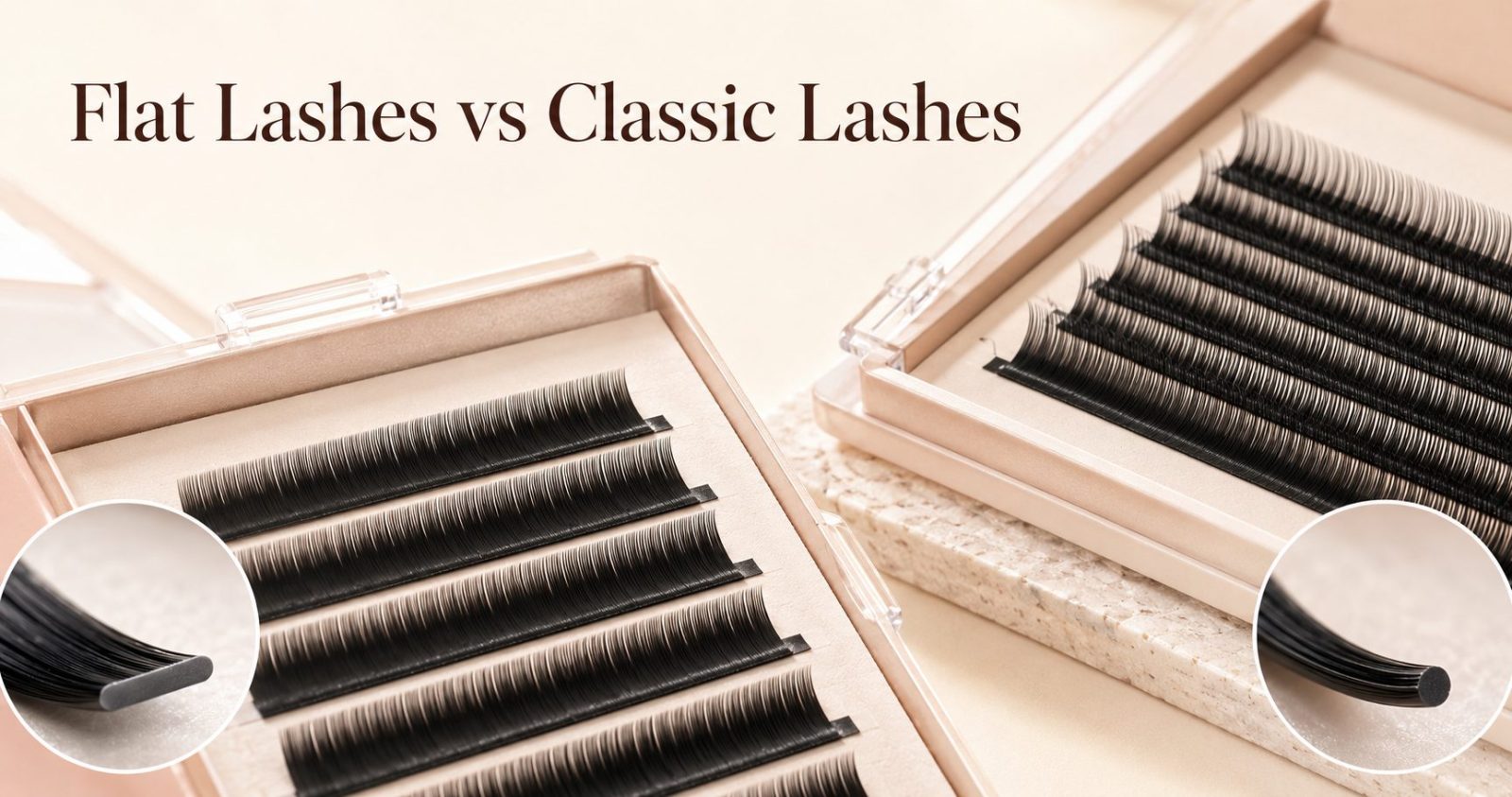
Flat lashes and classic lashes are both professional eyelash extension products, but their fiber shape and product positioning are different. For lash brands, salon suppliers, importers and distributors, choosing between them requires more than comparing photographs or selecting a popular thickness.
Wholesale buyers should compare flat lashes vs classic lashes through base shape, diameter, curl, length, tray format, strip release, sample consistency, private label packaging and repeat-order requirements.
This article explains the main sourcing differences and shows how buyers can prepare a more accurate specification request for professional eyelash extension suppliers.
Flat Lashes vs Classic Lashes at a Glance
| Comparison | Flat Lash Extensions | Classic Lash Extensions |
|---|---|---|
| Fiber profile | Flattened or elliptical profile | Conventional round profile |
| Visual positioning | Often selected for a darker or more defined classic-style result | Traditional one-to-one classic extension positioning |
| Important specifications | Flat profile, base width, tip structure, diameter, curl and length | Round profile, diameter, curl, length and taper |
| Sample evaluation | Profile consistency, pickup, separation and curl | Diameter consistency, pickup, separation and curl |
| Commercial role | Can extend a professional brand’s classic lash range | Often forms the core of a professional extension collection |
These are general sourcing distinctions rather than universal performance claims. Fiber construction and terminology can vary among suppliers, so buyers should confirm the actual profile and approved sample before using a specification in product descriptions or packaging.
What Are Flat Lash Extensions?
Flat lash extensions are individual professional extensions with a flattened or elliptical fiber profile instead of a conventional round profile. They may also be described by suppliers using terms such as ellipse lashes, cashmere flat lashes or other product-specific names.
These terms should not automatically be treated as identical. Buyers should request photographs of the cross-section or base, supplier specifications and physical samples to confirm the actual construction.
Important flat lash details may include:
- The shape and width of the flattened base.
- Whether the tip is single, split or another confirmed structure.
- Fiber diameter and weight characteristics.
- Curl and length consistency.
- Color and surface appearance.
- Pickup and separation from the strip.
- Tray labeling and SKU accuracy.
What Are Classic Lash Extensions?
Classic lash extensions normally use individual fibers with a conventional round profile and are intended for professional one-to-one application. They are commonly organized by diameter, curl, length, color and tray format.
For wholesale classic lash extensions, buyers should confirm:
- Requested fiber diameter.
- Required curl types.
- Single-length or mixed-length trays.
- Number of rows per tray.
- Fiber color and finish.
- Strip adhesion and release behavior.
- Tray card, label and outer-box requirements.
Classic lash extensions may look simple as a category, but a distributor can still create many SKUs by combining different diameters, curls, lengths and tray formats. Product-range planning is therefore important before requesting quotations.
0.15mm Flat Lashes vs 0.15mm Classic Lashes
0.15mm flat lash extensions and 0.15mm classic lash extensions may share the same stated diameter, but the number alone does not confirm that their complete fiber profiles, weight or finished appearance are equivalent.
Because flat and round fibers use different cross-sectional shapes, buyers should avoid making performance claims based only on the diameter printed on a supplier list. Sample comparison should include:
- Actual base profile and fiber shape.
- Visual darkness and definition.
- Curl consistency from root to tip.
- Fiber separation and pickup.
- Professional technician feedback.
- Consistency across several trays.
A brand planning both categories should keep separate product codes for flat and classic fibers, even when their printed diameter, curl and length are the same.
What About 0.20mm Flat Lashes?
0.20mm flat lash extensions represent another detailed long-tail sourcing direction. However, buyers should not assume that every supplier produces the same 0.20mm profile or that it is appropriate for every professional application.
The buyer should ask a trained lash technician to evaluate the approved sample and confirm the intended market positioning before adding the specification to a commercial range.
Choosing C Curl and D Curl Flat Lashes
Curl is one of the most important SKU variables in a professional extension collection. Common sourcing searches include C curl flat lashes and D curl flat lashes, but curl names are not always visually identical across different suppliers.
Wholesale buyers should compare:
- The complete curl profile rather than only the letter.
- Curl consistency across different lengths.
- Consistency between production samples and later orders.
- Whether flat and classic products follow the same visual curl reference.
- How curl information is printed on tray cards and outer boxes.
If a brand sells both flat and classic lash extensions, it should decide whether the same curl names are expected to produce closely matched visual results across the two product categories.
Single-Length vs Mixed-Length Lash Trays
Flat and classic lash extensions can be planned in single-length or mixed-length trays, depending on supplier capability and buyer requirements.
Single-Length Trays
Every row contains the same confirmed length. This format can support professional buyers who use higher quantities of specific lengths and need clear inventory control.
Mixed-Length Lash Trays
Mixed length lash trays combine several lengths in one package. A target configuration such as an 8–14mm mixed length lash tray can cover a wider mapping range, but the buyer must confirm exactly how many rows are assigned to each length.
“8–14mm mixed” is not a complete specification by itself. Buyers should record:
- Every included length.
- Number of rows assigned to each length.
- Total number of rows.
- Curl and diameter.
- Flat or classic fiber profile.
- Tray card and label information.
12-Row vs 16-Row Lash Extension Trays
Row count is another useful professional long-tail specification. Buyers may research 12-row flat lash trays, 16-row lash extension trays or other tray configurations.
A higher row count does not automatically mean that two trays contain directly comparable quantities. Buyers should also check:
- Usable strip length.
- Fiber spacing on each strip.
- Consistency of the selected length and curl.
- Tray dimensions and outer-box compatibility.
- Label space and SKU visibility.
- Carton packing and warehouse requirements.
When comparing quotations, professional buyers should compare the complete tray specification rather than row count alone.
Wholesale Specification Checklist
| Specification | Example Sourcing Direction | What Must Be Confirmed |
|---|---|---|
| Fiber profile | Flat, ellipse or classic round | Actual construction and supplier terminology |
| Diameter | 0.15mm or 0.20mm | Available diameter and approved sample profile |
| Curl | C curl or D curl | Visual curl reference and consistency |
| Length | Single length or 8–14mm mixed lengths | Exact length and row allocation |
| Tray format | 12-row or 16-row tray | Strip length, fiber quantity and box dimensions |
| Packaging | Standard tray or private label packaging | Artwork, SKU, labels and printed specifications |
The examples above are sourcing directions rather than statements of fixed inventory. Final combinations, availability, samples, MOQ, pricing and lead time must be confirmed for each project.
Sample Testing Before a Bulk Order
Professional extension samples should be evaluated by trained lash technicians. Buyers should compare more than one strip or one tray section before approving a product.
A sample-testing record may include:
- Confirm whether the fiber profile matches the requested flat or classic construction.
- Check diameter, length and curl labeling.
- Compare curl consistency across several strips.
- Evaluate fiber separation and pickup from the strip.
- Review the tray card, labels and SKU information.
- Collect professional technician feedback.
- Keep an approved sample for future production comparison.
Buyers expanding beyond classic and flat lashes can also review our premade lash fans guide for distributors.
Planning a Professional Extension Range
A distributor does not need to launch every diameter, curl and length simultaneously. Too many combinations can create slow-moving SKUs and complicate repeat ordering.
A structured range may begin with:
- Selected classic lash specifications already familiar to the target market.
- One or two flat lash specifications for comparison.
- Core curls supported by local salon demand.
- A combination of single-length and mixed-length trays.
- A consistent tray card, box and SKU system.
Sales and reorder data can then guide later expansion. Our wholesale lash supply planning article explains how distributors can coordinate product selection, quality control, inventory and repeat purchases.
Private Label Flat and Classic Lashes
Private label flat lash extensions and classic lash collections need packaging that clearly identifies every SKU. Diameter, curl, length, row count and fiber type should match the approved product specification.
Before printing packaging, confirm:
- Product name and fiber profile.
- Diameter, curl and length.
- Single-length or mixed-length configuration.
- Row count and tray format.
- Product code and buyer-provided barcode.
- Artwork version and printing requirements.
Read our private label lash packaging guide before approving tray cards and outer boxes.
Working With a Pingdu Eyelash Sourcing Partner
Pingdu Lashes supports professional brands, importers, distributors and Beauty Supply companies through supplier matching, specification confirmation, sample coordination and private label packaging planning.
Flat and classic lash projects can begin with a target specification, but final fiber construction, diameter, curl, length, row count, materials, packaging, MOQ, pricing and production lead time must be confirmed with the selected supplier.
Explore our eyelash products and sourcing categories or learn more about our custom eyelash and private label service.
Planning a Flat or Classic Lash Extension Range?
Send us your target fiber profile, diameter, curl, length range, tray format and packaging requirements. We can coordinate supplier matching, professional sample evaluation and specification confirmation.