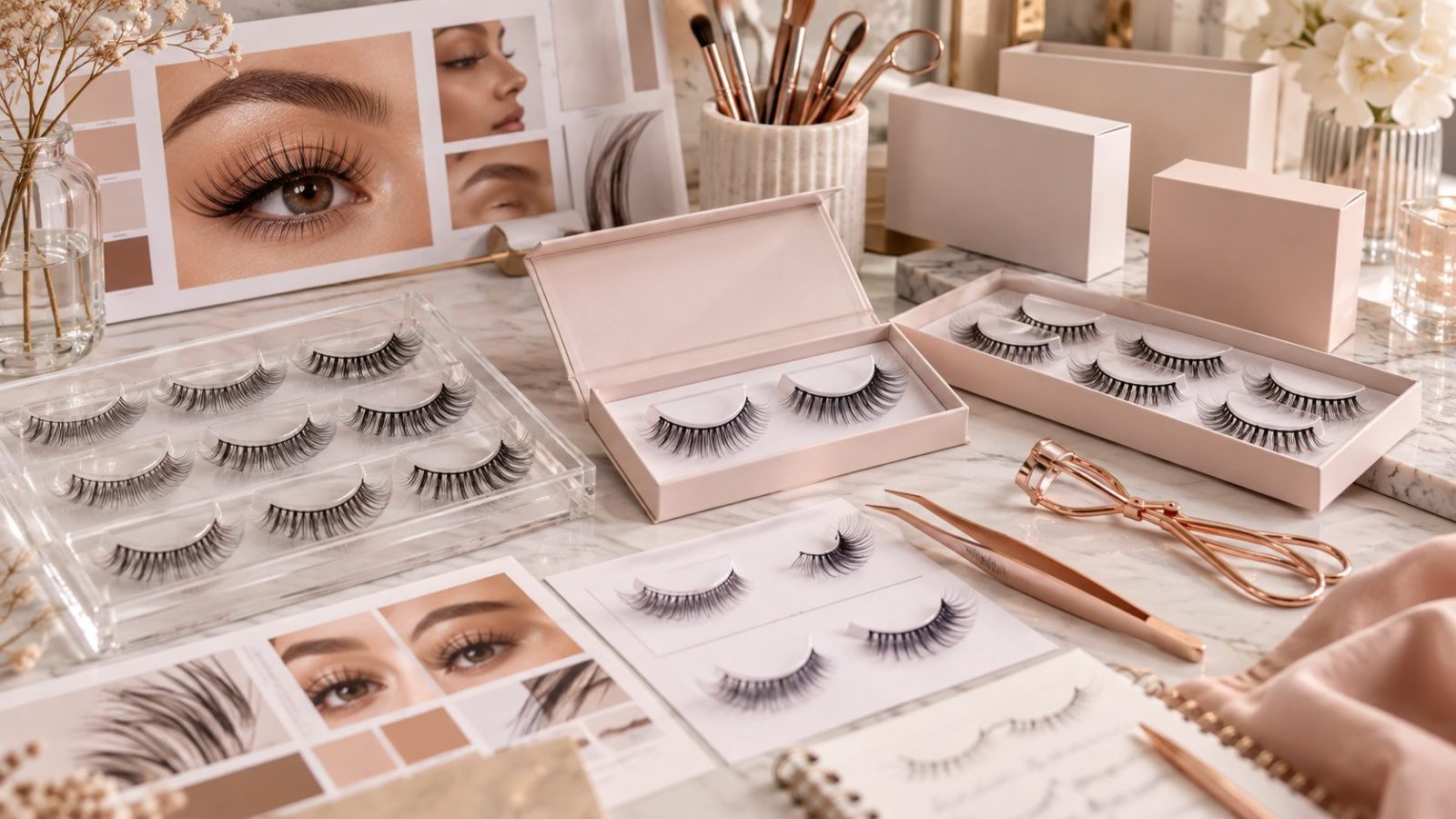
Consumers increasingly want false lashes that look more customized, lightweight and natural while remaining easier to apply than individual lash clusters or salon extensions.
This creates an interesting product opportunity for beauty brands: extension-look strip lashes.
Ardell Individual Illusion is one useful market benchmark because it demonstrates how a traditional strip lash can be designed to visually resemble the placement, spacing and dimension of individually applied lashes.
For private label buyers, the opportunity is not to copy another brand’s packaging, product names or protected design.
The better approach is to understand the product logic and develop an independent strip lash collection that delivers an extension-inspired look through your own lash pattern, band structure, fiber selection, packaging and brand positioning.
Quick Answer: How Can a Brand Develop an Ardell Individual Illusion Alternative?
A private label extension-look strip lash can be developed by combining several product elements:
- Piece-by-piece visual lash placement
- Soft spacing between lash groups
- Lightweight strip construction
- Natural-to-fuller density options
- Thin flexible lash band
- Soft tapered fibers
- Different lash lengths and eye shapes
- Natural, wispy, cat-eye and soft glam styles
- Custom lash trays
- Private label retail packaging
The objective is to create the visual effect of individually placed lashes while maintaining the convenience of a single strip application.
Why Use Ardell Individual Illusion as a Product Benchmark?
Successful products can help buyers understand how a category solves a specific customer problem.
Traditional strip lashes can sometimes look too uniform or dense.
Individual lashes and professional extensions can create more customized results, but they usually require more application time, precision or professional skill.
An extension-look strip lash sits between these two experiences.
It can offer:
- The convenience of a strip lash
- The visual spacing of individual lashes
- A lighter and more dimensional appearance
- Less application complexity than individual lash placement
- A more customized-looking finish
This product logic can be useful for brands targeting consumers who want a refined lash effect without a complicated application process.
Extension-Look Strip Lashes Are Not the Same as Standard Strip Lashes
A conventional strip lash often uses a relatively continuous fiber pattern across the lash band.
An extension-look strip lash should create the impression that separate lash sections have been positioned individually.
This effect can be achieved through:
- Controlled spacing
- Alternating lash lengths
- Small fiber groupings
- Intentional density variation
- Visible separation between sections
- Soft layering
The final result should look more dimensional and less like one uniform wall of fibers.
1. Start with the Desired Finished Look
Before selecting a factory sample, define the visual effect the product should create.
Possible directions include:
- Natural extension effect
- Soft sparse effect
- Wispy extension effect
- Natural volume effect
- Cat-eye extension effect
- Soft glam effect
This gives the manufacturer a clearer development target than simply requesting “a natural strip lash.”
2. Develop a Piece-by-Piece Lash Pattern
The defining characteristic of this category is the way the fibers are visually grouped.
Instead of creating a completely continuous lash surface, the pattern should suggest separate lash placements.
Development variables may include:
- Width of each lash grouping
- Distance between lash groups
- Number of fibers in each section
- Length variation between groups
- Amount of overlap
- Layering direction
Small changes in spacing can dramatically change the final appearance.
3. Natural Sparse Extension-Look Lashes
A sparse version can be designed for customers who want subtle enhancement rather than heavy volume.
This type of product may use:
- More visible spacing
- Lower fiber density
- Moderate lengths
- Fine tapered fibers
- Soft lash peaks
The objective is to create definition while allowing the natural lash line to remain visible.
4. Fuller Extension-Look Strip Lashes
A second SKU can use the same product concept with slightly increased density.
This gives brands a natural progression within the collection:
- Natural
- Natural Fuller
- Wispy
- Soft Glam
This is usually more commercially useful than creating multiple styles that look almost identical.
5. Wispy Extension-Look Strip Lashes
A wispy version can combine the extension-look structure with more obvious peaks and texture.
Possible features include:
- Alternating lash lengths
- Defined spikes
- Softer filler fibers
- Layered texture
- Controlled spacing
The challenge is to maintain the piece-by-piece effect without making the lash look disorganized.
6. Cat-Eye Extension-Look Lashes
Brands can also develop a cat-eye direction by gradually increasing length toward the outer section.
This may include:
- Shorter inner fibers
- Gradual mid-eye transition
- Longer outer lash groups
- More defined outer-corner spacing
The finished effect can visually lengthen the eye while preserving the extension-inspired lash pattern.
7. Consider Different Intensity Levels
A well-structured collection can help customers choose based on intensity rather than complicated technical descriptions.
| Collection Level | Suggested Product Direction |
| Natural | Sparse Lightweight Extension-Look Lash |
| Defined | Balanced Individual-Effect Lash |
| Wispy | Textured Extension-Look Lash |
| Lifted | Cat-Eye Extension-Look Lash |
| Soft Glam | Fuller Dimensional Extension-Look Lash |
This creates a clear product architecture for online stores, distributors and retail buyers.
8. The Lash Band Is Critical
The band can determine whether an extension-look strip lash feels refined or obviously artificial.
A heavy band can reduce the visual illusion of individually placed lashes.
Possible band directions may include:
- Thin black cotton-style band
- Fine flexible band
- Clear band
- Soft lightweight band
The best option depends on the desired visual effect and customer positioning.
9. Thin Black Band for Defined Lash-Line Effect
A thin black band can create subtle definition along the lash line while remaining relatively discreet.
This may suit:
- Extension-look collections
- Customers who wear eyeliner
- Soft glam styles
- More defined lash effects
The band should remain flexible enough to follow the eyelid comfortably.
10. Clear Band for an Even More Natural Appearance
A clear band can be considered for brands targeting customers who prefer a minimal makeup effect.
It may work particularly well with:
- Natural sparse styles
- Shorter lash lengths
- No-eyeliner makeup
- Lightweight everyday collections
However, band transparency alone does not guarantee a natural result. Fiber placement and density remain equally important.
11. Fiber Selection Influences the Extension Effect
Extension-look strip lashes usually benefit from fibers that taper naturally rather than ending with a blunt appearance.
Possible fiber directions include:
- Soft black fibers
- Matte black fibers
- Fine tapered fibers
- Lightweight faux mink-style fibers
- Brown fibers
The fiber finish should match the target customer and overall product positioning.
12. Brown Extension-Look Strip Lashes
Brown fibers can be used to create an even softer version of the extension-look concept.
This may appeal to:
- Natural makeup customers
- Consumers with lighter hair
- Soft bridal makeup
- Minimal beauty collections
- Customers who find deep black lashes too strong
A beauty brand can therefore extend the product concept beyond black lashes without changing the basic product structure.
13. Different Length Profiles Can Create Different Effects
Length distribution should be developed intentionally.
Possible profiles include:
- Balanced length across the eye
- Gradual outer-corner increase
- Longer center for open-eye styling
- Short natural everyday profile
- Mixed-length wispy profile
The length pattern should support the visual story of each SKU.
14. Extension-Look Strip Lashes for Different Eye Shapes
The same pattern may not suit every eye shape equally.
A collection can be developed around different styling goals:
- Almond-eye enhancement
- Round-eye opening effect
- Outer-corner lift
- Soft cat-eye effect
- Short-band options for smaller eyes
This can create meaningful product differences rather than cosmetic changes to the same lash.
15. Beginner-Friendly Positioning
One of the strongest commercial benefits of this product category is that it can visually resemble a more advanced lash technique while remaining a strip lash.
This can appeal to customers who:
- Like the look of lash extensions
- Do not want a salon appointment
- Find individual lashes difficult to apply
- Do not want to create lash maps themselves
- Prefer a single-strip application
For brands, this makes the product suitable for both experienced strip lash users and customers exploring more extension-inspired styles.
16. Extension-Look Strip Lashes vs Individual Lashes
Individual lashes require multiple separate pieces to be positioned along the lash line.
Extension-look strip lashes combine the visual concept into one complete band.
This means the two categories offer different customer experiences.
| Feature | Individual Lashes | Extension-Look Strip Lashes |
| Application | Multiple separate pieces | One strip |
| Mapping | Often selected during application | Pre-designed into lash pattern |
| Customization | Very flexible | Defined by product style |
| Application Complexity | Higher | Lower |
| Target User | More precision-oriented | Convenience-oriented |
17. Extension-Look Strip Lashes vs Salon Lash Extensions
Professional lash extensions are applied individually or in fans by trained lash artists and are designed for longer-term wear.
Extension-look strip lashes are temporary false lashes designed to imitate some of the visual characteristics of extension styling.
They should not be marketed as equivalent to professional salon extensions.
Instead, the value proposition is:
extension-inspired appearance with strip lash convenience.
18. Extension-Look Strip Lashes vs DIY Cluster Lashes
DIY cluster systems use multiple smaller lash segments applied separately.
Extension-look strip lashes provide a similar piece-by-piece visual concept but integrate all sections into one strip.
DIY clusters may offer more flexibility in lash mapping, while strip lashes can offer faster application for customers who prefer a simpler process.
Brands interested in DIY systems can also explore our Private Label DIY Cluster Lash Kit.
19. Build a Collection Instead of One Generic SKU
A beauty brand can use the same basic extension-look concept to develop multiple clearly differentiated products.
For example:
- Natural Sparse Extension-Look Lash
- Natural Fuller Extension-Look Lash
- Wispy Extension-Look Lash
- Cat-Eye Extension-Look Lash
- Soft Glam Extension-Look Lash
- Brown Extension-Look Lash
This creates a real product family that can be expanded over time.
20. Consider Full Strip and Shorter Strip Formats
Not every extension-look product needs to use a full-length lash band.
Brands can evaluate:
- Full strip lashes
- Three-quarter strip lashes
- Half strip lashes
- Outer-corner accent lashes
Shorter formats may be suitable for customers who want a more targeted outer-eye effect or find full strip lashes difficult to fit.
Brands interested in a natural half-lash format can also view our Private Label Natural Half Strip Lashes.
21. Private Label Packaging Should Explain the Product Benefit
Customers may not immediately understand what makes an extension-look strip lash different from a conventional strip lash.
Packaging can communicate features such as:
- Extension-inspired effect
- Piece-by-piece appearance
- Lightweight design
- Natural or fuller intensity
- Eye shape or style direction
- Application instructions
- Storage guidance
Private label packaging may also include:
- Custom logo
- Brand colors
- Style name
- Intensity level
- Custom tray
- Barcode
- SKU code
- Retail-ready outer box
22. Do Not Copy Ardell Packaging or Product Identity
Using Ardell Individual Illusion as a benchmark does not mean reproducing Ardell’s visual identity or protected commercial assets.
Private label buyers can study:
- The extension-inspired strip lash concept
- The balance between spacing and density
- The convenience of one-strip application
- Natural versus fuller product differentiation
- The target customer problem being solved
The new product should use its own:
- Brand name
- Logo
- Packaging artwork
- Product names
- Lash pattern
- Length profile
- Band structure
- Fiber specification
- Marketing positioning
Brands should independently review trademark, patent, design and other intellectual property considerations relevant to their target market before launch.
23. Use Physical Benchmark Samples During Development
A physical benchmark sample can communicate the target experience more accurately than photographs alone.
The development team can evaluate:
- Lash spacing
- Fiber grouping
- Density
- Length profile
- Band thickness
- Band flexibility
- Fiber softness
- Tray structure
- Overall visual effect
The purpose is not to reproduce the sample exactly.
The purpose is to understand which product characteristics create the desired customer experience and then develop an independent specification.
24. Compare Several Sample Patterns
Extension-look lashes are highly dependent on fiber placement.
Brands should consider comparing multiple pattern directions during development.
For example:
- More sparse spacing
- Closer spacing
- Higher density
- Longer peaks
- Shorter natural fibers
- Different outer-corner lengths
Small differences can create very different visual results.
25. Test the Lash on the Eye, Not Only in the Tray
A lash may look attractive inside the packaging but behave differently when worn.
Sample evaluation should include:
- Fit along the eyelid
- Inner-corner comfort
- Outer-corner position
- Band flexibility
- How naturally the fibers blend
- Whether the spacing remains visually balanced
- Overall weight
Wear testing is particularly important for products positioned around a natural or seamless effect.
26. Pilot Production Helps Test Repeatability
An approved sample shows that a target appearance can be produced once.
A pilot order helps determine whether the same fiber placement, spacing and overall appearance can be repeated across commercial production.
Pilot-order evaluation may include:
- Left and right lash symmetry
- Fiber grouping consistency
- Spacing consistency
- Length accuracy
- Band consistency
- Tray placement
- Packaging accuracy
- SKU management
This is especially important for beauty brands that expect repeat orders.
27. Repeat-Order Consistency Should Be Planned from the Beginning
Once a brand finds a successful lash pattern, future batches need to maintain the same visual character.
Production references should include:
- Approved physical sample
- Style code
- Fiber specification
- Lash length profile
- Density reference
- Spacing reference
- Band specification
- Tray model
- Packaging version
The buyer should not need to rebuild the product from the beginning every time a repeat order is placed.
Who Are Extension-Look Strip Lashes Suitable For?
This product direction can be developed for:
- False eyelash brands
- Beauty brands
- Cosmetics distributors
- Amazon beauty sellers
- Shopify brands
- TikTok Shop brands
- Beauty retailers
- Private label product developers
It can be particularly useful for brands looking for a strip lash concept that offers a more customized appearance than standard uniform lash designs.
What Should I Send a Manufacturer to Develop an Ardell Individual Illusion-Style Product?
A buyer can normally begin development by providing:
- Physical benchmark sample
- Target customer
- Target market
- Natural or fuller intensity preference
- Preferred lash length
- Preferred spacing
- Desired eye shape
- Band preference
- Fiber color
- Packaging concept
- Expected order quantity
- Target launch schedule
Reference images and competitor products can also help explain the intended market position.
Pingdu Lashes Support for Private Label Extension-Look Strip Lash Development
Pingdu Lashes supports beauty brands, distributors and professional buyers with eyelash product development, sample coordination, private label packaging and repeat-order management.
For extension-look strip lash projects, development may include:
- Lash pattern development
- Spacing and density adjustment
- Fiber selection
- Band selection
- Length profile development
- Natural, wispy or cat-eye style development
- Sample revisions
- Custom lash trays
- Private label packaging
- Pilot-order evaluation
- Multi-SKU collection planning
Buyers can provide a physical market benchmark, reference image or detailed product concept.
We coordinate development according to the desired visual effect, target customer and brand positioning.
Brands developing a wider strip lash collection can also explore our Private Label Wispy Strip Lashes Collection.
If you are developing an extension-look strip lash collection for your beauty brand, visit our Custom Service page to discuss product specifications, benchmark samples, packaging and expected order quantities.
Frequently Asked Questions
What are extension-look strip lashes?
Extension-look strip lashes are false lashes designed with spacing, grouped fibers and varied lengths that visually imitate some of the dimensional characteristics of individually applied lashes while remaining one complete strip.
Can a manufacturer develop an Ardell Individual Illusion alternative?
Yes. An existing market product can be used as a benchmark while developing an independent lash pattern, band structure, fiber specification, packaging and brand identity.
Are extension-look strip lashes the same as individual lashes?
No. Individual lashes are applied as multiple separate pieces, while extension-look strip lashes integrate the visual pattern into one strip.
Are they the same as professional lash extensions?
No. Professional lash extensions are applied individually by trained lash artists and are intended for longer-term wear. Extension-look strip lashes are temporary false lashes designed to create an extension-inspired appearance.
Can I develop natural and fuller versions?
Yes. Brands can create different density levels ranging from sparse natural styles to fuller soft glam effects.
Can I develop wispy or cat-eye versions?
Yes. Fiber spacing, length distribution and outer-corner progression can be customized to create wispy, cat-eye and other visual directions.
Can I use a clear lash band?
Clear, thin black and other lightweight band directions can be evaluated depending on the desired visual effect and product structure.
Can I develop brown extension-look lashes?
Yes. Brown fibers can be considered for softer and more natural product positioning.
Can the packaging be customized?
Yes. Private label packaging can include custom logos, colors, lash names, trays, barcodes, SKU information, inserts and retail boxes.
Should I approve a pilot order before scaling?
For established beauty brands and distributors, a pilot order can help verify fiber placement, spacing, symmetry, tray assembly and packaging consistency before larger-scale production.



