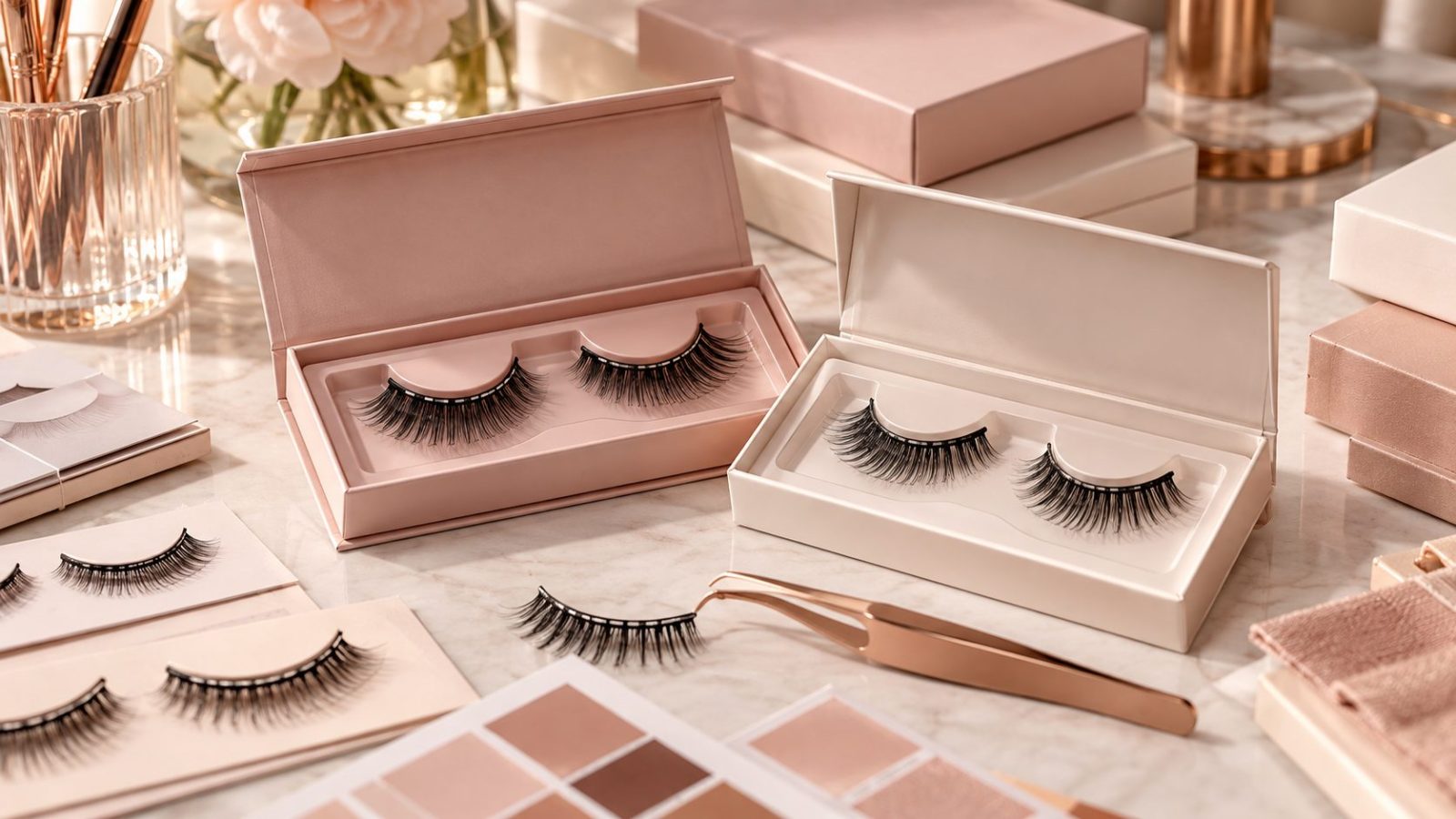
Self-adhesive strip lashes are becoming an important product direction for beauty brands that want to make false lashes easier and faster to apply.
Instead of asking customers to purchase and apply separate lash glue, a self-adhesive strip lash uses an adhesive band that is already integrated into the product.
Established beauty brands such as Lilly Lashes can be useful market benchmarks because they show how self-adhesive lashes can be developed into a broader collection with different lengths, styles, intensity levels and full-band or half-lash formats.
For private label buyers, however, the objective should not be to copy another brand’s packaging, product names or protected design.
The better approach is to study the product logic and develop an independent self-adhesive lash collection with your own specifications, branding, packaging and customer positioning.
Quick Answer: How Can a Brand Develop a Private Label Lilly Lashes Alternative?
A beauty brand can develop a reusable self-adhesive strip lash collection by coordinating several product elements:
- Self-adhesive lash band
- Full strip or half strip format
- Natural, wispy, cat-eye or dramatic lash styles
- Different lengths and densities
- Clear or black band direction
- Reusable adhesive performance
- Protective lash tray
- Application and storage instructions
- Private label retail packaging
The most important development question is not simply whether the lash has adhesive on the band.
The real question is whether the complete product provides a reliable, comfortable and easy-to-understand customer experience.
Why Use Lilly Lashes as a Market Benchmark?
Successful beauty brands can help buyers understand how a product category is organized and communicated to consumers.
For self-adhesive lashes, a market benchmark can help answer practical questions such as:
- Should the brand launch full strip lashes, half lashes or both?
- How many natural versus dramatic styles should be offered?
- How should different intensity levels be communicated?
- How many times should the adhesive band remain usable?
- How should customers store the lashes between applications?
- Should the brand offer replacement lashes or multi-packs?
- How should instructions explain application and removal?
These questions help brands build a product system instead of simply adding another generic false lash SKU.
Self-Adhesive Strip Lashes Are Different from Traditional Glue-On Lashes
Traditional strip lashes usually require a separate lash adhesive.
Self-adhesive strip lashes are designed with adhesive already applied to the lash band, allowing customers to apply the lashes without using a separate glue product during normal use.
This creates several potential advantages for consumers:
- Fewer application steps
- Less need to handle liquid lash glue
- Faster makeup routines
- More beginner-friendly positioning
- Portable beauty use
- Convenient travel application
For beauty brands, the product can also create a more differentiated category within an existing strip lash collection.
1. Decide Whether to Develop Full Strip, Half Strip or Both
The first product decision is the lash format.
Full Strip Self-Adhesive Lashes
Full strip lashes extend across most of the lash line and can provide a complete eye transformation.
They are suitable for brands targeting customers who already wear traditional strip lashes but want a faster application method.
Half Strip Self-Adhesive Lashes
Half strip lashes focus mainly on the outer section of the eye.
They can provide:
- Natural outer-corner lift
- Soft cat-eye effect
- Lighter wearing experience
- Easier positioning for beginners
Brands can launch one format first or create a coordinated collection containing both.
2. Build Clear Lash Style Differences
A self-adhesive lash collection should not consist of many nearly identical styles.
Each SKU should have a clear visual purpose.
A practical collection may include:
Natural
Shorter, lighter lashes designed for everyday wear and subtle enhancement.
Wispy
Layered fibers and visible peaks for a softer textured effect.
Cat Eye
Increasing outer-corner length for a lifted and elongated appearance.
Soft Glam
Moderate density and length for customers who want more impact without a very dramatic finish.
Dramatic
Fuller, longer lashes designed for stronger makeup looks and evening wear.
Clear differentiation helps online customers understand which product is most suitable for them.
3. Define Lash Length and Density by Customer Type
Length and density should be developed according to the target consumer rather than copied from one existing product.
For example:
- Short natural styles for everyday customers
- Medium wispy styles for soft glam users
- Longer outer corners for cat-eye customers
- Fuller fibers for dramatic lash users
A balanced launch collection can cover several customer needs without creating unnecessary SKU complexity.
4. The Adhesive Band Is the Core Technical Element
The adhesive band is what separates a self-adhesive lash from a conventional strip lash.
During product development, buyers should evaluate more than initial stickiness.
Important factors include:
- Initial adhesion
- Band flexibility
- Comfort along the eyelid
- Inner-corner attachment
- Outer-corner attachment
- Removal behavior
- Adhesive residue
- Reusability
- Performance after storage
A band that feels very sticky during the first application may still perform poorly if it becomes uncomfortable, difficult to remove or loses adhesion too quickly.
5. Reusability Should Be Tested, Not Assumed
Reusable positioning can be attractive for beauty brands, but the number of applications should be based on actual product testing.
During sample evaluation, buyers can test:
- First application
- Second application
- Third application
- Repeated removal and storage
- Band cleanliness
- Adhesive strength after reuse
- Lash fiber condition
Brands should avoid making exaggerated reuse claims unless those claims are supported by consistent product testing.
6. Lash Storage Can Affect Reuse Performance
Reusable self-adhesive lashes should be stored carefully after removal.
The lash tray can therefore become part of the product system rather than simply decorative packaging.
A suitable tray may help:
- Maintain lash curve
- Protect the adhesive band
- Reduce dust exposure
- Protect lash fibers
- Make repeat application easier
Brands may also include clear storage instructions inside the packaging.
7. Clear Band or Black Band?
The lash band can influence both appearance and application experience.
Clear Band
A clear or less visible band may be suitable for:
- Natural makeup
- No-eyeliner looks
- Everyday styles
- Beginner-friendly products
Black Band
A black band can create stronger lash-line definition and may suit:
- Cat-eye styles
- Glam looks
- Eyeliner users
- More dramatic collections
The band structure should still remain flexible and comfortable regardless of color.
8. Develop the Product Around Real Application Behavior
A successful self-adhesive lash should be tested on how customers actually apply the product.
Sample testing should evaluate:
- How easy the lash is to remove from the tray
- Whether the adhesive band is damaged during removal
- Whether the lash is easy to position
- Whether repositioning is possible
- Whether the inner corner stays attached
- Whether the outer corner lifts
- Whether the band feels heavy or sticky
- How comfortable the product feels after extended wear
These details can be more important to customer satisfaction than the appearance of the lash inside the package.
9. Beginner-Friendly Does Not Mean Low-End
Easy application can be positioned as a premium convenience feature rather than a cheap product feature.
Beauty brands can develop self-adhesive lashes for:
- Busy professionals
- Travel customers
- First-time lash users
- Consumers who dislike liquid glue
- Customers who want faster makeup routines
The packaging, lash fibers and overall brand presentation should reflect the intended market position.
10. Consider a Natural-to-Dramatic Collection Structure
A simple collection architecture can help customers choose products more easily.
| Collection Level | Product Direction |
| Natural | Short Lightweight Self-Adhesive Lash |
| Soft | Wispy Everyday Self-Adhesive Lash |
| Lifted | Cat Eye Self-Adhesive Lash |
| Glam | Fuller Self-Adhesive Strip Lash |
| Accent | Self-Adhesive Half Lash |
This structure gives the customer a clear reason to choose one SKU over another.
11. Private Label Packaging Should Explain the Application System
Consumers who have only used traditional lash glue may not immediately understand how self-adhesive lashes work.
Packaging should clearly explain:
- How to remove the lash from the tray
- How to position the lash
- How to reposition if necessary
- How to remove the lash safely
- How to store the lash
- Whether the lash is intended for reuse
Private label packaging may also include:
- Custom logo
- Brand colors
- Lash style name
- Intensity level
- Barcode
- SKU code
- Application illustrations
- Printed insert
- Retail-ready box
12. Do Not Copy Lilly Lashes Packaging or Product Identity
Using Lilly Lashes as a benchmark does not mean copying its branding or commercial presentation.
A private label buyer may study:
- The self-adhesive product concept
- The range of lash styles
- The collection structure
- Full strip versus half strip formats
- The customer convenience message
- The repeat-use concept
But the new product should use its own:
- Brand name
- Logo
- Packaging design
- Product names
- Lash specifications
- Band structure
- Adhesive performance targets
- Marketing positioning
Brands should independently review trademark, patent, design and other intellectual property considerations relevant to their target market.
13. Start Development with Physical Benchmark Samples
Physical benchmark samples can help communicate the desired user experience more accurately than photographs alone.
A development team can review:
- Lash width
- Fiber density
- Lash length
- Band thickness
- Band flexibility
- Adhesive feel
- Lash tray design
- Removal process
- Storage method
- Overall customer experience
The objective is to understand which characteristics are useful and then develop an independent product specification.
14. Compare Multiple Adhesive Band Samples
For self-adhesive lashes, it can be useful to test more than one adhesive band direction.
Buyers can compare:
- Different adhesion levels
- Different band thicknesses
- Different band flexibility
- Different clear or black band options
- Different reusable performance
The final choice should balance ease of application, comfort, appearance and repeat-use performance.
15. Test Repositioning During Application
Many customers do not place strip lashes perfectly on the first attempt.
For beginner-friendly products, the ability to reposition the lash can therefore be important.
During testing, brands should evaluate whether:
- The lash can be lifted and repositioned
- The adhesive remains functional
- The band maintains its shape
- The customer can make small adjustments without damaging the product
This can strongly influence the perceived ease of use.
16. Test the Product on Different Eye Shapes
A lash that fits one eye shape well may not perform equally well on another.
Sample testing may include:
- Almond eyes
- Round eyes
- Hooded eyes
- Small eyes
- Different eyelid curves
Brands may also consider offering half lashes or shorter-band styles for customers who find full strip lashes difficult to fit.
17. Consider Multi-Pack and Refill Product Opportunities
Once the core product is established, self-adhesive lashes can be expanded into different retail formats.
Possible directions include:
- Single-pair retail box
- Multi-pair pack
- Natural lash set
- Mixed-style set
- Half lash collection
- Travel lash kit
This gives beauty brands more options for price positioning and repeat purchases.
18. Sample Approval Should Include Packaging and Tray Design
The lash itself should not be the only part of sample approval.
For self-adhesive products, the tray can directly affect product performance.
Buyers should confirm:
- How securely the lash sits in the tray
- Whether the adhesive touches unwanted surfaces
- How easily the lash can be removed
- Whether the lash shape is protected
- Whether the tray can support reuse and storage
This makes tray development part of the functional product design.
19. Use a Pilot Order Before Large-Scale Production
A development sample shows that a supplier can produce one approved product.
A pilot order helps test whether the same result can be repeated across commercial quantities.
A pilot order may be used to evaluate:
- Adhesive consistency
- Lash symmetry
- Band consistency
- Lash style accuracy
- Tray accuracy
- Packaging assembly
- SKU management
- Final inspection
This is especially important for established brands that need repeat-order consistency.
You can also read our guide on how to test a new lash supplier before moving your orders.
20. Plan Repeat-Order Consistency from the Beginning
Once a beauty brand launches a successful self-adhesive lash, customers expect the next production batch to look and perform the same way.
Production references should therefore include:
- Lash style code
- Lash length
- Fiber specification
- Density
- Band specification
- Adhesive reference
- Tray model
- Packaging version
- SKU code
Approved samples should be maintained as production references for repeat orders.
Self-Adhesive Lashes vs Traditional Glue-On Strip Lashes
Traditional strip lashes require separate lash adhesive, while self-adhesive strip lashes integrate the adhesive into the lash band.
Traditional glue-on lashes may suit experienced users who prefer more control over adhesive application.
Self-adhesive lashes may appeal to customers who prioritize speed, convenience and simpler application.
Beauty brands can offer both categories because they serve different customer needs.
Self-Adhesive Lashes vs Magnetic Lashes
Self-adhesive lashes and magnetic lashes both attempt to simplify false lash application, but they use different attachment systems.
Self-adhesive lashes rely on an adhesive band.
Magnetic lashes rely on magnetic components, usually combined with a compatible magnetic liner or another magnetic attachment system.
Brands interested in magnetic products can also read our guide on how to develop a private label magnetic lash system.
Self-Adhesive Full Strip vs Self-Adhesive Half Lash
Full strip products provide more complete lash-line coverage.
Half lashes concentrate the effect toward the outer section of the eye.
Brands may launch both formats to serve:
- Full-glam customers
- Natural makeup customers
- Beginners
- Cat-eye customers
- Customers who prefer shorter lash bands
Can a Beauty Brand Develop a Complete Self-Adhesive Lash Collection?
Yes.
A private label collection can include several clearly differentiated SKUs under one consistent packaging system.
For example:
- Natural Everyday Self-Adhesive Lash
- Wispy Self-Adhesive Lash
- Cat Eye Self-Adhesive Lash
- Soft Glam Self-Adhesive Lash
- Dramatic Self-Adhesive Lash
- Natural Self-Adhesive Half Lash
This creates a broader retail category instead of relying on a single product.
What Should I Send a Manufacturer to Develop a Lilly Lashes-Style Self-Adhesive Product?
A buyer can normally begin development by providing:
- Physical benchmark sample
- Target customer
- Target market
- Preferred lash style
- Desired lash length
- Desired density
- Full strip or half strip preference
- Band preference
- Reuse expectations
- Packaging concept
- Expected order quantity
- Target launch date
The more clearly these requirements are defined, the easier it becomes to develop suitable samples.
Pingdu Lashes Support for Private Label Self-Adhesive Lash Development
Pingdu Lashes supports beauty brands, distributors and professional buyers with eyelash product development, sample coordination, private label packaging and repeat-order management.
For self-adhesive strip lash projects, development may include:
- Lash style selection
- Full strip or half strip development
- Band structure evaluation
- Adhesive band testing
- Length and density adjustments
- Sample revisions
- Tray development
- Private label packaging
- Pilot-order evaluation
- Multi-SKU collection planning
Buyers can provide an existing market reference, physical sample or detailed product concept.
We coordinate development according to the buyer’s target customer, sales channel and brand positioning.
If you are developing a reusable self-adhesive lash collection, visit our Custom Service page to discuss product specifications, packaging requirements and expected order quantity.
Frequently Asked Questions
Can a manufacturer develop a private label Lilly Lashes alternative?
Yes. An established self-adhesive lash brand can be used as a market benchmark while developing an independent product with your own lash specifications, adhesive band, packaging and brand identity.
Are self-adhesive lashes the same as pre-glued lashes?
The terms are sometimes used similarly in the market, but product structures and reuse expectations can vary. Buyers should define the intended adhesive performance, band structure and customer experience during development.
Can self-adhesive lashes be reusable?
They can be developed with reuse in mind, but the number of successful applications depends on the adhesive system, storage, handling and product design. Reuse claims should be based on actual testing.
Can I customize natural, wispy and dramatic styles?
Yes. Different lengths, densities, layering patterns and outer-corner effects can be developed for separate SKUs.
Can I develop self-adhesive half lashes?
Yes. Half strip products can be developed for customers who prefer a shorter band and more concentrated outer-corner lift.
Can I customize the lash band?
Band color, flexibility, thickness and adhesive direction can be discussed during sample development depending on the manufacturing solution.
Can I create custom packaging?
Yes. Private label packaging can include custom logos, brand colors, lash names, trays, inserts, instructions, barcodes and retail boxes.
Should I send a Lilly Lashes product as a benchmark?
A physical benchmark can help communicate the target user experience more clearly. The final product should still use independent specifications, branding, packaging and product positioning.
Should I place a pilot order before a larger launch?
For established brands and distributors, a pilot order can help verify adhesive consistency, lash style accuracy, tray performance, packaging and overall production repeatability before scaling.
Can self-adhesive lashes be part of a broader strip lash collection?
Yes. They can be developed alongside traditional glue-on strip lashes, half strip lashes, brown lashes, wispy lashes and other private label lash products.



