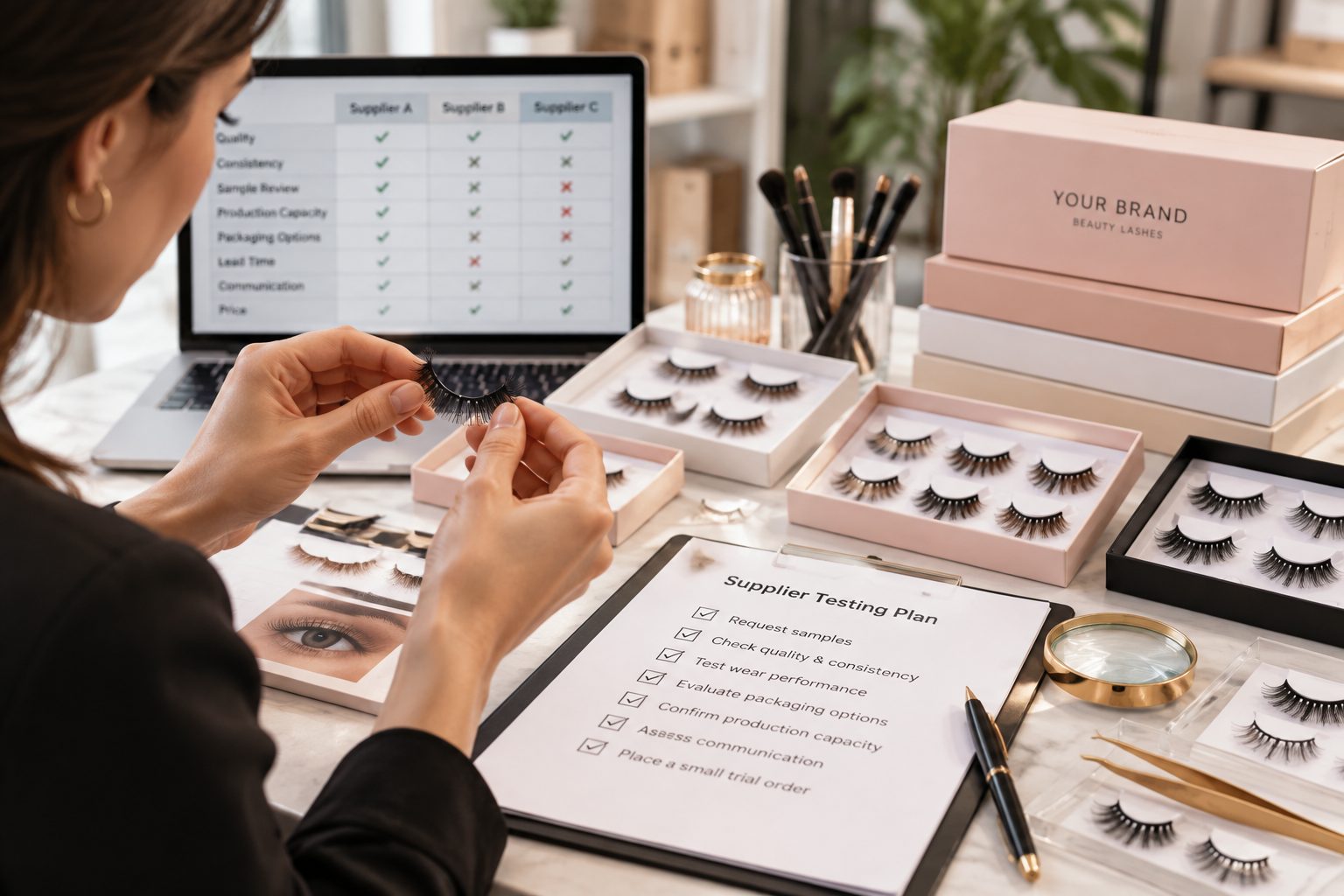
For established beauty brands, changing a lash supplier is not a simple purchasing decision.
A new supplier may offer better communication, stronger production capability or a more suitable manufacturing solution, but moving orders too quickly can create unnecessary risks.
The most important question is not:
“Can this supplier make a good lash sample?”
The real question is:
“Can this supplier consistently reproduce my products and support my brand after the first order?”
Before transferring your main orders, a structured supplier testing process can help beauty brands evaluate whether a new lash supplier is suitable for long-term cooperation.
Quick Answer: How Do I Test a New Lash Supplier Before Moving My Orders?
A professional lash supplier evaluation process usually includes:
- Understanding supplier capabilities
- Sending existing product samples
- Testing sample matching ability
- Confirming product specifications
- Evaluating communication efficiency
- Checking packaging capability
- Placing a pilot order
- Reviewing production consistency
- Testing repeat-order performance
The purpose is not to find a supplier who can produce one attractive sample.
The purpose is to find a supplier who can consistently maintain the same commercial standard for future orders.
Why Should You Test a New Lash Supplier Before Switching?
Many brands make supplier decisions based only on the first sample.
However, a sample only shows one production result at one specific moment.
It does not always prove:
- Long-term production stability
- Quality control capability
- Multi-SKU management ability
- Packaging accuracy
- Production communication
- Repeat-order consistency
For brands that already have customers and sales channels, supplier testing helps reduce the risk of product changes, delays and customer complaints.
1. Evaluate Whether the Supplier Understands Your Product
Before requesting samples, pay attention to the supplier’s communication.
A professional lash manufacturer should understand important product details, including:
- Lash style
- Length
- Curl
- Thickness
- Fiber material
- Band structure
- Packaging requirements
- Target market positioning
A supplier who only focuses on quantity and price may not fully understand the product development process behind a successful lash collection.
2. Provide Existing Products as Reference Samples
If your brand already sells lashes, your current products are the most valuable reference for supplier testing.
Whenever possible, provide physical samples instead of relying only on photos.
The new supplier should evaluate:
- Overall appearance
- Fiber softness
- Lash shape
- Density
- Length pattern
- Curl direction
- Band flexibility
- Packaging presentation
This is especially important when replacing an existing supplier because the goal is usually to maintain your current commercial product standard.
3. Check the Supplier’s Sample Development Process
The first sample is only the beginning of the evaluation.
A reliable supplier should be able to understand feedback and make accurate improvements.
During sample development, evaluate:
- How they analyze differences
- How they respond to revisions
- Whether they record specifications
- Whether they can maintain communication throughout development
A supplier that can improve samples professionally may be more valuable than one that simply provides a good first sample.
4. Confirm Product Specifications Before Production
Before placing an order, confirm all important product specifications.
These may include:
- Product name
- SKU number
- Lash style
- Length range
- Curl
- Thickness
- Fiber color
- Material
- Packaging version
- Label information
Clear specifications help prevent differences between approved samples and future production.
5. Test Communication During the Development Stage
Communication quality before production often reflects future cooperation.
Evaluate:
- Response speed
- Understanding of requirements
- Attention to details
- Problem-solving ability
- Production updates
A supplier may have good manufacturing ability, but poor communication can still create problems during large-scale cooperation.
6. Evaluate Packaging and Private Label Capability
For private label lash brands, packaging is part of the product experience.
A supplier should be able to support:
- Custom logo
- Custom boxes
- Labels
- Barcode requirements
- Instruction cards
- Retail packaging
A successful supplier transition requires both product consistency and packaging accuracy.
7. Start With a Pilot Order
A pilot order is one of the most important steps before transferring larger order volumes.
It helps test real production conditions, including:
- Production timeline
- Product consistency
- Packaging accuracy
- Quality control
- Shipping preparation
A supplier should prove commercial production capability, not only sample-making ability.
8. Test Multiple SKUs Instead of Only One Product
A supplier that performs well on one simple product may not always manage a larger product range.
If your brand has multiple SKUs, consider testing:
- A best-selling product
- A complicated lash style
- A high-volume product
- A product with custom packaging
This provides a better understanding of the supplier’s production management capability.
9. Compare Production With Approved Samples
The approved sample should become the production reference.
During evaluation, compare:
- Approved sample versus bulk production
- Different cartons
- Different production batches
Check:
- Lash shape
- Density
- Length consistency
- Color consistency
- Packaging accuracy
10. Evaluate Repeat Order Consistency
The first order is not the final test of a supplier.
For long-term cooperation, repeat orders are often more important.
A reliable lash supplier should maintain:
- Approved product standards
- SKU records
- Packaging details
- Production requirements
- Quality expectations
Repeat-order consistency is one of the strongest indicators of supplier reliability.
Common Mistakes When Testing a New Lash Supplier
- Choosing only based on price
- Testing only one simple product
- Skipping sample approval
- Not providing existing product references
- Moving all orders too quickly
- Ignoring packaging requirements
- Not checking repeat production
A Practical Lash Supplier Testing Process
| Stage | Purpose |
|---|---|
| Supplier discussion | Understand capability and communication |
| Sample matching | Check product reproduction ability |
| Specification confirmation | Create clear product standards |
| Pilot order | Test commercial production |
| Quality review | Compare production with approved samples |
| Repeat order | Confirm long-term consistency |
How Pingdu Lashes Supports Supplier Evaluation
Pingdu Lashes works with beauty brands, distributors and professional buyers who need to evaluate a reliable lash manufacturing partner in China.
Brands can provide:
- Existing lash samples
- Product specifications
- Packaging references
- SKU information
- Current product requirements
We support sample matching, product development, private label packaging and pilot production before larger order decisions.
The goal is not to encourage brands to change suppliers immediately.
The goal is to provide a structured evaluation process so brands can make a confident supplier decision with lower risk.
Frequently Asked Questions
Can I test a new lash supplier without moving all my orders?
Yes. Many brands begin with samples and pilot orders before transferring larger production volumes.
Is a good lash sample enough to choose a supplier?
No. Production consistency, communication, packaging accuracy and repeat-order performance are also important.
How many products should I test with a new lash supplier?
It depends on your product range, but testing several representative SKUs usually provides a more accurate evaluation.
Should I send my current lash products to a new supplier?
Yes. Physical samples help suppliers understand your existing commercial product standard.
What is the most important supplier test?
The ability to consistently reproduce approved products during commercial production and repeat orders is one of the most important factors.



