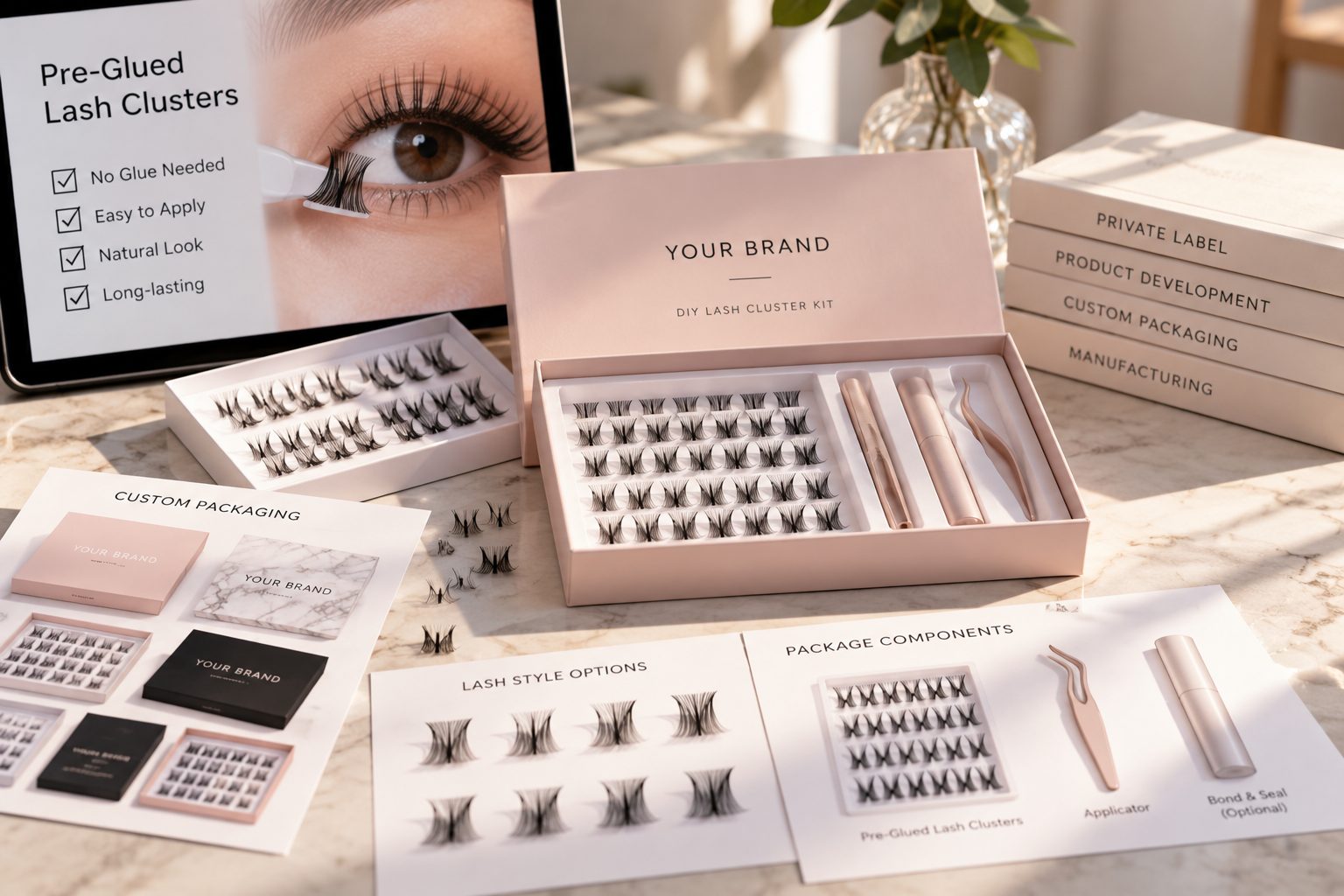
A distributor or established beauty brand may see a successful product such as KISS imPRESS pre-glued lash clusters and ask a very practical sourcing question:
Who can manufacture a similar pre-glued lash cluster product for my own private label brand?
The answer is not simply to find a supplier that can produce lash clusters.
To develop a commercially viable alternative, the supplier or product development partner needs to understand the complete product system: lash cluster construction, pre-applied adhesive performance, length combinations, tray design, applicator compatibility, packaging, quality control and repeat-order consistency.
The goal should not be to copy another brand’s logo, packaging or protected design. The goal is to use a successful market product as a benchmark and develop an independent private label product with a similar product concept, application experience and target customer.
Quick Answer: Who Can Make Pre-Glued Lash Clusters Similar to KISS imPRESS?
A specialized lash manufacturing partner with experience in DIY cluster lashes, pre-glued lash systems, private label packaging and product development can help develop this type of product.
For distributors and established beauty brands, the ideal partner should be able to support:
- Benchmark product analysis
- Pre-glued lash cluster development
- Cluster style and length customization
- Adhesive system evaluation
- Sample matching and revisions
- Custom tray and packaging development
- Pilot production
- Multi-SKU management
- Repeat-order consistency
This is different from simply purchasing a standard cluster lash tray from a catalogue.
The project should be treated as a complete private label product development program.
Why Are Beauty Brands Interested in Products Similar to KISS imPRESS?
The commercial appeal of a pre-glued lash cluster system is easy to understand.
Traditional DIY cluster systems normally require the customer to apply a separate bond or adhesive before placing the lashes.
A pre-glued cluster concept simplifies that process by placing the adhesive function directly on the lash cluster or application system.
For consumers, this can create a faster and easier application experience.
For beauty brands and distributors, the concept can also create a strong retail product because it combines convenience, visible product differentiation and an easy-to-understand marketing message.
However, developing a competitive product requires more than simply adding adhesive to an existing cluster lash.
Do Not Copy the Brand — Benchmark the Product Concept
When a buyer says, “I want something similar to KISS imPRESS,” this should normally be interpreted as a product development benchmark.
The buyer may want to reproduce certain commercial characteristics, such as:
- Easy at-home application
- Pre-glued cluster construction
- Natural or wispy lash effects
- Mixed-length lash mapping
- Convenient tray organization
- Compact retail packaging
- Simple application instructions
The new private label product should still have its own brand identity, packaging artwork, product specifications and positioning.
This benchmark approach is common in product development because it gives the supplier a clear reference for the desired customer experience.
1. Start With the Benchmark Product
If you already know the exact market product you want to benchmark, providing a physical reference sample is extremely useful.
Photos can show the general appearance, but physical samples allow the development team to evaluate more details.
These may include:
- Cluster width
- Fiber softness
- Density
- Length distribution
- Curl direction
- Cluster base structure
- Adhesive placement
- Tray arrangement
- Application feel
A professional development process should identify which characteristics must be similar and which characteristics should be changed for your own brand.
2. Define the Target Application Experience
Two products can look similar in the box but provide very different application experiences.
For pre-glued lash clusters, important questions include:
- How easily can the cluster be removed from the tray?
- How quickly does it attach during application?
- Does the cluster base remain flexible?
- Does the adhesive affect the appearance of the lash?
- How comfortable does the finished lash feel?
- Can customers adjust placement easily?
The target application experience should be defined before finalizing the product.
This is especially important for brands selling through Amazon, TikTok Shop, Shopify or retail channels, where consumer reviews can quickly expose application problems.
3. Develop the Pre-Glued Adhesive System
The adhesive system is one of the most important differences between a standard DIY cluster lash and a pre-glued cluster product.
It can affect:
- Application speed
- Initial tack
- Cluster handling
- Comfort
- Product storage
- Packaging requirements
The adhesive system should therefore be evaluated together with the lash structure rather than treated as a separate accessory.
Brands should approve the final application experience through physical sample testing before moving into larger production.
4. Choose the Right Lash Cluster Structure
The lash style still determines the visual result of the product.
A private label pre-glued collection can be developed in several directions.
Natural
Soft density and balanced lengths for customers who want an everyday lash effect.
Wispy
Layered fibers and uneven peaks for a lighter, more textured appearance.
Cat Eye
Progressively longer outer clusters designed to create a more elongated eye shape.
Soft Volume
A fuller effect while maintaining a lightweight appearance suitable for home application.
A distributor does not necessarily need to launch every style at the beginning.
A focused collection with several clearly differentiated styles can be easier to test and scale.
5. Develop a Length Map Instead of Selling Random Mixed Lengths
Length combinations should be developed according to the intended lash look.
For example, a product may include shorter inner-eye clusters, medium central clusters and longer outer-eye clusters.
The important point is that the length combination should help customers recreate a predictable finished look.
This allows the brand to market the product as a complete lash design rather than simply a box of mixed clusters.
6. Consider Cluster Quantity and Tray Layout
Product architecture is also important.
A distributor should decide:
- How many clusters should be included?
- How many lengths should be included?
- How should different lengths be separated?
- Should the tray support one complete application or multiple applications?
- Should replacement lash trays be developed later?
These decisions affect production cost, packaging size, retail pricing and customer perception.
A well-designed tray can also make the product easier to understand when customers first open the box.
7. Decide Whether the Product Needs an Applicator
Some private label pre-glued lash products may be sold as lash-only refills, while others may include an applicator.
For a complete retail kit, an applicator can improve product presentation and reduce the need for customers to purchase additional tools.
However, the applicator should also be tested with the final lash cluster structure.
The shape, tension and gripping area of the tool can affect the application experience.
8. Build Independent Private Label Packaging
A product inspired by a successful market benchmark should still look clearly like your own brand.
Private label packaging can include:
- Custom logo
- Brand colors
- Custom box structure
- Product name
- Style identification
- Length information
- Barcode
- Application instructions
- Retail information
Avoid simply reproducing another company’s branding or packaging appearance.
The stronger commercial strategy is to keep the useful product concept while creating an independent brand identity.
9. Test Several Samples Before Final Approval
Benchmark-based product development normally requires more than one sample round.
The first sample may reveal differences in:
- Cluster softness
- Density
- Length distribution
- Adhesive feel
- Application control
- Finished lash appearance
Feedback from each round should be recorded clearly.
Once the target result is approved, the final sample should become the reference standard for production.
If you are comparing several suppliers, our guide on how to compare lash samples from different suppliers explains how to evaluate samples more systematically.
10. Place a Pilot Order Before Moving to Large Volume
For a large distributor or established beauty brand, sample approval alone should not be the final decision.
A pilot order helps test whether the supplier can reproduce the approved product under commercial production conditions.
The pilot order can reveal issues that are difficult to detect during sample development, including:
- Batch consistency
- Tray accuracy
- Packaging errors
- SKU management
- Production communication
- Final inspection quality
This is especially important if the product may later be purchased in large quantities or launched across multiple markets.
Brands evaluating a new manufacturing partner can also read our guide on how to test a new lash supplier before moving orders.
11. Test More Than One SKU if You Are a Large Distributor
A distributor planning a larger private label collection should not evaluate supplier capability based on only one simple style.
A more useful development test may include:
- One natural style
- One wispy style
- One higher-density style
- Different length combinations
This helps evaluate whether the supplier can manage multiple specifications correctly.
Multi-SKU management becomes increasingly important when order volume grows.
12. Think About Repeat Orders Before the First Order
A successful product development project should be designed for repeat production from the beginning.
Important specifications should be recorded, including:
- Approved lash style
- Length map
- Cluster structure
- Adhesive specification
- Tray arrangement
- Packaging version
- SKU information
The real value of a supplier is not producing one successful batch.
It is maintaining the approved standard across future orders.
What Should I Send a Manufacturer if I Want a Product Similar to KISS imPRESS?
A buyer can normally begin the project by providing:
- The benchmark product or clear reference photos
- The exact features you want to reproduce
- The features you want to change
- Your target market
- Preferred lash styles
- Expected kit configuration
- Packaging requirements
- Estimated order quantity
- Target launch schedule
The more clearly these requirements are defined, the easier it becomes to develop accurate samples.
Can a Distributor Develop Its Own Version Instead of Buying an Existing Brand?
Yes.
A distributor does not need to sell the benchmark brand itself in order to enter the same product category.
A private label project can use the successful product concept as market research and then develop an independent version with its own lash styles, specifications, packaging and brand positioning.
This approach is particularly suitable for distributors that already understand their local customers and want greater control over product selection, pricing and branding.
How Is This Different From Simply Copying KISS imPRESS?
There is an important difference between product benchmarking and brand copying.
Product benchmarking means studying how a successful product solves a customer problem and using those insights to develop your own product.
Your final product should have its own:
- Brand name
- Logo
- Packaging artwork
- Product specifications
- Style selection
- Marketing positioning
Brands should also independently review any trademark, design, patent or other intellectual property considerations that may apply in their target market.
Pingdu Lashes Support for Pre-Glued Lash Cluster Development
Pingdu Lashes supports beauty brands, distributors and professional buyers that want to develop new lash products based on clear market benchmarks.
We work with specialized manufacturing partners across different eyelash categories and help coordinate product selection, sample matching, private label development, packaging and repeat-order requirements.
For a pre-glued cluster lash project, buyers can provide an existing market product, product photographs or detailed specifications as a development reference.
We can then help coordinate:
- Product matching
- Style development
- Sample revisions
- Packaging development
- Pilot-order evaluation
- Multi-SKU requirements
You can also review our custom lash development services or our private label DIY cluster lash kit for related product development options.
Frequently Asked Questions
Who can manufacture pre-glued lash clusters similar to KISS imPRESS?
A supplier or product development partner experienced in pre-glued lash clusters, DIY lash products, private label packaging and sample development can support this type of project. Large buyers should evaluate both sample quality and commercial production consistency.
Can I create my own private label version of a product similar to KISS imPRESS?
Yes. A successful market product can be used as a benchmark for developing an independent private label product with your own specifications, styles, packaging and branding.
Can the lash style be customized?
Yes. Natural, wispy, cat eye, soft volume and other lash effects can be developed depending on the target market and customer preference.
Can the length combination be customized?
Yes. Mixed-length combinations and lash maps can be developed according to the desired finished eye look.
Can I customize the adhesive system?
The adhesive and cluster structure should be evaluated together during sample development. Final specifications depend on the required application experience, product structure and manufacturing solution.
Can I customize the tray and retail packaging?
Yes. Private label projects can include customized trays, boxes, logos, product inserts, instructions, barcode information and other retail packaging elements.
Should I send an original KISS imPRESS product as a reference?
A physical benchmark sample can make product analysis more accurate because it allows the development team to evaluate the lash structure, adhesive placement, tray configuration and application experience directly.
Can a distributor order several styles under the same private label collection?
Yes. Distributors can develop multiple SKUs with different lash styles, lengths and packaging while maintaining one consistent brand identity.
What is the safest way to test this type of new supplier?
Start with benchmark analysis and samples, approve the final specification, place a pilot order and compare bulk production with the approved reference before moving larger volumes.



