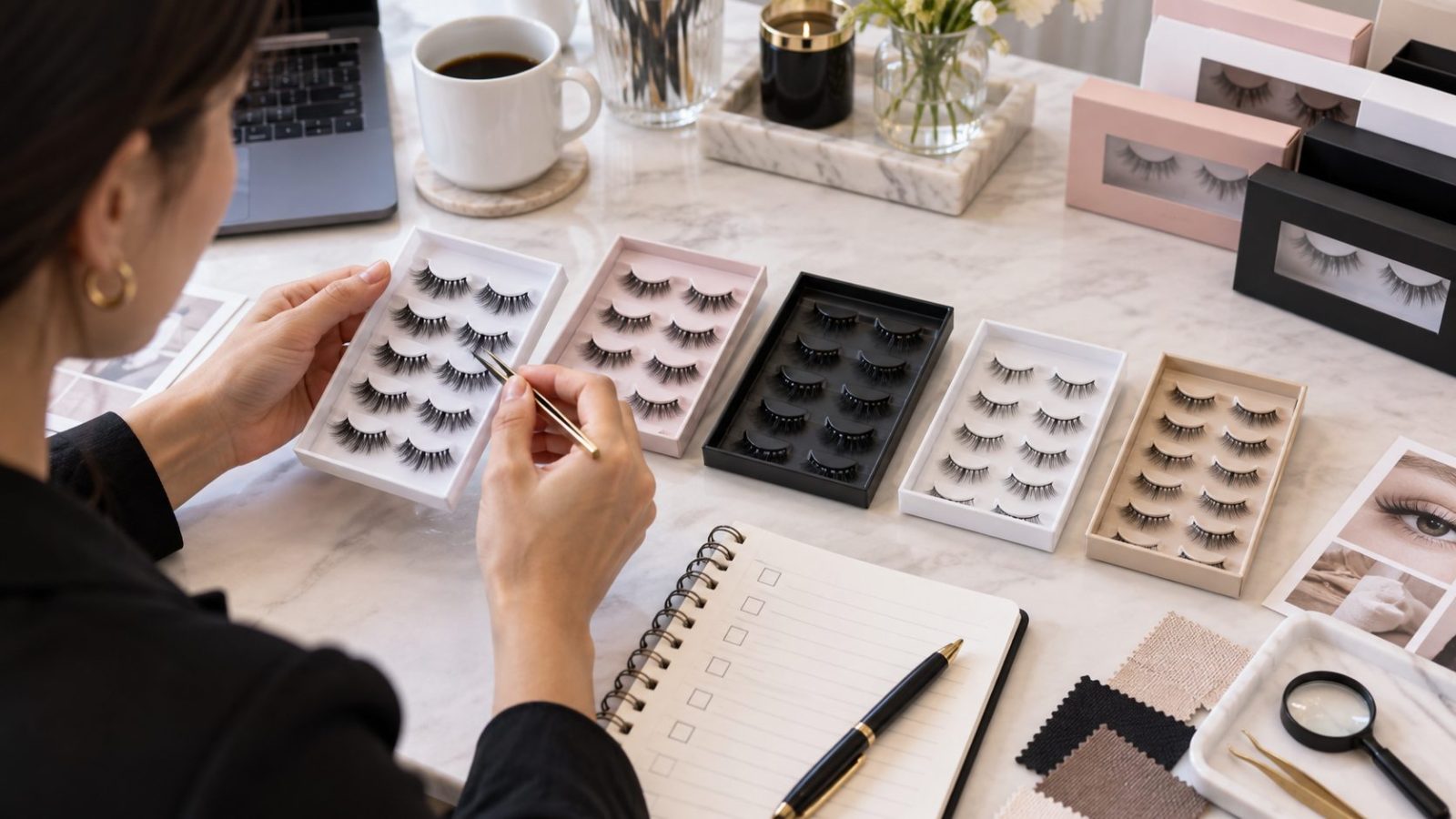
If you are testing lash samples from several suppliers, do not compare them only by appearance or price.
A useful lash sample comparison should check whether each supplier can meet the same specification, whether the product performs consistently, whether the packaging is suitable for your market, and whether the approved sample can be reproduced in future bulk and repeat orders.
For established beauty brands, distributors and professional lash companies, the objective is not simply to choose the “best-looking” sample. It is to identify which supplier can provide the most suitable and repeatable product for your business.
Quick Answer: How Should I Compare Lash Samples from Different Suppliers?
Compare all suppliers using the same product requirements and the same evaluation checklist.
Key areas should include:
- Product appearance
- Fiber softness and finish
- Length and curl accuracy
- Density and style consistency
- Band, base or tray construction
- Application performance
- Packaging quality
- Specification accuracy
- Consistency between multiple samples
- Supplier communication and documentation
- Ability to reproduce the approved sample in bulk production
If you are still comparing different lash categories, you can review our wholesale lash product range before requesting additional samples.
1. Make Sure You Are Comparing the Same Product Specification
The first mistake buyers make is comparing samples that are not actually the same product.
For example, two strip lashes may look similar in photos but differ in:
- Fiber material
- Band type
- Length
- Density
- Layering
- Curl
- Weight
The same problem applies to cluster lashes and professional lash extensions.
Before comparing quality, confirm that each supplier is working from the same target specification.
If Supplier A sends a softer, lighter product and Supplier B sends a denser, heavier product, the difference may come from the specification rather than the supplier’s production quality.
2. Use One Reference Sample or Specification Sheet
If your brand already sells lashes, use your current approved product as the main reference.
You can provide each supplier with:
- A physical reference sample
- Clear product photos
- Length information
- Curl
- Thickness
- Density
- Band or base requirements
- Tray configuration
- Packaging reference
This makes the comparison more objective.
Instead of asking “Which sample do I like more?”, the buyer can ask:
Which supplier matched my target product more accurately?
3. Compare Product Appearance Under the Same Conditions
Compare samples under the same lighting and from the same viewing distance.
For visual evaluation, buyers can check:
- Overall shape
- Left-right symmetry
- Layering
- Fiber direction
- Density distribution
- Spike pattern
- Curl appearance
- Color consistency
- Overall finish
Do not rely only on supplier photos, because photography, lighting and editing can make similar products look different.
Physical comparison is more useful for final supplier evaluation.
4. Check Fiber Softness and Surface Finish
For many retail and professional lash products, softness and finish strongly affect perceived quality.
Compare whether the fibers feel:
- Soft or stiff
- Lightweight or heavy
- Natural or overly glossy
- Smooth or rough
- Flexible or rigid
For established beauty brands, these details matter because customers often notice changes in fiber feel even when the overall lash style looks similar.
5. Measure Length, Curl and Thickness Accuracy
Do not assume the printed specification is always identical to the physical product.
For professional lash extensions, buyers should check:
- Actual length
- Curl shape
- Thickness
- Row consistency
- Mixed-length accuracy
For strip and cluster lashes, buyers can also compare whether the actual visible length and curl match the requested style.
Small differences may be acceptable depending on the product, but repeated specification differences should be discussed before supplier approval.
6. Compare Band, Base or Root Construction
The base structure can affect comfort, application and product performance.
Depending on the lash category, compare:
- Strip lash band thickness
- Band flexibility
- Cluster lash base width
- Base flatness
- Professional extension root structure
- Premade fan base consistency
- Magnetic lash band construction
A product may look attractive in the box but perform poorly if the base construction is inconsistent.
7. Test the Product the Way Your Customer Will Use It
Visual inspection is not enough.
Samples should be tested under realistic use conditions.
For example:
Strip Lashes
- Band flexibility
- Ease of application
- Comfort
- Shape after application
- Product durability
DIY Cluster Lashes
- Ease of pickup
- Base comfort
- Layering performance
- Spacing consistency
- Appearance after application
Professional Lash Extensions
- Pickup from the strip
- Fan-opening performance
- Base control
- Curl stability
- Row consistency
The best sample is not always the one that looks best before use. It should also perform correctly during application.
8. Compare More Than One Sample from Each Supplier
One good sample does not prove production consistency.
If possible, check several pieces, trays or styles from the same supplier.
This helps identify whether:
- Different units look the same
- Curl remains consistent
- Density varies
- Bases vary between pieces
- Packaging quality is stable
- Labels and specifications remain accurate
For larger purchasing programs, consistency across multiple samples is more important than one exceptionally good piece.
9. Evaluate Packaging at the Same Time
For beauty brands, the sample should be evaluated as a complete retail or professional product.
Check:
- Tray quality
- Box construction
- Printing quality
- Logo placement
- Barcode area
- Product information
- SKU identification
- Protection during shipping
If you require private label packaging, ask the supplier how sample packaging will be translated into commercial production.
You can also review our private label and custom packaging services when comparing packaging options.
10. Compare the Supplier’s Understanding, Not Just the Sample
The physical sample is only one part of supplier evaluation.
Also compare how each supplier handled the sample process.
Did the supplier:
- Ask useful questions before sending samples?
- Understand your target specification?
- Explain the differences between available options?
- Record requested changes?
- Confirm sample codes clearly?
- Separate different SKUs correctly?
- Respond clearly when a sample did not match?
A supplier that sends a good sample but cannot clearly document the product may create problems later during bulk production.
11. Record Sample Codes and Results
When comparing several suppliers, it is easy to forget which sample came from which company.
Create a simple comparison record.
| Area | Supplier A | Supplier B | Supplier C |
|---|---|---|---|
| Sample Code | Record | Record | Record |
| Style Match | Check | Check | Check |
| Softness | Check | Check | Check |
| Curl Accuracy | Check | Check | Check |
| Length Accuracy | Check | Check | Check |
| Base / Band | Check | Check | Check |
| Application Performance | Check | Check | Check |
| Packaging | Check | Check | Check |
| Communication | Check | Check | Check |
This does not need to be complicated. The goal is to make the supplier decision based on consistent criteria rather than memory.
12. Do Not Compare Price Until You Confirm the Samples Are Equivalent
Price comparison becomes useful only after you know the samples are based on similar specifications and quality expectations.
If one supplier offers:
- Softer fibers
- More complex layering
- Better packaging
- More rows per tray
- Different materials
then a direct price comparison may be misleading.
First confirm that the products are equivalent enough to compare. Then evaluate the commercial quotation.
13. Ask Whether the Approved Sample Can Be Reproduced
This is one of the most important questions before placing a commercial order.
Ask the supplier how the approved sample will be recorded.
Useful records may include:
- Physical approval sample
- Internal product code
- Confirmed specification sheet
- Reference photographs
- Packaging artwork version
- SKU information
- Approved modifications
The objective is to make sure future production is based on the approved reference rather than a general product description.
14. Test Any Requested Changes Before Bulk Production
If none of the first samples is perfect, this does not always mean the supplier should be rejected.
Sometimes a supplier may have the right product base but require a small adjustment such as:
- Shorter length
- Softer fiber
- Lower density
- Different curl
- Thinner band
- Different tray configuration
The important question is whether the supplier understands the requested change and can produce a revised sample correctly.
This revision process can reveal more about supplier capability than the first sample alone.
15. Compare Bulk Production Risk, Not Just Sample Quality
A sample can be handmade or carefully selected, while commercial production involves larger quantities and multiple SKUs.
Before selecting a supplier, consider:
- Can the product specification be documented?
- Can several SKUs be managed correctly?
- Can packaging versions be separated?
- Can production volume increase?
- Can repeat orders follow the same reference?
- Can quality issues be traced and corrected?
For established beauty brands, the supplier with the best single sample is not always the supplier with the lowest long-term purchasing risk.
How Many Lash Suppliers Should I Sample?
There is no fixed number, but many professional buyers compare a small shortlist rather than requesting samples from too many companies.
Testing too many suppliers can create unnecessary cost and make comparison difficult.
A more practical process is:
- Shortlist suppliers based on product capability
- Request comparable samples from the strongest candidates
- Evaluate samples using the same checklist
- Request revisions where necessary
- Reduce the shortlist before discussing larger orders
Should I Choose the Supplier with the Best Sample?
Not automatically.
A strong supplier decision should consider both the sample and the commercial process.
For example, Supplier A may send a slightly better sample, while Supplier B may provide:
- More accurate specification records
- Better multi-SKU management
- More reliable packaging coordination
- Clearer communication
- Stronger repeat-order support
The final choice depends on what matters most for your brand and purchasing model.
A Practical Lash Sample Comparison Checklist
| Comparison Area | What to Check |
|---|---|
| Specification | Are all suppliers working from the same target requirements? |
| Style | Does the sample match the intended visual direction? |
| Fiber | Is the softness, finish and flexibility suitable? |
| Length / Curl | Do the physical specifications match the confirmed requirements? |
| Base / Band | Is the construction comfortable and consistent? |
| Performance | Does the product work correctly during application? |
| Consistency | Are several samples from the same supplier similar? |
| Packaging | Is the tray or retail packaging suitable for the market? |
| Communication | Does the supplier understand and document changes clearly? |
| Repeatability | Can the approved sample be reproduced for bulk and repeat orders? |
How Pingdu Lashes Supports Sample Comparison
Pingdu Lashes works with beauty brands, distributors and professional lash buyers that are comparing product options from China.
If you already have an approved product or samples from another supplier, you can send:
- Product photos
- A physical reference sample
- Current specifications
- Target changes
- Packaging requirements
- Estimated quantities
- Number of SKUs
We can help identify suitable product options for comparison and coordinate sample matching across strip lashes, DIY cluster lashes, professional lash extensions and magnetic lashes.
For buyers evaluating long-term supply, you can also read our guide on how established beauty brands evaluate lash manufacturers for long-term OEM supply.
Frequently Asked Questions
What is the most important thing when comparing lash samples?
The most important point is to make sure the samples are based on the same target specification. Otherwise, differences may come from product design rather than supplier quality.
Should I choose the cheapest supplier after sample testing?
Not necessarily. Price should be compared together with product quality, specification accuracy, communication, packaging, production capability and repeat-order consistency.
Should I test lash samples physically?
Yes. Physical testing allows buyers to evaluate softness, construction, application performance, curl, length and packaging more accurately than photos alone.
Can I send my current lash product to a new supplier for matching?
Yes. An existing approved sample can help the supplier understand your target product more accurately and can make sample comparison more objective.
How many suppliers should I compare?
There is no fixed number. A small shortlist of suitable suppliers is usually easier to evaluate than requesting samples from a very large number of companies.
What if a sample is close but not exactly right?
You can request a revised sample if the supplier has correctly understood the product direction. The revision process is also useful for evaluating the supplier’s communication and development capability.
How do I know if the approved sample can be repeated in bulk production?
Ask how the supplier records the approved reference, including the physical sample, product code, specification sheet, photos, packaging version and approved modifications.



