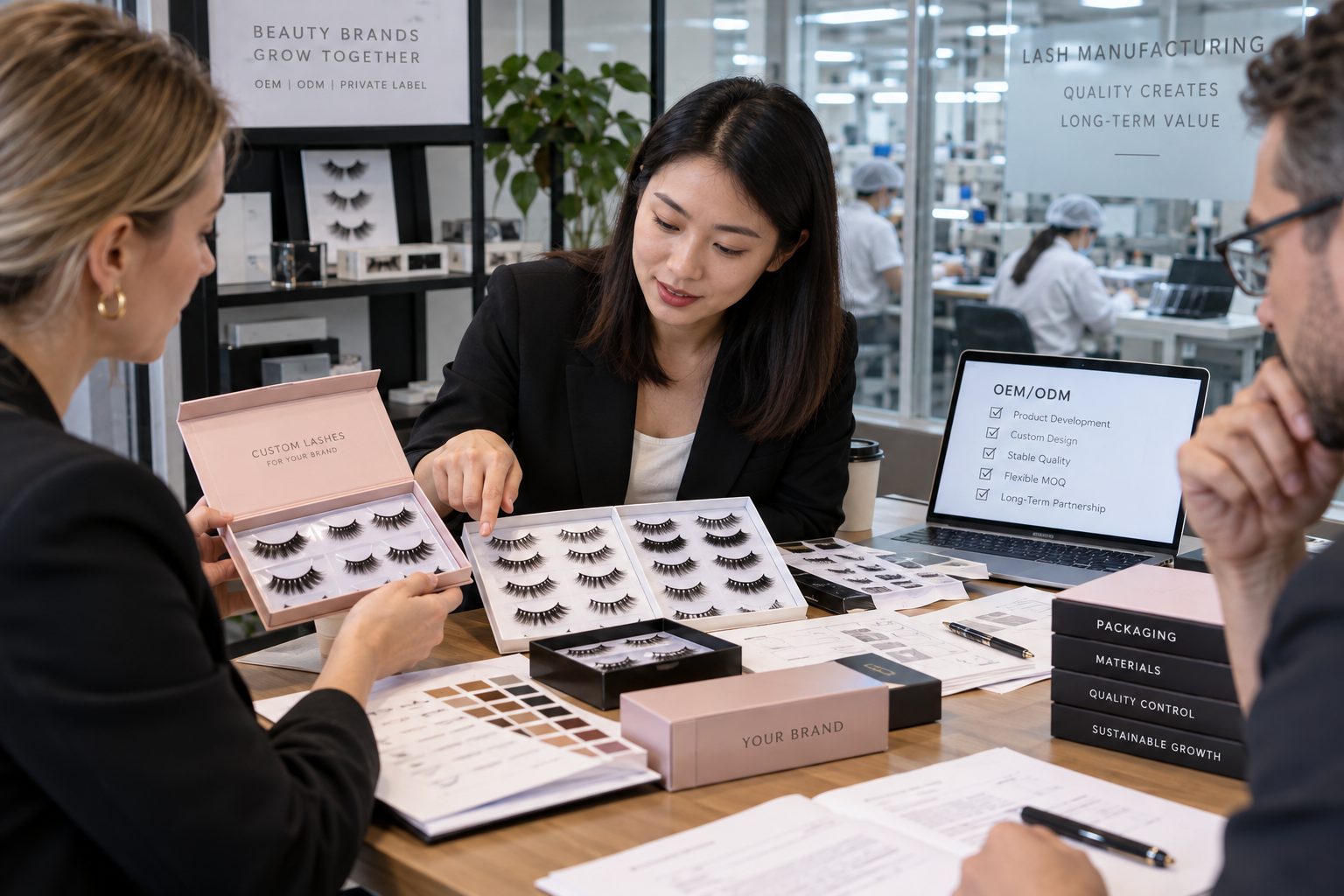
For established beauty brands, choosing a lash manufacturer is not simply about finding a supplier that can produce an acceptable sample or offer a competitive quotation.
Long-term OEM supply requires much more. A manufacturer must be able to support consistent product quality, repeat production, multiple SKUs, packaging coordination, quality control, stable communication, and future product development as the brand grows.
This is especially important for beauty brands, professional lash companies, distributors, online retailers, and multi-channel sellers that rely on regular replenishment and cannot afford major differences between production batches.
When evaluating a lash manufacturing partner for long-term cooperation, experienced buyers usually look beyond the first sample and focus on the manufacturer’s ability to support the entire product lifecycle.
Why Long-Term OEM Supply Requires a Different Evaluation Process
A supplier may be able to prepare a good sample, but long-term manufacturing performance is measured over many production cycles.
Established brands need to know whether the manufacturer can maintain the same product specifications when order quantities increase, new styles are added, packaging changes, or repeat orders are placed several months later.
The key question is not only:
“Can this factory make this product?”
It is also:
“Can this manufacturer reproduce the same product consistently across future orders?”
For brands with existing customers, distributors, retail partners, or online sales channels, this consistency is critical.
1. Product Consistency Across Repeat Orders
Repeat order consistency is one of the most important factors when evaluating a lash manufacturer.
A beauty brand may spend months building customer recognition around a specific lash style. If the next production batch has different curl, density, fiber appearance, band thickness, length distribution, or overall shape, customers may notice immediately.
Buyers should therefore evaluate whether the manufacturer has systems for recording and controlling approved specifications.
Important consistency points may include:
- Lash shape and mapping
- Fiber appearance and softness
- Curl consistency
- Length consistency
- Density and layering
- Band or lash base construction
- Tray arrangement
- Packaging dimensions
- Label and barcode placement
- Color consistency across packaging batches
A reliable OEM manufacturer should be able to use approved samples, product specifications, packaging files, and production records as references for future orders.
2. Quality Control During Mass Production
Sample quality and mass-production quality are not always the same.
For larger buyers, the more important question is how quality is controlled when hundreds, thousands, or tens of thousands of units are being produced.
Quality control should not depend only on a final inspection after production is completed. It should be integrated into different stages of manufacturing.
Depending on the lash category, quality checks may include:
- Incoming material inspection
- Production specification checks
- Shape and curl comparison
- Length and density checks
- Band or base inspection
- Tray and inner packaging inspection
- Printed packaging verification
- Logo, barcode, and label checks
- Final packing inspection
- Random inspection before shipment
For established brands, the objective is not simply to find defective pieces. The objective is to reduce variation across the whole production batch.
3. Ability to Manage Multiple SKUs
Many established beauty brands do not purchase only one lash style.
A professional product line may include different categories such as:
- Strip lashes
- DIY cluster lashes
- Professional lash extensions
- Different lengths
- Different curls
- Different densities
- Brown or colored lash options
- Retail packaging variations
Managing several SKUs requires stronger production organization than producing a single item.
Manufacturers need to correctly separate specifications, packaging, labels, quantities, and product codes so that different styles are not mixed during production or packing.
For distributors and larger brands, this capability becomes increasingly important as the product range expands.
Brands considering a broader lash program can review our lash product range to understand how different categories can be developed within one manufacturing partnership.
4. Production Capacity and Scalability
Production capacity should be evaluated according to the brand’s future requirements, not only its current order size.
A brand may begin with a moderate order, but successful products can require much larger repeat production later.
When evaluating manufacturing capacity, buyers should consider:
- Normal production volume
- Peak-season capacity
- Lead time for repeat orders
- Ability to add production volume
- Ability to manage multiple products at the same time
- Packaging coordination capacity
- Ability to respond to urgent replenishment
The goal is not necessarily to choose the largest factory. The goal is to choose a manufacturing partner whose production system matches the buyer’s expected growth and order structure.
5. Packaging Coordination for Established Brands
For established beauty brands, packaging is part of the product, not an afterthought.
The manufacturer may need to coordinate custom boxes, trays, inserts, labels, barcodes, batch information, retail requirements, or different packaging versions for different markets.
Packaging problems can delay an otherwise completed production order.
Experienced buyers therefore evaluate whether the lash manufacturer can coordinate product manufacturing and packaging production together.
Important questions include:
- Can existing packaging artwork be used?
- Can packaging specifications be repeated accurately?
- Can barcode or label information be updated between orders?
- Can multiple packaging versions be managed within one order?
- Can the manufacturer coordinate packaging timing with lash production?
- Can packaging changes be tested before mass production?
Strong packaging coordination becomes particularly important when brands sell through multiple retail or e-commerce channels.
6. Product Development Capability
Long-term OEM cooperation usually involves more than repeating the same products forever.
Beauty brands need to respond to changing customer preferences, market trends, competitor launches, and new retail opportunities.
A useful manufacturing partner should therefore be able to support ongoing product development.
This may include:
- Developing new lash styles
- Adjusting existing specifications
- Creating different density options
- Developing softer or more natural looks
- Expanding into professional lash extensions
- Creating new strip lash collections
- Developing brown or alternative color options
- Updating packaging
- Supporting new product line extensions
For established brands, development capability can reduce the need to find a new supplier every time a new product category is added.
7. Communication and Specification Management
Clear communication becomes increasingly important as orders become larger and more complex.
A long-term OEM relationship may involve product specifications, packaging artwork, quantities, shipping schedules, revisions, samples, and repeat-order references.
Manufacturers should be able to organize this information clearly and confirm important details before production.
For larger buyers, effective communication should include:
- Clear product specification confirmation
- Sample reference management
- Packaging file confirmation
- Production schedule updates
- Change confirmation before production
- Clear communication about potential delays
- Repeat-order specification records
Poor communication can create problems even when the factory itself has good production capability.
8. How the Manufacturer Handles Problems
No manufacturing process is completely free from unexpected issues.
The quality of a long-term supplier relationship often becomes most visible when something does not go according to plan.
Established brands should pay attention to how a supplier responds when there is:
- A product specification discrepancy
- A packaging printing problem
- A production delay
- A quantity discrepancy
- A quality issue
- A shipping schedule change
A reliable manufacturing partner should investigate the cause, communicate clearly, propose a practical solution, and take steps to prevent the same problem from happening again.
Problem-solving capability is an important part of long-term supply reliability.
9. Lead Time and Repeat Order Planning
For brands with regular sales, lead time affects inventory planning.
A manufacturer should be able to provide realistic production estimates rather than promising the shortest possible delivery time simply to win the order.
Repeat-order planning may also help reduce stock shortages.
Brands should discuss:
- Standard production lead time
- Packaging production lead time
- Peak-season lead time
- Repeat-order scheduling
- Forecasted purchasing volume
- Shipping preparation time
When both sides understand expected order frequency and volume, production planning can become more efficient.
10. Manufacturing Transparency
Established buyers normally want to understand who is actually responsible for manufacturing their products.
This does not mean every brand needs to manage every production detail directly.
However, buyers should understand the supplier’s role in the supply chain, including product development, production coordination, packaging, inspection, and shipment preparation.
Greater transparency helps reduce misunderstandings and makes long-term cooperation easier to manage.
What Should Established Beauty Brands Ask a Lash Manufacturer?
Before building a long-term OEM relationship, buyers can ask questions such as:
| Evaluation Area | Questions to Ask |
| Repeat Orders | How do you maintain specifications between different production batches? |
| Quality Control | What quality checks are carried out during and after production? |
| Capacity | Can production volume increase if our sales grow? |
| Multi-SKU Orders | How do you manage multiple styles and packaging specifications in one order? |
| Packaging | Can you coordinate custom packaging, barcodes, labels, and different packaging versions? |
| Product Development | Can you help develop new lash styles or expand our existing collection? |
| Lead Time | What is the normal lead time for initial and repeat orders? |
| Problem Resolution | How are quality or production issues handled? |
Short-Term Supplier vs Long-Term Manufacturing Partner
| Short-Term Supplier Focus | Long-Term Manufacturing Partner Focus |
| Single quotation | Long-term cost and supply stability |
| One sample | Repeat production consistency |
| Single SKU | Multi-SKU management |
| Immediate order | Ongoing replenishment planning |
| Basic packaging | Retail-ready packaging coordination |
| Existing products only | Continuous product development |
| Final inspection only | Quality control throughout production |
When Should a Brand Consider Changing or Adding a Manufacturing Partner?
Established brands may review their supply chain when current suppliers can no longer support their growth.
Common reasons include:
- Repeated batch inconsistency
- Long or unpredictable lead times
- Limited product development capability
- Difficulty handling multiple SKUs
- Packaging coordination problems
- Poor communication
- Limited capacity for growing order volumes
- Quality problems that repeatedly return
Some brands completely replace a supplier, while others add a second manufacturing partner to increase capacity or reduce supply risk.
Building a Long-Term OEM Lash Supply Relationship
The strongest supplier relationships usually develop gradually.
Brands begin by confirming products and specifications, evaluating production performance, reviewing quality, and monitoring repeat orders.
As trust develops, the relationship can expand into larger production volumes, additional lash categories, new packaging programs, and more complex product development.
For established brands, the objective should not be to find the cheapest supplier for every individual order.
The more important objective is to build a manufacturing system that can support stable supply, consistent quality, efficient product development, and long-term business growth.
Working with Pingdu Lashes
Pingdu Lashes works with beauty brands, professional lash companies, distributors, and private label customers that require more than basic product sourcing.
Our manufacturing support can include lash product development, OEM production, private label packaging, specification management, quality control, multi-SKU coordination, and repeat-order production.
If your company is reviewing lash manufacturers for an existing product line or planning to consolidate more products with one manufacturing partner, you can learn more about our custom lash manufacturing services.
Frequently Asked Questions
What is the most important factor when choosing a long-term lash manufacturer?
There is no single factor. Established brands should evaluate product consistency, production capacity, quality control, communication, packaging coordination, lead time, and the manufacturer’s ability to support future product development.
Should brands evaluate a manufacturer only by samples?
No. Samples are important for confirming product direction, but they do not fully demonstrate mass-production capability or repeat-order consistency. Buyers should also evaluate production systems, quality control, packaging management, and repeat-order processes.
Can one manufacturer manage several lash categories?
Yes, depending on the manufacturer’s capabilities. Working with one manufacturing partner across multiple lash categories can simplify communication and supply management, but the supplier must have strong SKU and specification management.
Why is repeat-order consistency important?
Customers expect the same product each time they purchase from a beauty brand. Significant changes in curl, density, shape, materials, or packaging can affect customer satisfaction and brand reputation.
Can Pingdu Lashes support established beauty brands and distributors?
Yes. Pingdu Lashes supports private label and OEM lash projects for beauty brands, professional lash companies, distributors, and buyers developing or expanding multi-product lash collections.



