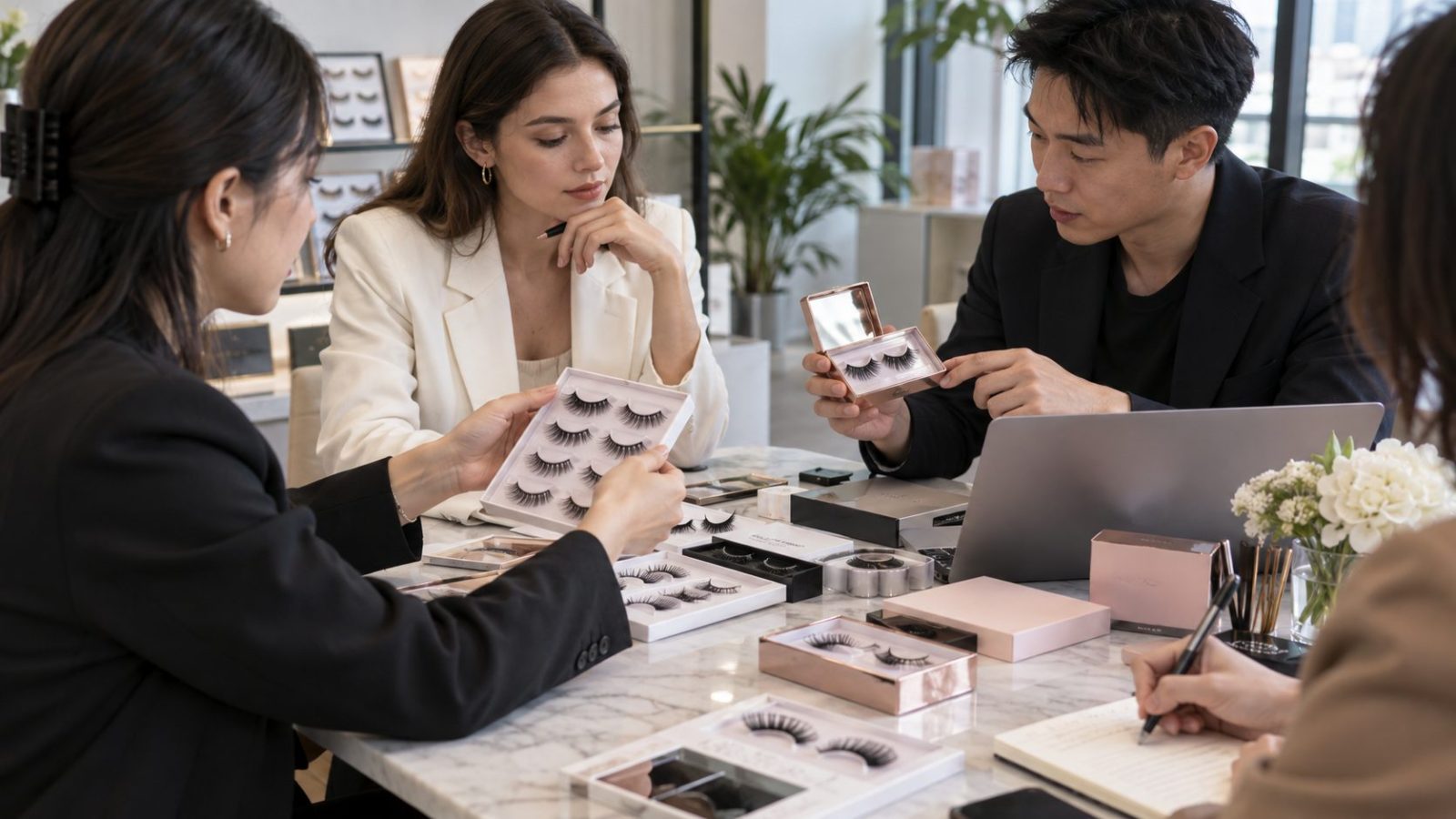
If you are choosing a lash supplier in China for your beauty brand, do not compare suppliers only by price or the number of products in their catalog.
A reliable lash supplier should be able to understand your product requirements, provide suitable samples, explain specifications clearly, support private label packaging, manage multiple SKUs, and reproduce approved products consistently when you place repeat or larger orders.
For established beauty brands and distributors, the most important question is not simply whether a supplier can sell eyelashes. It is whether the supplier can support your purchasing process from product matching to samples, packaging, production and future replenishment.
Quick Answer: How Do I Choose a Reliable Lash Supplier in China?
Choose a supplier that can demonstrate clear product knowledge, responsive communication, sample matching, specification control, private label capability, realistic production information and support for repeat orders.
Before placing a large order, compare suppliers in these areas:
- Experience with the lash category you need
- Ability to understand your existing products or target specifications
- Quality of sample matching
- Clarity of quotations
- Private label and packaging support
- Multi-SKU management
- Quality control and repeat-order consistency
- Production capacity for future growth
- Communication during product development
- Ability to handle problems professionally
If you are still comparing product directions, you can review our wholesale eyelash product range across strip lashes, cluster lashes, professional lash extensions and magnetic lashes.
1. Start with the Product Category You Actually Need
Not every lash supplier is equally strong in every product category.
Before comparing suppliers, define the products you are actually sourcing.
These may include:
- Strip lashes
- DIY cluster lashes
- Pre-glued or press-on lashes
- Professional lash extensions
- Premade fans
- Easy fan lashes
- Magnetic lashes
- Private label lash collections
A supplier that is strong in strip lashes may not necessarily be the best option for professional lash extensions. A supplier with good cluster lash products may have limited experience with retail packaging or multi-SKU professional lash trays.
This is why buyers should evaluate the supplier according to the product category they actually intend to purchase.
2. Check Whether the Supplier Understands Your Requirements Before Quoting
A reliable supplier should not immediately send one generic price without understanding what you need.
For a useful quotation, the supplier may need to know:
- Product type
- Style or reference image
- Length
- Curl
- Thickness or density
- Band, base or tray structure
- Quantity
- Packaging requirements
- Private label requirements
- Destination market
If you already sell lashes, providing a physical sample, clear photos or your existing specifications can make the comparison more accurate.
A supplier that asks relevant questions before quoting usually has a better chance of understanding the product correctly.
3. Do Not Judge a Lash Supplier Only by Catalog Size
A very large catalog does not automatically mean stronger manufacturing or sourcing capability.
What matters more is whether the supplier can identify the right product for your requirements and explain the differences between available options.
For example, two products may both be described as “wispy cluster lashes” but differ significantly in:
- Fiber softness
- Density
- Length distribution
- Base structure
- Spike pattern
- Curl
- Tray quantity
A reliable supplier should help the buyer narrow the options instead of simply sending hundreds of unrelated products.
4. Compare Physical Samples Before Choosing a Supplier
Product photos are useful for initial screening, but they are not enough for supplier approval.
Physical samples allow buyers to evaluate:
- Product appearance
- Fiber softness
- Curl consistency
- Length accuracy
- Density
- Band or base construction
- Left-right symmetry
- Tray presentation
- Packaging quality
- Overall finish
If you already have a best-selling product, compare the new sample directly with the existing approved product.
This is especially important for established brands that do not want noticeable changes when testing a new supplier.
5. Ask How the Supplier Will Record the Approved Sample
One good sample does not prove that future production will remain consistent.
Before placing a larger order, ask how the approved product will be referenced for future production.
Useful records may include:
- Approved physical sample
- Internal product code
- Confirmed specifications
- Reference photos
- Tray configuration
- Packaging artwork
- Barcode information
- Approved changes
The objective is to reduce the risk that every repeat order becomes a new interpretation of the same product.
6. Compare Quotations on the Same Specification
A lower price does not always mean that one supplier is more competitive.
Before comparing prices, make sure each supplier is quoting the same product structure.
| Area | What Should Be the Same? |
|---|---|
| Product | Style, material, curl, length, density or thickness |
| Structure | Band, base, tray, row count or cluster quantity |
| Packaging | Box, tray, card, logo and labels |
| Quantity | Same order volume or SKU quantity |
| Customization | Same private label requirements |
| Shipping | Same shipping method and commercial terms |
If the specifications are different, the prices are not directly comparable.
7. Evaluate Private Label and Packaging Capability
For beauty brands, packaging is often part of the product rather than a separate detail.
A reliable supplier should be able to discuss requirements such as:
- Custom logo
- Custom boxes
- Lash cards
- Custom trays
- Instruction cards
- Barcodes
- Product labels
- Different packaging versions
- Retail-ready presentation
For multi-SKU collections, the supplier should also be able to distinguish packaging files and product references accurately.
You can review our private label and OEM lash services for product development and packaging coordination options.
8. Check Whether the Supplier Can Manage Multiple SKUs
Established beauty brands and distributors often purchase more than one lash style.
A commercial order may contain:
- Different lash categories
- Multiple styles
- Different lengths or curls
- Several packaging versions
- Different barcodes
- Different retail markets
As the number of SKUs increases, order management becomes as important as the individual product.
The supplier should be able to keep product references, packaging versions and approved specifications clearly separated.
9. Ask About Production Capacity Before You Need Large Volume
A supplier may be suitable for samples but not necessarily for a growing commercial program.
Before approving a long-term supplier, buyers can ask:
- Can production increase if monthly demand grows?
- Can multiple SKUs be produced in the same purchasing cycle?
- How are busy-season production schedules handled?
- How are packaging lead times coordinated?
- Can repeat orders be planned in advance?
You do not need to place a very large order immediately, but it is useful to know whether the supplier can support larger purchasing volumes later.
10. Pay Attention to Communication During the Sample Stage
The sample stage is also a test of the supplier’s communication.
Pay attention to whether the supplier:
- Understands technical questions
- Confirms changes in writing
- Identifies missing information
- Explains what can and cannot be customized
- Keeps different SKUs organized
- Separates product and packaging questions clearly
If communication becomes confusing before the first order, the risk usually becomes greater when the order contains more SKUs, packaging files and production deadlines.
11. Ask How Quality Control Is Handled During Bulk Production
Sample approval is only the beginning.
Buyers should understand how the supplier checks products during commercial production.
Depending on the product, quality checks may include:
- Style consistency
- Curl and length
- Fiber alignment
- Density
- Band or base construction
- Tray accuracy
- Packaging printing
- Barcode and label accuracy
- Final packing condition
The exact inspection process will depend on the lash category, but buyers should expect the supplier to work from confirmed specifications rather than subjective descriptions such as “good quality.”
12. Consider Whether the Supplier Is Suitable for Long-Term OEM Supply
A supplier may produce an acceptable first order but still be unsuitable for long-term cooperation.
For established beauty brands, long-term suitability includes:
- Product consistency
- Specification management
- Quality control
- Packaging coordination
- Multi-SKU management
- Communication
- Repeat-order planning
- Capacity for larger orders
For a deeper supplier evaluation, read our guide on how established beauty brands evaluate lash manufacturers for long-term OEM supply.
What Are the Warning Signs of an Unreliable Lash Supplier?
No single sign automatically proves that a supplier is unreliable, but buyers should investigate further when they repeatedly see problems such as:
- Quoting without confirming specifications
- Using the same answer for very different products
- Unclear or changing product details
- Samples that cannot be referenced for future orders
- Packaging information that is not confirmed before printing
- Difficulty separating multiple SKUs
- Unrealistic promises about customization or lead times
- Poor documentation of requested changes
- Large differences between sample and production without explanation
The objective is not to find a supplier that promises everything. It is to find one that communicates clearly about what can actually be supplied.
Should I Choose a Factory or a Lash Sourcing Partner in China?
That depends on your product range and purchasing model.
A single specialized factory may be suitable when you purchase one focused product category in high volume.
A sourcing partner can be useful when your brand needs several lash categories, packaging coordination, supplier matching and one point of communication across different product directions.
The important question is not simply whether the company calls itself a factory, trading company or sourcing partner.
Buyers should understand:
- Who is responsible for product matching?
- Who manages the samples?
- Who confirms specifications?
- Who coordinates packaging?
- Who handles quality issues?
- Who maintains the records for repeat orders?
Pingdu Lashes works with specialized manufacturing partners across different eyelash categories and coordinates product selection, samples, private label development, packaging and repeat-order requirements for professional buyers.
What Information Should I Send a Lash Supplier?
If you want to receive useful product recommendations and a more accurate quotation, send as much of the following information as possible:
- Your company type
- Destination market
- Lash category
- Reference photos or physical sample
- Required specifications
- Estimated quantity
- Number of SKUs
- Private label requirements
- Packaging requirements
- Expected purchasing schedule
If you already have a supplier, you can also explain which parts of the current product or purchasing process you want to improve.
A Practical Lash Supplier Evaluation Checklist
| Question | What a Buyer Should Confirm |
|---|---|
| Does the supplier understand my product? | Specifications and references are discussed before quoting. |
| Can I test physical samples? | Samples can be reviewed before larger production. |
| Can approved products be repeated? | Samples, codes and specifications are recorded. |
| Can they support private label? | Product, logo, packaging and labels can be coordinated. |
| Can they manage several SKUs? | Products and packaging versions remain clearly separated. |
| Can they support larger orders later? | Capacity and lead times can scale with demand. |
| Is the communication clear? | Questions, changes and limitations are confirmed in writing. |
| Can they support repeat orders? | Approved references are maintained for future purchasing. |
How Can Pingdu Lashes Support Beauty Brands?
Pingdu Lashes supports beauty brands, lash companies, distributors and professional buyers sourcing eyelash products from China.
Our work may include:
- Product sourcing and matching
- Sample coordination
- Strip lashes
- DIY cluster lashes
- Professional lash extensions
- Magnetic lashes
- Private label development
- Custom packaging coordination
- Multi-SKU purchasing support
- Repeat-order specification management
If you are comparing lash suppliers in China, you can send us your existing product, reference image, target specifications, quantity and packaging requirements.
We can first help determine which product directions are suitable for comparison before you decide whether to request samples or move to a commercial order.
Frequently Asked Questions
How do I know if a lash supplier in China is reliable?
Evaluate the supplier through product knowledge, sample quality, specification control, communication, packaging capability, multi-SKU management and repeat-order consistency rather than price alone.
Should I always choose a lash factory instead of a sourcing company?
Not necessarily. A specialized factory can be suitable for one focused product category, while a sourcing partner may be useful when a buyer needs several lash categories, packaging coordination and supplier matching. The important point is to understand who is responsible for product quality and order management.
Should I request samples before placing a lash order?
Yes. Physical samples allow you to compare appearance, construction, specifications and packaging before committing to larger production.
What should I send a lash supplier for an accurate quotation?
Send the product category, reference image or sample, specifications, quantity, packaging requirements, private label requirements and destination market.
Is the cheapest lash supplier usually the best choice?
No. Price should be compared together with product quality, specification accuracy, packaging, communication, lead time, production capability and repeat-order consistency.
Can one supplier provide different lash categories?
Some suppliers or sourcing partners can coordinate several categories, but buyers should still confirm that each product is supported by suitable manufacturing resources and clear quality standards.



