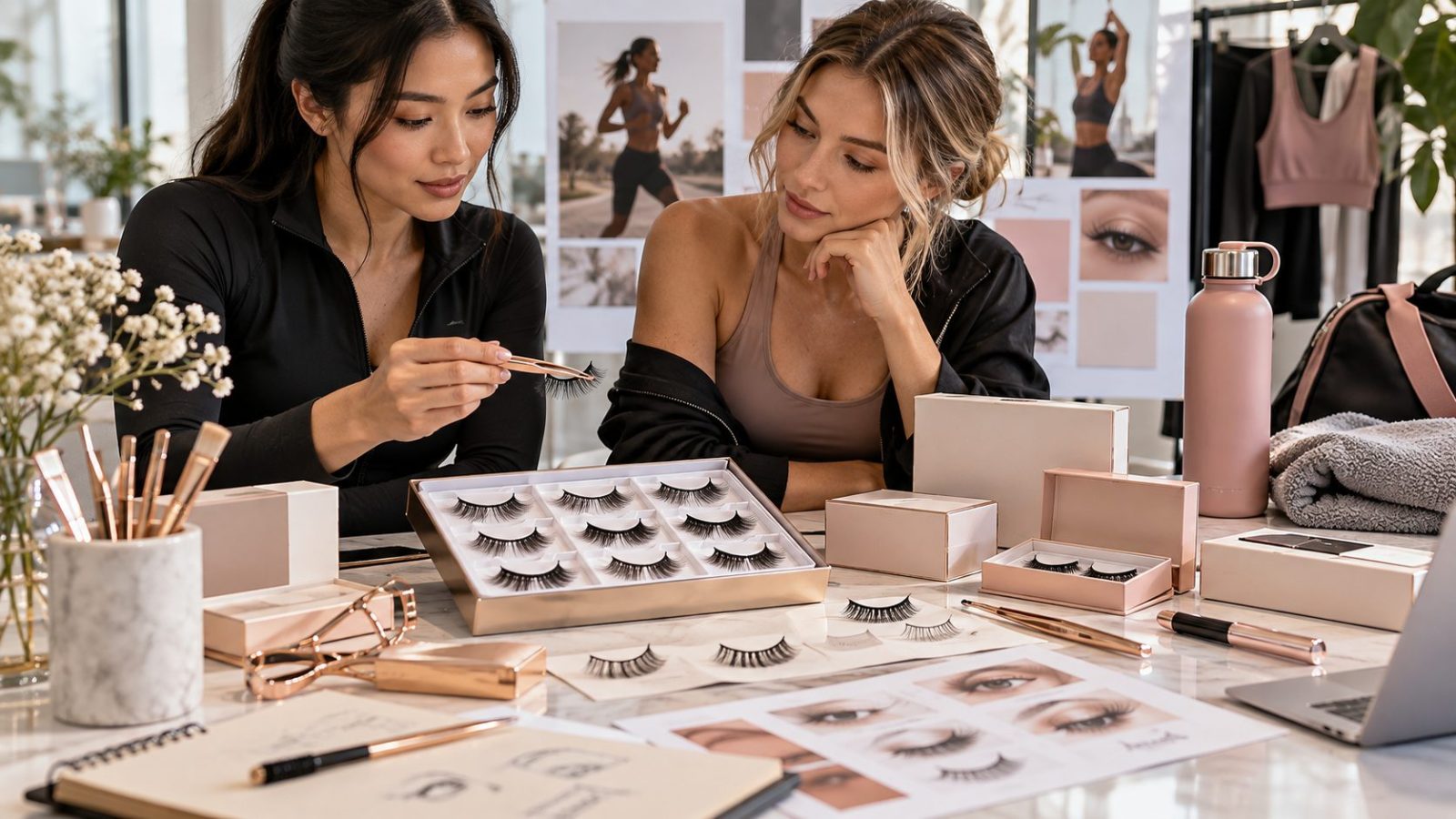
For beauty brands developing strip lashes for active consumers, the product challenge is very different from simply creating another natural, wispy, or dramatic lash style.
The customer may wear the lashes during workouts, long commutes, warm weather, humid conditions, outdoor activities, or a full day that moves from work to exercise and social occasions. In these situations, appearance alone is not enough. The brand also needs to think about curl retention, band flexibility, fiber stability, adhesive compatibility, comfort, and how the finished lash system performs when exposed to moisture and movement.
Ardell Active Lash is a useful retail benchmark for understanding this category. The range is positioned around active lifestyles, with products emphasizing water resistance, sweat resistance, flexible bands, and curl retention.
For a private label beauty brand, however, the goal should not be to copy Ardell’s product, name, packaging, or claims. The better approach is to study the consumer problem behind the product and develop an independent specification with its own lash architecture, testing standards, packaging, and brand identity.
Why Active-Lifestyle Strip Lashes Are a Different Product Category
A standard strip lash is usually developed primarily around appearance:
- Length
- Volume
- Shape
- Fiber texture
- Band appearance
An active-lifestyle lash adds another layer of product requirements.
The brand may also need to consider:
- Curl stability after moisture exposure
- Fiber shape retention
- Band flexibility during movement
- Comfort during extended wear
- Compatibility with the intended lash adhesive
- Resistance to deformation during wear
- Performance in warm or humid environments
This means the product should be developed as a performance-oriented lash system rather than simply a conventional lash placed inside sporty packaging.
1. Start with the Consumer Scenario
Before selecting the lash style, define exactly what “active” means for your target customer.
Different brands may be developing for very different situations:
- Gym and fitness consumers
- Yoga and Pilates users
- Outdoor lifestyle customers
- Consumers living in hot or humid climates
- Busy customers wearing lashes from morning to evening
- Festival, travel, and event customers
- Consumers who want more reliable wear during everyday activity
A lash intended for a light yoga session does not necessarily need the same performance profile as a lash marketed for intense workouts or tropical climates.
Defining the real use case helps determine what should be tested and which claims may eventually be appropriate for the packaging.
2. Curl Retention Is an Important Development Point
For an active-lifestyle strip lash, maintaining the intended lash shape can be just as important as keeping the product attached.
Moisture, heat, storage conditions, handling, and repeated use can affect the appearance of some fibers.
During sampling, beauty brands should evaluate whether the lash retains its intended:
- Curl profile
- Fiber direction
- Outer-corner lift
- Layering structure
- Overall silhouette
This should be evaluated on the finished lash rather than only on loose fiber material.
If curl retention is one of the main selling points, the approved sample should become the visual and technical reference for future production.
3. The Lash Band Must Balance Flexibility and Stability
Movement creates another challenge.
A band that feels acceptable during short indoor wear may feel very different during longer periods of movement, facial expression, heat, and perspiration.
For this category, brands should compare:
- Band flexibility
- Band thickness
- Band weight
- Inner-corner comfort
- Outer-corner stability
- Ability to follow the natural eye curve
- Fiber attachment to the band
The objective is not simply to create the thinnest possible band.
A very delicate band may be visually attractive but difficult to handle consistently. A heavier band may offer more structure but reduce comfort.
The correct specification should balance appearance, flexibility, stability, and application performance.
4. Lash Shape Should Match the Active-Lifestyle Positioning
There is no single lash style that defines an active collection.
Brands can develop different visual directions depending on the customer profile.
| Product Direction | Visual Logic | Possible Customer Positioning |
|---|---|---|
| Active Natural | Light density and moderate length | Everyday wear, gym, casual lifestyle |
| Active Cat-Eye | Graduated outer-corner length | Fitness-to-social styling |
| Active Wispy | Controlled mixed lengths and texture | Younger beauty and social-commerce customers |
| Active Volume | Stronger density with weight control | Consumers wanting visible makeup definition |
| Active Short Lash | Shorter, refined proportions | Beginners and minimal-makeup consumers |
The active-performance concept can therefore support a complete product family rather than only one SKU.
5. Fiber Selection Should Be Evaluated After Moisture Exposure
Fiber appearance inside the tray is only the starting point.
For a performance-oriented product, brands should evaluate whether the selected fiber maintains its shape and visual quality under the intended test conditions.
Important evaluation points may include:
- Fiber softness
- Fiber weight
- Color depth
- Surface finish
- Taper consistency
- Curl retention
- Shape recovery
- Resistance to visible clumping or deformation
If several fibers are available, samples can be compared under the same test conditions before the final material is approved.
6. The Lash and Adhesive Should Be Considered as a System
A strip lash cannot remain attached to the eyelid by itself.
This is an important point when developing an active-lifestyle product.
The performance experienced by the consumer depends not only on the lash but also on the adhesive, application method, skin condition, environment, and wear conditions.
For this reason, beauty brands should be careful about making broad performance claims based only on the lash fibers or band.
If the product is designed to be used with a specific adhesive, the lash-and-adhesive combination should be evaluated together.
Development testing may compare:
- Initial attachment
- Band movement
- Inner-corner lifting
- Outer-corner lifting
- Comfort
- Performance after moisture exposure
- Removal experience
If adhesive is sold separately, the brand should also make sure the product instructions clearly explain the recommended application method.
7. “Sweat-Resistant” and “Water-Resistant” Should Be Tested Claims
This is one of the most important differences between product development and marketing copy.
A supplier saying that a product is suitable for active lifestyles does not automatically mean that every performance claim should immediately appear on retail packaging.
If your brand wants to use claims such as:
- Sweat-resistant
- Sweat-proof
- Water-resistant
- Long-wear
- Workout-friendly
- Humidity-resistant
the finished product should be evaluated using a defined testing method that matches the intended claim and target market.
The test should identify:
- What is being tested
- Whether the lash alone or lash-and-adhesive system is being evaluated
- Exposure conditions
- Test duration
- Pass/fail criteria
- Number of samples evaluated
- Any limitations of the claim
Beauty brands should also review the advertising, cosmetic, and consumer-product requirements that apply in their sales market before printing performance claims on packaging.
8. Create a Repeatable Sample Testing Protocol
Testing should not be informal if performance is part of the product positioning.
A brand can create a simple internal sample comparison sheet for every development round.
| Evaluation Area | What to Check |
|---|---|
| Curl | Shape before and after defined moisture exposure |
| Band | Flexibility, deformation, edge stability |
| Fibers | Clumping, separation, direction and appearance |
| Fit | Inner and outer corner behavior |
| Comfort | Feedback during the intended wear period |
| Appearance | Front, side and close-up comparison |
| Packaging | Protection of lash shape before use |
Photographs taken before and after testing can become part of the approved development record.
This also makes communication with the manufacturing partner more precise when adjustments are required.
9. Packaging Must Protect the Performance Specification
Performance can be affected before the consumer even opens the product.
If the lash becomes compressed, twisted, or deformed inside the tray, the product may no longer match the approved sample.
Packaging development should therefore consider:
- Tray curvature
- Lash positioning
- Fiber protection
- Band fixation
- Carton strength
- Shipping protection
- Humidity exposure during storage
This is especially important for products whose positioning depends on maintaining a defined 3D curl or lifted shape.
10. Develop the Packaging Message Around a Real Consumer Benefit
An active collection should not rely only on sporty graphics.
The packaging should clearly explain why the product exists.
Depending on verified product performance, possible communication directions may include:
- Flexible Fit
- Lightweight Comfort
- Curl-Retention Design
- Designed for Active Lifestyles
- Day-to-Night Wear
- Performance-Tested
Claims involving water, sweat, wear duration, or other measurable performance should only be used when supported by appropriate testing.
Private label packaging can also include:
- Custom brand logo
- Independent product name
- Style number
- Barcode
- Application instructions
- Material or product information
- Warnings where required
- Market-specific labeling
11. Single-Pair or Multipack?
Active-lifestyle strip lashes can also be developed in different retail formats.
A single-pair pack can be useful for introducing a new style or premium positioning.
A multipack can make sense for consumers who use the same lash style regularly and may support stronger repeat-purchase positioning.
Brands should compare:
- Target retail price
- Packaging cost
- Customer usage frequency
- Retail channel
- Amazon or e-commerce shipping requirements
- Expected order quantity
The best configuration depends on the brand’s commercial strategy rather than on the benchmark product alone.
12. Quality Control Must Include Performance-Critical Details
For a normal fashion lash, a buyer may focus heavily on visual consistency.
For an active-lifestyle lash, quality control should also include the characteristics that influence product performance.
Key QC points can include:
- Curl consistency
- Fiber direction
- Band flexibility
- Band dimensions
- Fiber attachment
- Left and right symmetry
- Tray positioning
- Visible deformation
- Packaging protection
If the approved sample has been tested for a particular performance characteristic, bulk production should remain as close as possible to that approved specification.
13. Repeat-Order Consistency Is Especially Important for Performance Products
A beauty brand may successfully test the first production batch, but problems can arise if later orders use noticeably different fibers, band structures, curl profiles, or manufacturing tolerances.
For repeat orders, brands should retain:
- Approved physical sample
- Product specification sheet
- Fiber reference
- Band reference
- Tray specification
- Packaging specification
- Test records
- QC photos
These references help reduce subjective interpretation between different production runs.
14. What to Send a Manufacturer Before Developing Samples
A clear product brief will make the development process more efficient.
Before requesting samples, provide as much of the following information as possible:
- Target consumer
- Target market
- Intended use scenario
- Natural, wispy, cat-eye, volume, or other style direction
- Preferred length
- Preferred density
- Band preference
- Fiber appearance
- Single-pair or multipack requirement
- Packaging requirement
- Expected order quantity
- Target performance claims
- Benchmark images or physical reference samples
If performance claims are part of the brief, discuss how those claims will be validated before packaging is finalized.
15. Benchmark the Consumer Problem, Not the Ardell Brand
A successful retail product can provide useful information about what consumers value.
In the case of active-lifestyle lashes, the underlying consumer problem is clear:
How can a strip lash maintain an attractive, comfortable appearance when the wearer is active, exposed to heat or humidity, or wearing the product for an extended period?
A private label brand can build its own answer to that problem through independent decisions about:
- Lash style
- Fiber
- Curl structure
- Band construction
- Adhesive compatibility
- Testing
- Packaging
- Brand positioning
This creates a genuinely independent product rather than a visual copy of an established retail brand.
Private Label Active-Lifestyle Strip Lash Development with Pingdu Lashes
Pingdu Lashes supports beauty brands with lash sourcing, product development, sample comparison, private label packaging, production coordination, and repeat-order quality control.
If you are developing an active-lifestyle strip lash collection, we can help compare different lash patterns, band structures, fiber options, tray formats, and packaging directions before commercial production.
Performance-related claims should be confirmed through appropriate testing before final packaging and marketing materials are approved.
Our role is to help brands establish a clearer product specification and coordinate the development process so that sampling, production, quality control, and repeat orders can be managed more consistently.
Explore our Strip Lashes, learn more about our Private Label & Custom Service, or contact us to discuss your next lash product development project.
FAQ
Can I develop sweat-resistant strip lashes under my own brand?
Yes, an active-lifestyle strip lash can be developed as a private label project. However, performance claims such as sweat resistance or water resistance should be supported by suitable testing of the final product or lash-and-adhesive system before they are used in marketing.
Is the lash itself enough to make the product sweat-resistant?
Not necessarily. Real-world wear depends on the lash, band, adhesive, application method, skin condition, and environment. If attachment performance is part of the claim, the intended lash-and-adhesive combination should be evaluated together.
What should I test when developing an active-lifestyle lash?
Important areas may include curl retention, fiber deformation, band flexibility, comfort, fit, appearance after moisture exposure, packaging protection, and compatibility with the intended adhesive.
Can I create several styles within one active lash collection?
Yes. A brand can develop natural, short, cat-eye, wispy, and fuller styles around the same active-lifestyle positioning while maintaining independent specifications for each SKU.
Can I create a multipack version?
Yes. Single-pair and multipack structures can both be discussed during development. The most suitable option depends on the target retail price, customer usage pattern, packaging design, and order quantity.
Can you copy an Ardell Active Lash product exactly?
The better development approach is to use successful market products as benchmarks for consumer needs and product logic, then create an independent specification, product name, packaging design, testing standard, and brand identity.
When should packaging be finalized?
Packaging artwork involving performance claims should ideally be finalized after the relevant product specification and testing approach have been confirmed. This reduces the risk of printing claims that the final product has not yet demonstrated.
Benchmark note: Ardell and Active Lash are trademarks of their respective owner. They are referenced only to discuss publicly observable product positioning and product-development logic. Pingdu Lashes is not affiliated with or endorsed by Ardell.



