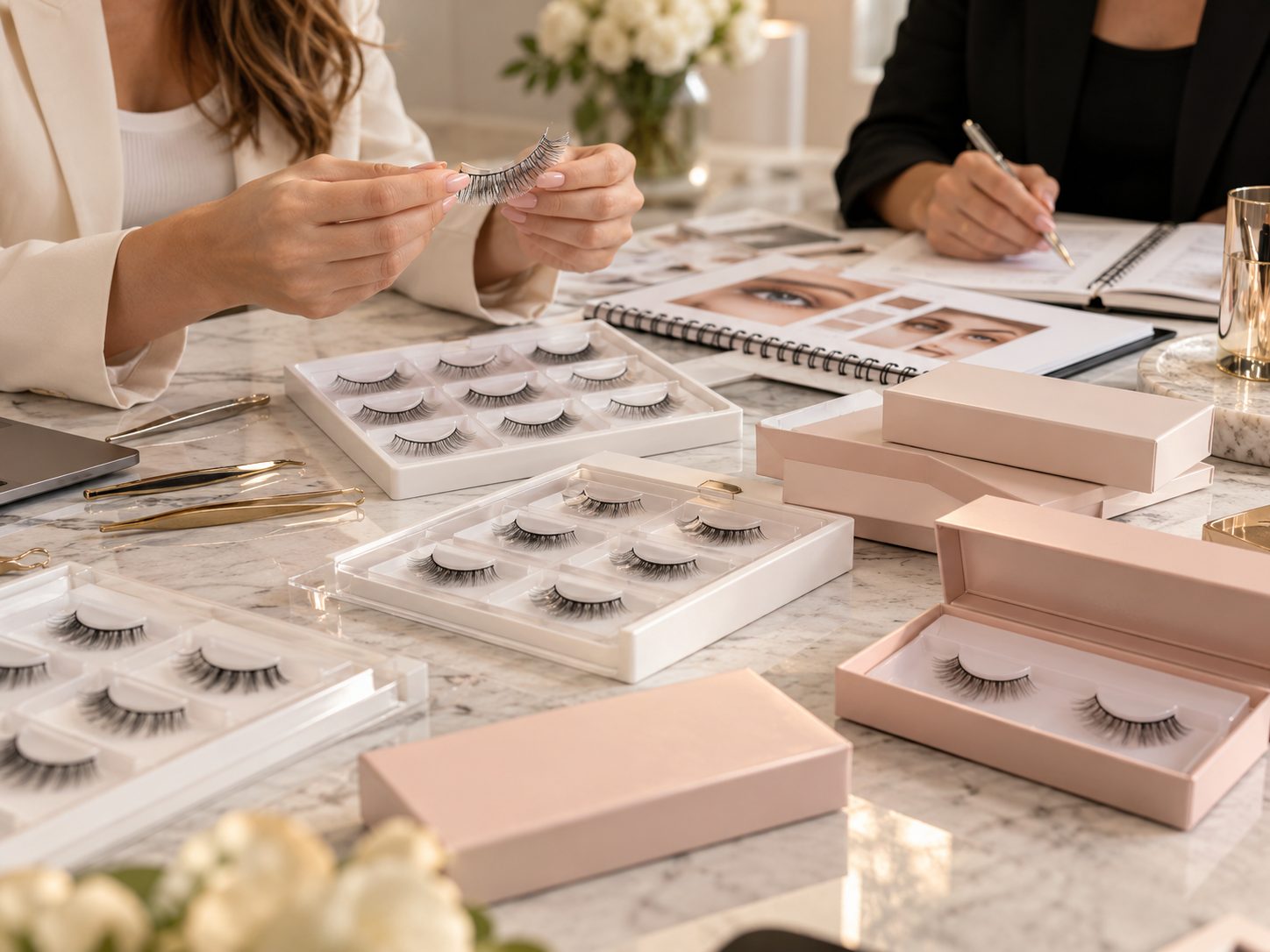
For beauty brands developing a natural-looking strip lash collection, the biggest challenge is often not adding more volume. It is making the lash look less obvious.
Consumers who want an everyday lash usually expect a product that blends into the natural lash line, feels lightweight, remains comfortable for extended wear, and adds definition without looking overly dramatic. This is why ultra-thin lash bands have become an important product-development direction for natural strip lashes.
The KISS My Lash But Better concept is a useful benchmark for understanding this category. Instead of simply increasing fiber density, the product logic focuses on a lightweight band, natural-looking volume, wearable proportions, and a finished result that visually integrates with the user’s own lashes.
For private label brands, the opportunity is not to copy an existing branded product. The better approach is to study the customer problem and product architecture, then develop an independent lash specification around your own target consumer, price point, packaging system, and brand identity.
Why Ultra-Thin Band Strip Lashes Are Different from Standard Natural Lashes
Many strip lashes are described as “natural,” but the word can refer to very different products.
A natural-looking lash is not determined only by fiber length or density. The band itself plays an important role in the final appearance.
A thick or visually obvious band can make even a soft lash pattern look more like a traditional false eyelash. A finer, more flexible band can help the lash sit closer to the natural lash line and reduce the visual separation between the false lash and the eyelid.
For brands developing this category, several elements need to work together:
- Ultra-thin or visually discreet lash band
- Lightweight fiber construction
- Controlled density rather than heavy volume
- Mixed or graduated fiber lengths
- Soft tapering toward the inner corner
- Balanced curl and lift
- Flexible band construction
- Consistent left-to-right symmetry
The goal is not simply to make a thinner version of an existing strip lash. The entire lash architecture should be developed around an effortless, everyday-wear experience.
1. Start with the Target Consumer, Not the Benchmark Product
Before discussing fiber length, band material, curl, or packaging, a beauty brand should first define who the lash is being designed for.
Possible target groups may include:
- First-time false lash users
- Consumers who normally wear mascara only
- Office and everyday makeup users
- Customers looking for a “no-makeup makeup” effect
- Beauty consumers who find traditional strip lashes too heavy
- Customers who want subtle enhancement rather than dramatic volume
This target-user decision affects almost every later specification.
For example, a beginner-focused lash may require a softer, more flexible band and moderate overall length. A premium natural collection may use more refined fiber distribution and a more sophisticated tray and carton design.
The benchmark should therefore help identify the consumer problem, not dictate the final specification.
2. The Lash Band Is the Core Development Point
For an ultra-natural strip lash, the band deserves as much attention as the fibers themselves.
During product development, brands should evaluate:
- Band thickness
- Band flexibility
- Band visibility after application
- Band color
- Band softness around the inner and outer corners
- How easily the band follows different eye shapes
- How securely fibers remain attached to the band
A thinner band can improve visual integration, but it should not become so fragile that it creates inconsistent application or poor repeat-use performance.
The development goal is to make the band thin enough to disappear visually, but stable enough for handling, application, packaging, and repeat use.
3. Build Natural Density Instead of Simply Reducing Volume
Natural lashes should still have structure.
If density is reduced without controlling fiber placement, the finished lash can look sparse or unfinished. A better development approach is to design density intentionally.
- Fine alternating fiber groups
- Soft crisscross patterns
- Short-to-medium mixed lengths
- Subtle outer-corner graduation
- Separated wispy fibers
- Light central emphasis
- Balanced full-eye distribution
4. Develop a Length Architecture for Everyday Wear
Length should be evaluated as a system rather than as one maximum number.
| Development Direction | Visual Effect | Suitable Positioning |
|---|---|---|
| Short Natural | Subtle enhancement with minimal visible extension | Beginners / mature consumers / everyday makeup |
| Balanced Natural | Defined eyes without obvious dramatic length | Mainstream retail collection |
| Natural Wispy | Light texture with separated longer fibers | Modern beauty and social commerce brands |
| Natural Cat-Eye | Soft outer-corner elongation | Fashion-focused everyday collection |
| Natural Doll-Eye | Slightly stronger center definition | Round-eye visual effect |
5. Band Color Can Change the Entire Product Positioning
A visually discreet or clear-style band can support a softer appearance, especially for consumers who do not want to wear heavy eyeliner.
A darker band can provide slightly stronger lash-line definition and may work well for consumers who already use eyeliner.
Sample evaluation should include:
- No-eyeliner application
- Thin eyeliner application
- Natural daylight
- Indoor lighting
- Front-facing photography
- Side-angle photography
6. Fiber Selection Should Support Softness and Shape Retention
Brands should not select fibers based only on appearance in the tray. They should evaluate how the fibers behave after removal, application, wear, and storage.
- Fiber softness
- Diameter and visual fineness
- Matte versus shinier appearance
- Tapering quality
- Curl retention
- Shape consistency
- Resistance to deformation in packaging
7. Sampling Should Compare Specifications, Not Just Styles
One of the most common mistakes in lash sourcing is approving a sample because it “looks good” without recording exactly why it looks good.
For repeat orders, the approved sample should become a measurable reference.
- Band type
- Band width and construction
- Fiber material
- Fiber color
- Curl direction
- Length distribution
- Density pattern
- Outer-corner graduation
- Tray position
- Packaging structure
8. Repeat Order Consistency Matters More Than the First Sample
For beauty brands, developing a good sample is only the beginning.
The more important commercial question is whether the same product can be reproduced consistently across future production runs.
- Band thickness consistency
- Fiber spacing
- Fiber attachment
- Left and right lash symmetry
- Length distribution
- Curl consistency
- Tray positioning
- Visible deformation
- Packaging consistency
9. Turn One Lash Style into a Complete Private Label Collection
| SKU Concept | Development Logic |
|---|---|
| Everyday Natural | Balanced length and light density |
| Short Natural | Reduced length for subtle enhancement |
| Natural Wispy | More texture and separated fibers |
| Natural Cat-Eye | Longer outer section for gentle elongation |
| Natural Volume | Slightly increased density while retaining a fine band |
10. Packaging Should Communicate the Product Advantage Immediately
- Ultra-Thin Band
- Lightweight Feel
- Natural-Looking Definition
- Everyday Wear
- Flexible Fit
- Soft Natural Volume
Private label packaging options may include:
- Single-pair cartons
- Multi-pair value packs
- Paperboard boxes
- Window packaging
- Custom inner trays
- Custom logo printing
- Barcode and retail labeling
- Market-specific warning and product information
11. What to Send a Lash Manufacturer Before Requesting Samples
- Reference visual or benchmark direction
- Target consumer
- Preferred lash length
- Desired density
- Preferred curl
- Natural, wispy, cat-eye, or doll-eye direction
- Band color and flexibility preference
- Single-pair or multipack requirement
- Custom packaging requirement
- Expected order quantity
- Target market
12. Benchmark the Product Logic, Not the Intellectual Property
Using a successful retail product as a benchmark does not mean duplicating the brand.
A responsible private label development process should avoid copying:
- Brand names
- Logos
- Product names
- Packaging artwork
- Protected graphics
- Proprietary brand assets
Instead, brands should identify the underlying product problem being solved.
How can a strip lash provide visible enhancement while making the band and overall false-lash effect less noticeable?
Private Label Ultra-Thin Band Strip Lash Development with Pingdu Lashes
Pingdu Lashes supports beauty brands with lash sourcing, product development, sampling, private label packaging, and production coordination.
If your brand is developing a natural strip lash collection, we can help compare different band structures, lash patterns, lengths, density levels, tray formats, and packaging options before commercial production.
Our goal is not simply to find a similar-looking lash. The goal is to help define a repeatable product specification that fits your brand and can be managed consistently across future orders.
Explore our Strip Lashes, learn more about our Private Label & Custom Service, or contact us to discuss your next lash development project.
FAQ
Can I develop an ultra-thin band strip lash under my own brand?
Yes. Band structure, lash pattern, fiber length, density, curl, tray presentation, and packaging can be evaluated during the private label development process.
Can I use a retail lash as a reference for product development?
Yes. A retail product can be used to explain the type of fit, appearance, band construction, density, or consumer experience you are targeting. However, your final product should use an independent specification, brand identity, product name, and packaging design.
What should I confirm when comparing ultra-thin lash band samples?
Compare band visibility, flexibility, comfort, fiber attachment, length distribution, density, symmetry, curl, application performance, and overall appearance after the lash is actually worn.
Can I develop several natural lash styles as one collection?
Yes. Natural, short, wispy, cat-eye, and slightly fuller styles can be developed around a related product architecture.
Can you provide custom packaging for private label strip lashes?
Custom packaging can be discussed together with the lash specification, including cartons, trays, logo presentation, labeling, barcodes, and single-pair or multipack structures.
Why is repeat order consistency important for natural strip lashes?
Natural styles rely on subtle differences in spacing, length, curl, density, and band construction. Approved samples and clear specification control help improve consistency between production runs.
Benchmark note: KISS and My Lash But Better are trademarks of their respective owner. They are referenced only to discuss publicly observable product positioning and product-development logic. Pingdu Lashes is not affiliated with or endorsed by KISS.



