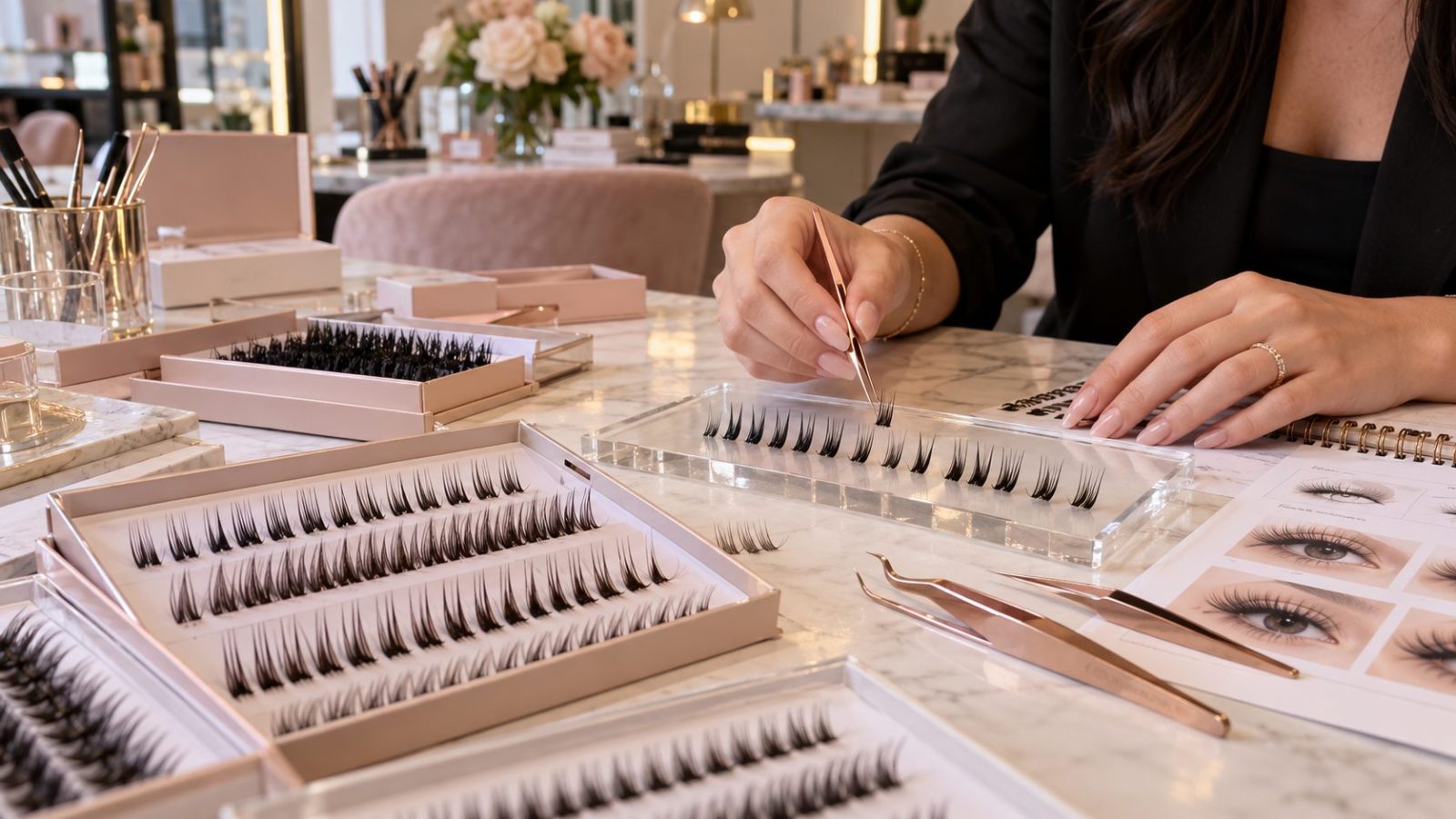
Wet Look lash extensions have become an important style direction for professional lash brands because they combine clean definition, visible texture and a more editorial finish than traditional soft volume sets.
For brands developing their own professional lash extension range, however, a Wet Look collection is not simply about adding a few pointed lashes to an existing tray.
The product needs to be developed around consistent spike structure, suitable curls and lengths, practical tray organization, technician usability and repeat-order consistency.
One way to simplify this process is to develop a collection around premade lash spikes.
Premade spikes can help lash artists create Wet Look, Wispy and textured sets more efficiently while giving brands a clearer product specification to standardize for private label and OEM production.
What Are Premade Lash Spikes?
Premade lash spikes are pre-formed lash units designed to create visible points, narrow closed sections or textured accents within a professional lash extension set.
They are different from conventional premade volume fans.
Traditional premade fans are usually developed to create soft volume and density, while premade spikes are designed primarily for definition, separation and texture.
Depending on the target style, a lash brand may develop spikes with different visual structures, thickness combinations, curls and lengths.
The exact construction should always be confirmed through physical samples because small differences in spike width, bonding area and fibre alignment can noticeably change the finished lash set.
Why Wet Look Collections Need a Clear Product Specification
A Wet Look result depends heavily on visual consistency.
If some spikes are too wide, some open during application and others have noticeably different curl directions, the final set may lose the clean textured appearance that the lash artist expects.
For this reason, beauty brands should not evaluate premade lash spikes only by looking at a tray photo.
A stronger development process should define the product in measurable and repeatable terms.
Important points may include:
- target spike appearance
- curl options
- length range
- fibre thickness
- spike width and density
- base structure
- tray layout
- strip labeling
- packaging format
- acceptable variation between production batches
These details become especially important when a brand wants to reorder the same collection over a long period.
1. Start with the Finished Lash Look
Product development should begin with the result the lash artist is expected to create.
A brand may want a clean Wet Look, a softer Wispy Wet Look, a stronger Spiky texture or a mixed textured set using spikes together with standard lash extensions.
These are related styles, but they do not necessarily require the same spike specification.
Before requesting samples, prepare visual references showing:
- the desired amount of separation
- how narrow or bold the spikes should appear
- the preferred curl direction
- the approximate length contrast between spikes and surrounding lashes
- whether the final effect should look natural, dramatic or editorial
A clear finished-look reference gives the manufacturer a better development target than simply asking for “Wet Look lashes.”
2. Build a Practical Curl Range
Curl selection affects both the appearance of the spike and how easily lash artists can integrate it into their existing work.
Instead of launching too many curls immediately, brands can begin with the curls most relevant to their professional customer base and expand after receiving application feedback.
During sampling, compare whether the curl remains visually consistent from the root area through the tip of the spike.
Also compare multiple trays rather than approving a specification from only one sample.
The goal is not simply to choose a curl name on a specification sheet. The goal is to confirm that the actual physical product repeatedly produces the intended shape.
3. Plan the Length Structure Around Real Application
A Wet Look collection should make sense when used by a lash technician.
Brands therefore need to decide whether they want:
- single-length trays
- mixed-length trays
- shorter spikes for inner corners
- medium lengths for the main body of the set
- longer spikes for mapping and accent points
The most suitable combination depends on the intended customer and application style.
For a new collection, mixed trays may help customers test several lengths, while established professional brands may prefer a broader range of individual-length trays.
This decision should be based on technician use rather than packaging appearance alone.
4. Test Spike Structure, Not Just Appearance
Two premade spikes can look similar inside the tray but behave differently during application.
Sample testing should therefore include practical handling.
Check whether technicians can remove the spike cleanly from the strip, pick it up reliably and position it without the structure changing unexpectedly.
Brands should also compare:
- spike symmetry
- fibre alignment
- tip definition
- base consistency
- curl consistency
- length consistency
- appearance after removal from the strip
If possible, ask more than one lash technician to test the samples.
A product that looks attractive in photography but is difficult to use may create problems after launch.
5. Decide How Premade Spikes Fit into the Full Collection
Premade lash spikes are usually stronger as part of a coordinated professional product system than as an isolated SKU.
A brand can develop them alongside complementary lash extension products such as classic lashes, volume lashes, easy fan lashes or other textured professional styles.
This creates more opportunities for lash artists to build complete sets using products from the same brand.
For example, a collection could position premade spikes as the texture component while standard extension trays provide the softer supporting layers.
The exact combination should reflect the brand’s target customer rather than copying another brand’s assortment.
6. Design the Tray for Professional Use
For professional lash products, packaging is part of product usability.
The external box matters for branding, but the internal tray layout is equally important.
During development, review:
- number and arrangement of strips
- length identification
- curl identification
- easy visual differentiation between variants
- space for private label branding
- barcode or SKU requirements
- outer box protection during shipping
A professional-looking package should also make stock management easier for distributors, salons and lash technicians.
7. Approve a Reference Sample Before Bulk Production
One of the most important steps in private label lash development is creating a clear approved reference.
Once the brand confirms the spike structure, curl, length configuration, tray format and packaging, the approved sample can become the comparison reference for later production.
This is particularly important for products where small visual differences are easy to notice.
When evaluating a bulk order, compare key characteristics against the approved sample rather than relying only on written specifications.
8. Pay Attention to Repeat-Order Consistency
A successful product is not defined only by the first order.
Professional lash brands need customers to receive a familiar product when they reorder months later.
For premade lash spikes, repeat-order evaluation may include:
- curl consistency
- length consistency
- spike width
- fibre alignment
- tray organization
- labeling
- packaging appearance
If the brand plans to scale the product, these points should be discussed during product development rather than after inconsistencies appear.
Premade Lash Spikes vs Premade Volume Fans
Brands should also explain the difference clearly to customers.
Premade volume fans are generally designed to create volume and coverage.
Premade lash spikes are designed to create stronger definition and visible texture.
Some lash sets may use both.
For example, a technician can use softer fans or individual extensions to build the main layer and then introduce spikes to create the Wet Look structure.
This distinction is useful for product descriptions, training materials and wholesale buyer communication.
How to Develop a Private Label Premade Lash Spike Collection
A practical development process can follow these steps:
- Define the target Wet Look or textured style.
- Select the initial curls and lengths.
- Confirm the desired spike structure.
- Request physical samples.
- Test the samples with lash technicians.
- Adjust the structure if necessary.
- Confirm the tray configuration.
- Develop private label packaging.
- Approve a final reference sample.
- Use the approved reference when checking repeat production.
This process gives the brand a clearer path from product concept to commercial launch.
Who Should Consider Adding Premade Lash Spikes?
Premade spikes may be suitable for:
- professional lash brands expanding their extension range
- private label brands targeting lash technicians
- distributors building a textured lash extension assortment
- brands developing Wet Look or Wispy professional collections
- existing extension brands looking for additional product differentiation
They may be less suitable for brands that do not yet understand their professional customer base or have not established a clear product positioning.
In those cases, sample testing and customer feedback should come before a large assortment expansion.
Developing Premade Lash Spikes with a Manufacturing Partner
When discussing a new premade spike project with a lash manufacturing partner, provide as much product information as possible.
Useful information includes reference photos, target market, preferred curl and length range, expected tray configuration, packaging requirements and estimated order quantities.
If the specification is still being developed, begin with samples rather than trying to finalize every detail from photos.
Pingdu Lashes supports beauty brands with lash product development, sample coordination, private label packaging and repeat-order specification management.
You can review our Private Label Premade Lash Spikes product page for a related professional lash extension development option.
You can also explore our Professional Lash Extensions range or contact us through our Custom Lash Services page to discuss a new collection.
Final Thoughts
A strong Wet Look lash collection requires more than a fashionable product name.
The spike structure, curl, length, tray organization, technician usability and repeat-order consistency all influence whether the product can become a reliable part of a professional lash brand.
By developing premade lash spikes around a clear reference sample and real application testing, brands can create a more controlled and scalable Wet Look product line.



