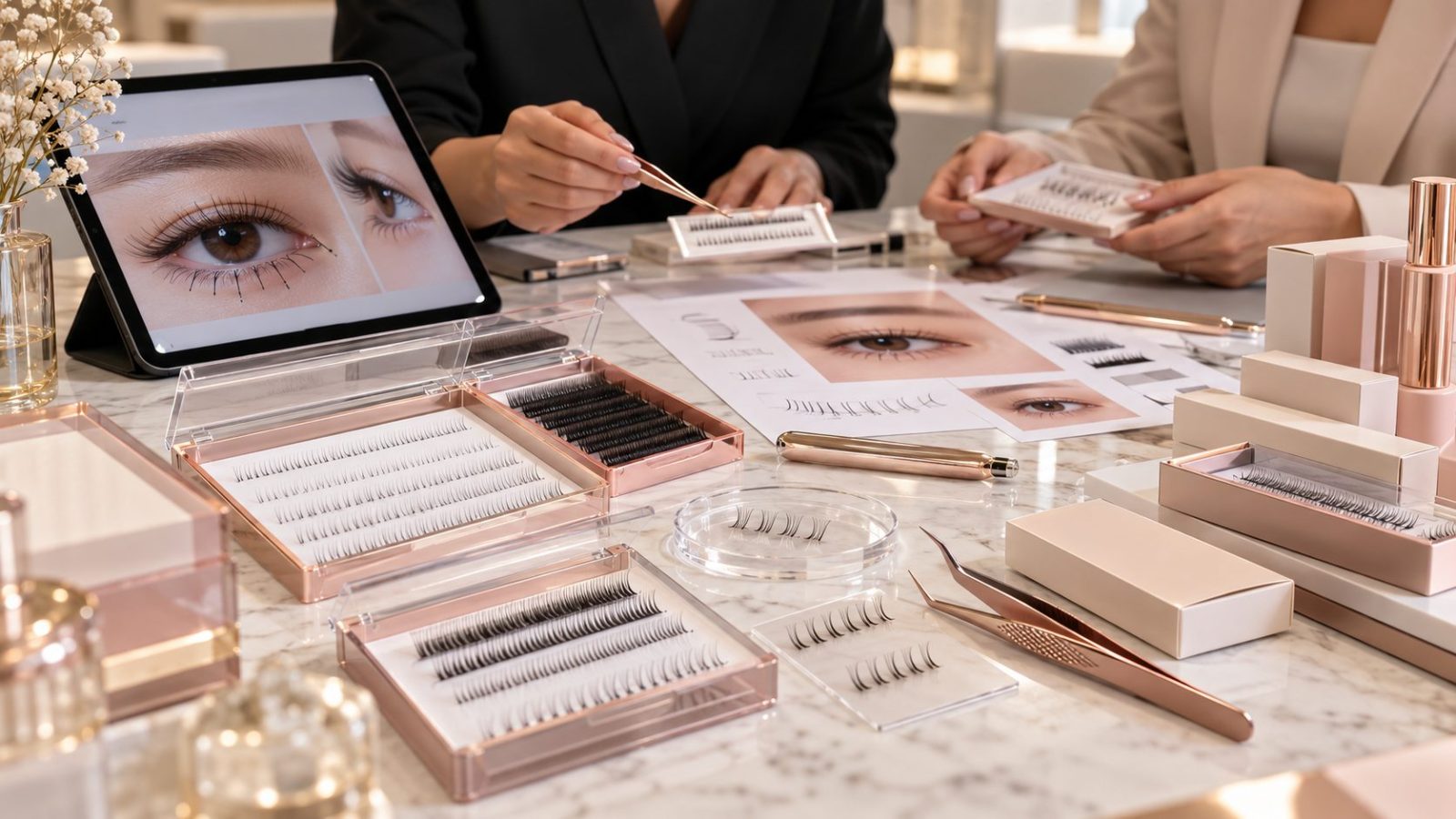
Bottom lash extensions can be a small category inside a professional lash collection, but they require their own product development logic.
They should not simply be treated as shorter versions of standard upper lash extensions.
Lower-lash application involves different visual proportions, handling requirements and styling expectations, so brands need to think carefully about length, curl, fibre weight, tray configuration and technician usability before launching the product.
For private label and OEM lash brands, a clear development process can also make repeat orders more consistent and easier to manage.
Why Bottom Lash Extensions Need Their Own Product Specification
Professional lash brands often begin with classic, volume, Easy Fan or premade lash products.
When Bottom Lash Extensions are added later, there can be a temptation to simply select a shorter length from an existing tray and change the label.
That approach may not create the best professional product.
Bottom lashes are visually more delicate, and the finished result can be affected by small differences in fibre length, curl direction, thickness and alignment.
For this reason, brands should develop a separate specification based on the intended lower-lash application rather than copying an upper-lash product.
1. Define the Target Professional Customer First
Before deciding on lengths or packaging, brands should identify who will actually use the product.
The target customer may include:
- professional lash artists
- lash salons
- lash academies
- professional beauty distributors
- established lash brands expanding their extension range
A product designed for experienced technicians may require a different tray configuration from one intended for a broader salon customer base.
The development process should therefore begin with technician workflow, not with packaging design.
2. Build a Practical Length Range
Length is one of the most important development decisions for Bottom Lash Extensions.
The objective is not simply to create the shortest possible lash.
The selected range should allow lash artists to create controlled lower-lash styling while maintaining the intended balance with the upper lash set.
Brands can consider several approaches:
- single-length trays for technicians who already know their preferred specification
- mixed-length trays for testing or broader application flexibility
- a focused short-length range for professional lower-lash work
- different tray combinations for different styling preferences
The best range should be confirmed through physical samples and technician testing rather than selected only from a catalogue.
3. Evaluate Curl as a Physical Product, Not Just a Name
Curl labels are useful for communication, but the actual physical curl is what matters during application.
Two products carrying a similar curl name can still look different when placed next to each other.
During sample evaluation, brands should check:
- curl direction
- consistency across the tray
- consistency between multiple sample trays
- how the curl looks after the fibre is removed from the strip
- whether the curl fits the intended lower-lash styling result
Once the desired curl has been approved, the physical reference sample becomes more useful than relying only on a written specification.
4. Control Fibre Thickness and Visual Weight
Bottom Lash Extensions usually need a more delicate visual balance than many upper-lash extension products.
That means fibre thickness should be evaluated together with length and curl rather than as an isolated specification.
A brand should ask:
- Does the fibre look too visually heavy for the intended lower-lash effect?
- Does it maintain enough definition?
- Is the overall appearance consistent with the brand’s professional positioning?
- Does the selected fibre work well with the intended length range?
The goal is to develop a product that looks intentional and professional rather than simply smaller than the brand’s standard upper-lash range.
5. Decide Between Mixed-Length and Single-Length Trays
Tray structure influences both product usability and inventory planning.
Mixed-length trays can be useful for a new launch because technicians can test several lengths from one product.
They can also make it easier for a brand to introduce Bottom Lash Extensions without immediately carrying a large number of separate SKUs.
Single-length trays, however, may be preferred by professional users who consistently work with specific lengths.
For established brands, a common development strategy is to begin with sample testing and a focused assortment, then expand individual lengths according to customer feedback and reorder patterns.
6. Test How Easily the Fibres Can Be Picked Up
Product photography cannot show how a lash fibre behaves during real application.
Technician testing is therefore an important part of Bottom Lash Extension development.
During sampling, evaluate:
- ease of fibre pickup
- whether fibres separate cleanly from the strip
- strip adhesive behavior
- fibre alignment
- curl consistency after pickup
- how easily the technician can identify lengths
If possible, ask several professional lash artists to test the same sample.
One technician’s preference may not represent the broader market, so multiple application opinions can provide more useful development feedback.
7. Create a Clear Approved Reference Sample
For private label products, the approved sample should become a practical production reference.
Once the brand confirms the final appearance, the reference can include:
- approved fibre appearance
- approved curl
- approved length structure
- tray configuration
- row organization
- labeling
- outer packaging
This reference helps the buyer and manufacturing partner communicate more clearly during future production.
It is especially useful when the product is reordered months later.
8. Design the Tray for Professional Workflow
Professional lash packaging needs to do more than look attractive.
The internal tray should help the technician work efficiently.
Brands should consider:
- clear curl identification
- clear length identification
- easy-to-read tray labels
- consistent row placement
- logical SKU naming
- space for brand information
If a collection contains many professional lash products, consistent label architecture becomes increasingly important.
A technician or distributor should be able to identify the correct product without unnecessary confusion.
9. Develop Packaging as Part of the Product System
Bottom Lash Extensions should visually belong to the same professional collection as the brand’s other lash extension products.
Private label packaging can coordinate:
- brand colors
- logo placement
- product naming
- curl and length identification
- SKU information
- barcode requirements
- distribution labels
The objective is not only visual consistency.
A clear packaging system also supports inventory management, wholesale distribution and repeat purchasing.
10. Plan for Repeat-Order Consistency Before the First Bulk Order
A lash product should not be judged only by the first successful sample.
For professional brands, the bigger question is whether the same product can be reproduced consistently when customers reorder.
For Bottom Lash Extensions, repeat-order checks may include:
- length consistency
- curl consistency
- fibre appearance
- row organization
- strip placement
- label accuracy
- packaging consistency
These expectations should be discussed before the first commercial order.
Waiting until the second or third order to define acceptable variation can make quality management more difficult.
Bottom Lash Extensions vs Bottom Lash Clusters
Brands should also distinguish professional Bottom Lash Extensions from Bottom Lash Clusters.
Bottom Lash Extensions are developed for professional lash extension application and form part of a salon or technician-focused extension range.
Bottom Lash Clusters are a different product format and may be positioned for cluster application, DIY systems or other beauty uses depending on the product design.
The two categories should not be treated as interchangeable.
Clear product naming helps both buyers and customers understand the intended application.
How Bottom Lash Extensions Fit into a Complete Professional Collection
Bottom Lash Extensions are most valuable when they complement a broader professional product range.
A brand may combine them with:
- Classic Lash Extensions
- Volume Lash Extensions
- Easy Fan Lashes
- Premade Volume Fans
- Premade Lash Spikes
- specialty curls
- brown or colored professional lash extensions
This allows the brand to support more application styles and build a stronger professional product system.
Instead of selling isolated trays, the brand can create a coordinated collection that gives lash artists multiple tools within one product family.
Questions to Ask a Bottom Lash Extension Manufacturer
Before placing a private label or OEM order, buyers can ask:
- Which length ranges can be developed?
- Which curl options are available?
- Which fibre specifications can be sampled?
- Can mixed-length trays be produced?
- Can single-length trays be developed later?
- What tray and row configurations are available?
- Can labels and packaging be customized?
- How are approved samples referenced for repeat orders?
- How are batch-to-batch differences checked?
These questions help move the discussion away from price alone and toward actual product development capability.
Start with Samples Before Expanding the Range
For a new Bottom Lash Extension project, it is usually more practical to begin with a focused sample program.
Test the most relevant lengths, curls and fibre options first.
After technician feedback, the brand can decide which specifications should become commercial SKUs.
This reduces the risk of launching too many similar variants before understanding actual customer demand.
Private Label Bottom Lash Extension Development
Pingdu Lashes supports beauty brands with professional lash product development, sample coordination, private label packaging and repeat-order specification management.
For a related product option, see our Private Label Bottom Lash Extensions for Professional Lash Artists.
You can also explore our Professional Lash Extensions collection for additional product development ideas.
For custom projects, packaging development or sample discussions, visit our Custom Lash Services page.
Final Thoughts
Bottom Lash Extensions may occupy only a small space inside a professional lash catalogue, but they should still be developed with the same discipline as a core product.
Length, curl, fibre weight, tray layout, technician usability and repeat-order consistency all influence whether the product works successfully in a professional range.
By beginning with clear application goals, testing physical samples and maintaining an approved reference, beauty brands can develop a more reliable Bottom Lash Extension product line that fits naturally into a broader professional lash collection.



