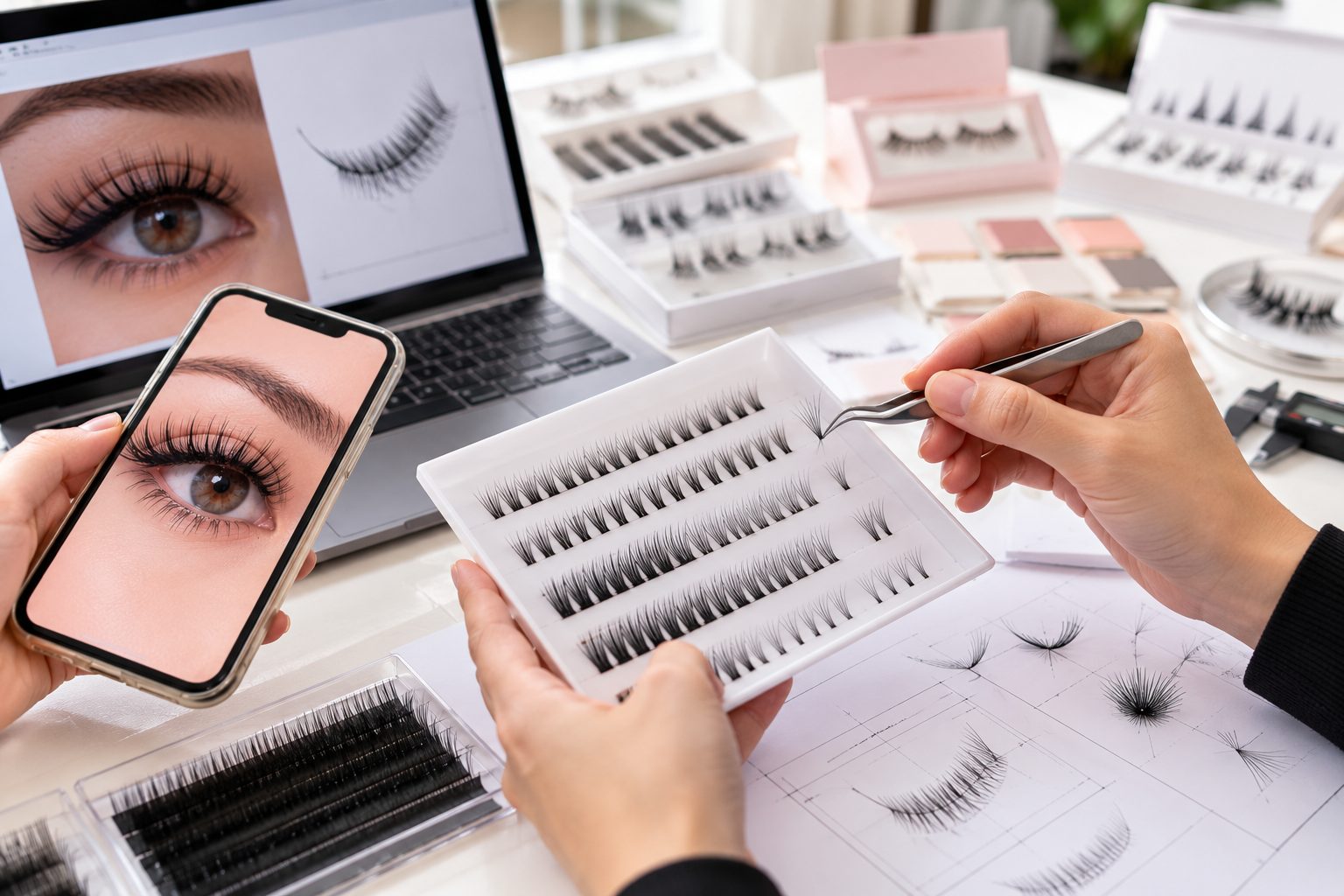
Yes. An eyelash manufacturer can often develop a similar product from a reference sample or photo, but the accuracy depends heavily on the information available.
A physical sample provides much more useful development information than a photo because the manufacturer can directly compare the lash structure, dimensions, curl, band or base, fibre arrangement, tray configuration and overall feel.
A photo can still be useful for defining the visual direction, but it cannot reliably reveal every hidden product specification.
For beauty brands developing private label or OEM lashes, the best approach is usually to use a reference product as a development benchmark, then create and approve a new specification through physical samples before bulk production.
Can a Lash Manufacturer Work from Only a Photo?
Yes, a photo can be used as a starting point.
For example, a clear reference image may help communicate:
- overall lash style
- natural, wispy, spiky or dramatic appearance
- approximate lash density
- visible length pattern
- lash mapping direction
- band appearance
- cluster structure
- packaging concept
However, a photograph does not provide a complete manufacturing specification.
Important details may not be visible, including:
- exact fibre material
- precise fibre thickness
- actual curl specification
- exact individual lengths
- fibre weight
- base construction
- strip adhesive behavior
- lash softness
- product flexibility
- manufacturing tolerances
This means a manufacturer can use the photo to create a development direction, but the first sample should be treated as a prototype rather than an exact final product.
Is a Physical Reference Sample Better Than a Photo?
Yes. A physical reference sample is normally much more useful for product development.
With a real sample, the development team can examine characteristics that are difficult or impossible to judge from an image.
Depending on the lash type, this may include:
- curl shape
- fibre diameter
- length distribution
- lash density
- fibre alignment
- band thickness and flexibility
- cluster base structure
- tray arrangement
- strip behavior
- overall softness and visual weight
The sample does not eliminate the need for development testing, but it gives the manufacturer a much clearer benchmark.
Can the New Product Be Exactly the Same as the Reference?
Brands should be careful with the word “exactly.”
A reference product can be used to communicate the desired appearance, construction and performance target, but several factors may prevent an identical result.
These can include:
- different raw materials
- different production equipment
- different manufacturing techniques
- supplier-specific fibre behavior
- different adhesives or components
- normal manufacturing tolerances
- proprietary product structures
A more practical objective is usually to develop a product that achieves the desired market positioning and application experience while creating a specification that the new manufacturing partner can reproduce consistently.
What Information Should a Brand Send with a Reference Photo?
If a physical sample is not available, sending more information with the image can significantly improve the development process.
Useful information includes:
- product type
- target customer
- target market
- desired lengths
- preferred curls
- preferred fibre thickness
- band or base preference
- tray size
- number of rows or clusters
- single-length or mixed-length configuration
- packaging requirements
- estimated order quantity
If some specifications are unknown, the brand can simply identify which parts of the reference product it likes most.
For example:
- “We want a similar natural effect, but slightly shorter.”
- “We like this cluster structure, but want our own length map.”
- “We want a softer band than this reference.”
- “We like the application effect but need completely different packaging.”
This is much more useful than sending one photo with the instruction “make the same.”
What Information Should a Brand Send with a Physical Sample?
A physical sample is more useful when the brand also explains the development goal.
The manufacturer should know whether the buyer wants to:
- reproduce the general application effect
- improve a current product
- change the curl or length range
- reduce or increase density
- modify the band or base
- change the tray configuration
- develop a new packaging system
- create a new version for a different market
Without this information, the manufacturer may not know which characteristics of the reference are essential and which can be changed.
How Does Reference-Based Lash Product Development Usually Work?
A practical development process can follow several stages.
Step 1: Review the Reference
The manufacturer reviews the photos, sample and any available specifications.
The goal is to identify the product characteristics that need to be matched, adjusted or redesigned.
Step 2: Confirm the Development Target
The buyer and manufacturer clarify what the new product should achieve.
This may include appearance, application style, target customer, tray configuration, packaging and price positioning.
Step 3: Create the First Sample
The first physical sample is produced according to the available information.
This should be treated as a development sample, not automatically as the final bulk specification.
Step 4: Compare the Sample
The buyer can compare the new sample with the original reference and evaluate the most important differences.
Depending on the product, comparison points may include:
- curl
- length
- density
- fibre softness
- band flexibility
- cluster structure
- application result
- tray organization
Step 5: Adjust the Specification
If necessary, the manufacturer modifies the product based on the buyer’s feedback.
Development may require more than one sample round when the product structure is highly specific.
Step 6: Approve a Final Reference Sample
Once the buyer is satisfied, the approved physical sample should become an important reference for bulk production.
This is also useful for repeat-order consistency later.
Which Eyelash Products Can Be Developed from References?
Reference-based development can be used for many eyelash categories.
Examples include:
- DIY cluster lashes
- pre-glued lash clusters
- strip lashes
- magnetic lashes
- professional lash extensions
- Easy Fan lashes
- premade volume fans
- premade lash spikes
- brown or colored lashes
- specialty curl products
The amount of information needed depends on the complexity of the product.
A simple visual style may be easier to develop from photos, while products with specific application systems or technical structures generally benefit more from physical reference samples.
Can a Manufacturer Improve the Reference Product Instead of Simply Matching It?
Yes, and for many brands this is a better product development strategy.
A reference product can be treated as a benchmark rather than a fixed specification.
For example, a brand may ask to:
- make the lash lighter
- adjust the density
- change the length map
- create a softer visual effect
- modify the curl
- improve tray organization
- change the packaging format
- build a wider product collection around the concept
This gives the brand an opportunity to create a product that better fits its own customers instead of simply following an existing market product.
What If the Brand Does Not Know the Technical Specifications?
That is common.
Beauty brands do not always know the exact fibre diameter, manufacturing structure or material details of a reference product.
In this situation, the buyer can describe the result it wants rather than guessing technical specifications.
Useful descriptions might include:
- “lighter and more natural”
- “more visible spikes”
- “softer and less dramatic”
- “stronger curl”
- “shorter inner corner”
- “easier for beginners to apply”
The manufacturer can then use sample development to translate those requirements into a workable product specification.
Should a Brand Send Several Reference Products?
Sometimes this can be useful.
A brand may like the lash structure of one product, the packaging of another and the length combination of a third.
In that case, clearly explain which characteristic is being referenced from each example.
This is more effective than asking a supplier to combine several products without explaining the development priorities.
What Should Be Confirmed Before Bulk Production?
Before placing a commercial order, the brand should confirm the final specification rather than relying only on the original reference.
The approved product may need to define:
- lash style
- curl
- length configuration
- fibre specification
- band or base structure
- tray layout
- row or cluster quantity
- labeling
- packaging
- approved reference sample
This creates a clearer production standard for both the buyer and the manufacturing partner.
Why Is the Approved Sample More Important Than the Original Reference?
The original reference starts the development process.
The approved sample defines the product the brand has actually chosen to manufacture.
These are not always the same.
During development, the brand may intentionally change the length, curl, density, structure or packaging.
For future repeat orders, the approved final sample should therefore become the primary physical reference.
This can help reduce misunderstandings when the same product is ordered again months later.
Can a Brand Send a Competitor’s Product as a Reference?
A competitor product can be used as a benchmark to explain general product characteristics or market expectations.
However, brands should develop their own commercial product specification, branding and packaging rather than reproduce protected logos, artwork, trademarks or proprietary brand assets without authorization.
The objective should be product development and benchmarking, not unauthorized duplication of another company’s protected brand identity.
Photo or Physical Sample: Which Should You Send?
| Reference Type | Best Use | Main Limitation |
|---|---|---|
| Photo | Visual direction, style, density and general concept | Hidden specifications cannot be confirmed |
| Video | Showing flexibility, movement, application or product handling | Still cannot confirm all physical specifications |
| Physical Sample | Detailed product comparison and specification development | May still require sampling and adjustment |
| Reference Sample + Written Requirements | Most complete development direction | Final specification still needs approval |
What Is the Best Way to Start?
If you already have a physical reference product, send photos first so the manufacturer can make an initial assessment.
If the project appears workable, the physical sample can then be reviewed for more detailed development.
If you only have photos or an idea, explain the desired market, customer, style and changes you want.
The project can then begin with a first development sample.
For brands comparing new suppliers, our guide on how to compare lash samples from different suppliers explains what to evaluate before making a supplier decision.
If you already have an existing product and want to move production, you can also read how to switch lash suppliers without changing your existing products.
Develop a Lash Product from Your Reference
Pingdu Lashes supports beauty brands with product development coordination, sample comparison, private label packaging and repeat-order specification management.
You can send a product photo, reference style or physical sample together with the changes you want to make.
The development process can then focus on creating a practical specification for your own brand rather than relying only on the original reference.
Explore our lash product range or visit our Custom Lash Services page to discuss a development project.
Frequently Asked Questions
Can a lash manufacturer make a product from just one photo?
Yes, a photo can be used to start development, especially for visual style. However, hidden specifications such as exact fibre thickness, material, curl and construction usually need to be confirmed through sampling.
Is sending a physical lash sample better?
Yes. A physical sample allows more detailed comparison of curl, length, fibre structure, softness, band or base construction and tray configuration.
Can the new lash product be modified from the reference?
Yes. Brands can change lengths, curls, density, structure, tray configuration and packaging to create a product that better fits their own market.
Do I need to know all the technical specifications?
No. If some specifications are unknown, describe the appearance, application experience and changes you want. Physical sampling can then be used to develop and confirm the final specification.
Should the original reference be used for every repeat order?
After development is complete, the final approved sample should normally become the main production reference because it represents the specification actually approved by the brand.



