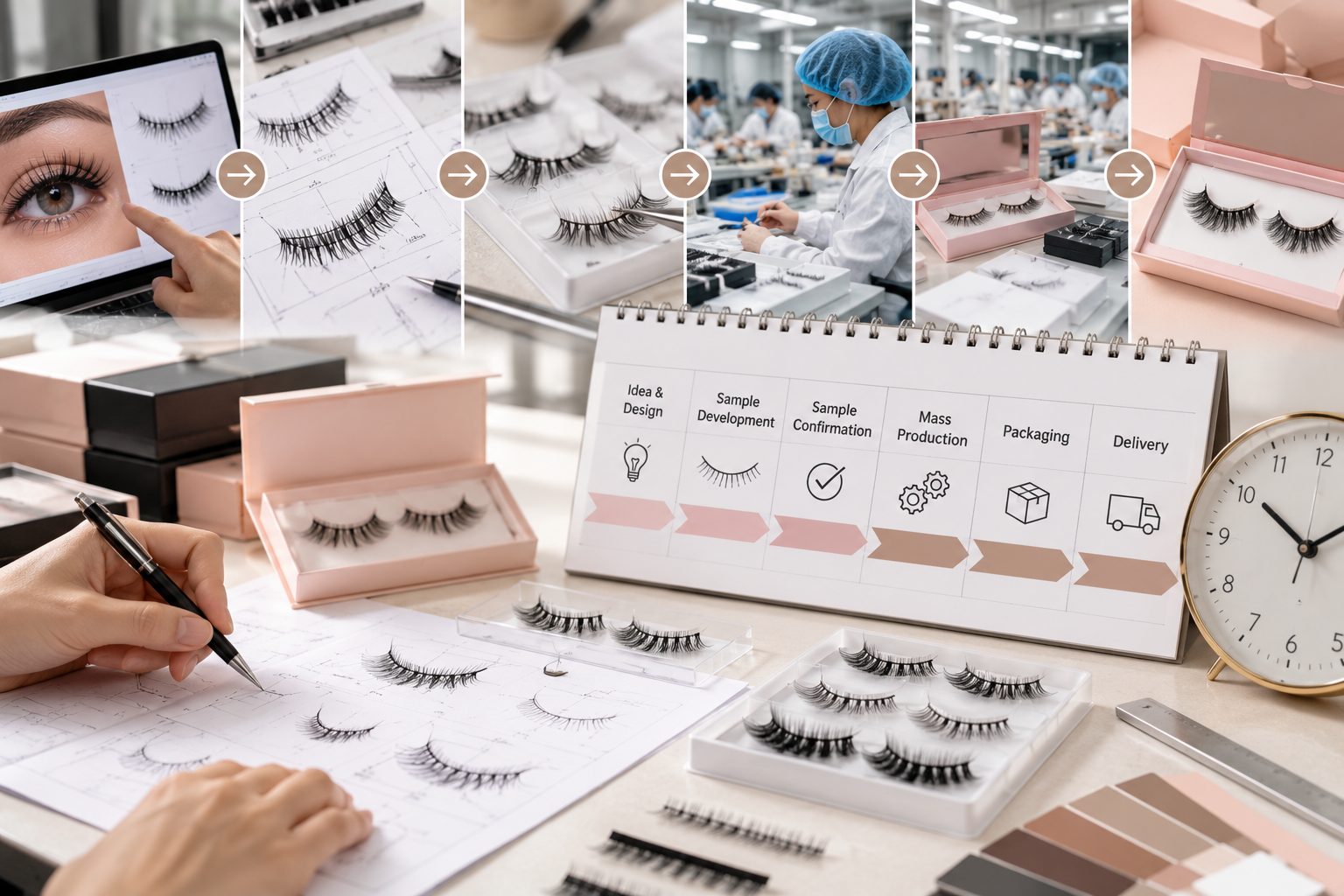
There is no single fixed timeline for developing private label lashes.
The total development time depends mainly on the product type, how much customization is required, the number of sample revisions, packaging development, how quickly the buyer provides feedback, and the manufacturer’s production schedule.
A simple private label project using an existing lash style and standard packaging can usually move faster than a fully customized OEM project that requires new lash structures, multiple sample rounds and custom packaging.
For beauty brands, the most useful approach is to understand the development stages rather than ask only, “How many days will it take?”
What Are the Main Stages of Private Label Lash Development?
A typical private label or OEM lash development project may include the following stages:
- product requirement confirmation
- reference product or photo review
- first sample development
- sample testing
- sample adjustment
- final sample approval
- packaging confirmation
- bulk production preparation
- production and quality control
Not every project requires the same number of steps.
If the buyer selects an existing product and only changes the brand label or packaging, the process may be relatively simple.
If the buyer wants to develop a new lash structure or modify an existing benchmark, the project usually requires more development work.
What Makes Lash Development Faster?
Development normally moves faster when the buyer has clear requirements from the beginning.
Useful information can include:
- product category
- reference photos
- physical reference samples
- desired lash style
- preferred lengths or curls when relevant
- target customer
- target market
- packaging direction
- estimated order quantity
The more clearly the development target is defined, the easier it is for the manufacturer to prepare the first sample in the right direction.
What Usually Causes Delays?
Many development delays are not caused by manufacturing alone.
Common reasons include:
- unclear product requirements
- changing the target style after sampling begins
- multiple sample revision rounds
- slow feedback from the buyer
- changing packaging during product development
- waiting for artwork or logo files
- unclear SKU planning
- late changes to quantities
- production scheduling during busy periods
For this reason, product development is usually faster when the buyer makes decisions in a structured order.
Does the Product Type Affect the Development Timeline?
Yes.
Different lash categories have different levels of development complexity.
For example, a standard strip lash style may be easier to evaluate visually than a professional lash extension product that requires detailed testing of curl, fibre behavior, tray configuration and technician usability.
A magnetic lash project may also require confirmation of the selected magnetic application system, while a DIY cluster lash project may require testing of cluster structure, mapping and kit configuration.
This is why two private label lash projects can have very different development timelines even when the order quantities are similar.
Is Using an Existing Lash Style Faster?
Usually, yes.
If a beauty brand selects an existing product from the manufacturer’s range and mainly changes the branding or packaging, fewer product-development decisions may be required.
This type of project can be suitable for brands that want to test a market before investing in deeper product customization.
However, the buyer should still confirm the physical sample before bulk production.
Does a Fully Customized Lash Take Longer?
It usually requires more development work.
A customized product may involve changes to:
- lash style
- length distribution
- curl
- density
- band or base structure
- tray configuration
- product set configuration
- packaging
Each additional variable can create another point that needs to be tested and approved.
The goal should not be to make the process as fast as possible, but to avoid unnecessary revision cycles.
Does Sending a Physical Reference Sample Save Time?
In many cases, yes.
A physical reference sample gives the manufacturer more information than a photograph alone.
It may help the development team evaluate:
- actual curl
- length structure
- fibre arrangement
- density
- band or base construction
- softness
- tray layout
This can reduce misunderstandings during the first sample stage.
You can read more in our guide on developing eyelashes from a reference sample or photo.
How Important Is the First Sample?
The first sample is important, but it should not automatically be treated as the final product.
Its main purpose is to turn the development concept into a physical product that can be evaluated.
After receiving the sample, the buyer should review the most important characteristics systematically rather than simply say “good” or “not good.”
Useful feedback may include:
- too long or too short
- too dense or too light
- curl needs adjustment
- band feels too firm
- cluster structure needs modification
- tray configuration should change
- packaging needs better positioning
How Many Sample Rounds Are Needed?
There is no fixed number.
Some projects can be approved after the first physical sample.
Other projects require several rounds because the buyer is developing a more specific product or making changes during the process.
For brands, the objective should be to keep each sample round focused on clear, measurable changes.
This is more efficient than repeatedly changing the overall concept.
Should Packaging Be Developed at the Same Time?
Packaging can be developed in parallel, but the sequence should be managed carefully.
If the final product dimensions or tray structure are still changing, completing packaging too early can create unnecessary redesign work.
A practical workflow is to confirm the main product structure first, then finalize packaging dimensions and artwork around the approved product.
Packaging development may include:
- box structure
- tray format
- logo placement
- product name
- style identification
- barcode information
- instructions
- market-specific labeling requirements
What Happens After the Lash Sample Is Approved?
Once the buyer approves the final physical sample, the project moves from development toward production preparation.
The approved sample should be linked to the final commercial specification.
This may include:
- product style
- approved dimensions
- curl or length configuration
- tray setup
- packaging
- labeling
- SKU information
The final approved sample should become an important reference for bulk production and future repeat orders.
Why Is the Approved Reference Sample Important?
Because the product may change during development.
The original reference photo or competitor sample may start the project, but the final approved sample represents the product the brand has actually chosen.
For repeat orders, this approved sample is more useful than relying only on written messages or the original benchmark.
Can Packaging Delay the Project?
Yes.
Custom packaging can become one of the slower parts of a private label project if:
- artwork is not ready
- multiple design revisions are required
- box structure changes
- product dimensions change
- printing details are not confirmed
- SKU information is incomplete
Brands that want to launch quickly can sometimes begin with a simpler packaging structure and develop more customized packaging later.
Can a Brand Start with Ready-Made Styles and Customize Later?
Yes.
This can be a practical strategy for new brands.
A brand may begin with an existing lash style, confirm market response, and then develop more customized products after learning which styles sell best.
This approach can reduce the number of product-development decisions at the beginning.
Does Order Quantity Affect Development Time?
Order quantity may affect production planning, but it is not the only factor that determines the development timeline.
A small order with complicated customization can require more development work than a larger order using an existing product specification.
The key difference is between development complexity and production quantity.
How Can a Beauty Brand Make the Process More Efficient?
Before starting development, prepare a clear project brief.
It should explain:
- what product you want
- who the target customer is
- which market you are selling to
- which reference products you like
- what you want to change
- your packaging direction
- your expected order structure
Then evaluate samples using the same criteria each time.
If you are comparing manufacturers, our guide on how to compare lash samples from different suppliers explains what to check before choosing a production partner.
Should a Brand Rush Sample Approval?
Usually not.
Approving a sample quickly may save a small amount of development time, but approving the wrong product can create much larger problems during bulk production.
Brands should focus on confirming the characteristics that matter to customers and repeat orders.
These may include:
- appearance
- comfort
- application performance
- style consistency
- packaging fit
- product identification
How Long Should a Brand Plan Before Launch?
Instead of planning around one fixed manufacturing number, brands should work backward from the intended launch date.
The plan should leave room for:
- sample development
- sample shipping
- testing
- revisions
- packaging confirmation
- production
- quality control
- international shipping
A project with enough decision time is usually easier to control than one that depends on every stage being completed immediately.
Private Label Lash Development with Pingdu Lashes
Pingdu Lashes supports beauty brands with product development coordination, sample comparison, private label packaging and repeat-order specification management.
If you already have a product idea, reference photo or physical sample, the first step is to clarify the product direction and identify which parts require customization.
You can explore our lash product range or visit our Custom Lash Services page to discuss a development project.
Frequently Asked Questions
How long does private label lash development take?
There is no fixed timeline. It depends on product complexity, sample revisions, packaging customization, buyer feedback and production scheduling.
What is the fastest type of private label lash project?
A project using an existing lash style with limited customization generally requires fewer development steps than a fully customized OEM product.
What causes the most delays?
Common causes include unclear specifications, changing requirements, slow sample feedback, repeated revisions and packaging changes.
Can a physical reference sample speed up development?
Yes. A physical sample can help the manufacturer understand product characteristics that may not be visible in photos.
Should I approve the first sample to save time?
Only if it genuinely meets the agreed product requirements. The approved sample becomes an important reference for bulk production and repeat orders.



