
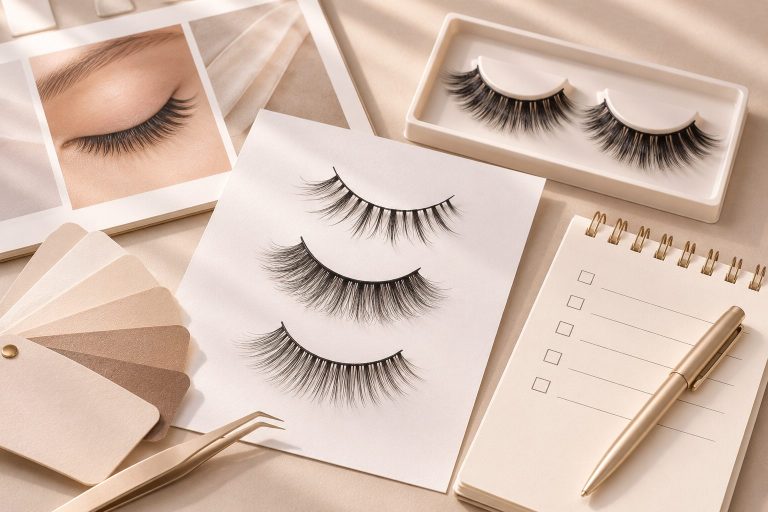

A successful original lash collection starts before the first physical sample is made. It begins with a clear understanding of the beauty brand’s identity, creative vision and intended customer experience.
A lash design brief translates those ideas into a structured development direction. It explains what the collection should express, how its visual identity should differ from existing products and what the development partner needs to understand before exploring physical designs.
For premium beauty brands, the goal is not simply to request a new eyelash style. It is to communicate a recognizable creative vision that can guide design decisions throughout the development process.
Key Takeaways
- A lash design brief should begin with brand identity and creative direction, not a list of technical specifications.
- A strong brief explains the desired aesthetic, intended audience, design references and visual boundaries.
- Mood boards communicate inspiration, but they must be accompanied by clear written instructions.
- Design decisions and technical feasibility should be evaluated separately before a final concept is approved.
- A well-structured brief creates a consistent reference for creative discussions, sample reviews and future collection development.
1. What Is a Lash Design Brief?
A lash design brief is a document that defines the creative objectives and essential development requirements of an eyelash collection.
It connects the brand’s aesthetic identity with the decisions that will eventually shape the physical product.
For a design-led project, the document should explain not only what the brand wants to create, but also why that direction matters.
For example, requesting “natural, premium eyelashes” communicates very little about the intended design.
Different brands may interpret natural beauty in completely different ways.
One may associate it with understated elegance and minimal visual contrast. Another may interpret it through softness, romantic movement and delicate definition.
A meaningful brief helps distinguish these creative interpretations.
It should establish several foundations:
- the brand’s creative identity;
- the intended audience;
- the emotional impression of the collection;
- the preferred aesthetic direction;
- the visual elements that should be avoided;
- the relationship between the new collection and existing products;
- the decisions that must be confirmed during development.
A design brief is not necessarily a final technical specification sheet.
Instead, it provides the creative framework from which more detailed product development decisions can emerge.
Brands interested in building a recognizable aesthetic can also explore our article on signature lash design and brand identity.
2. Start with the Brand’s Creative Identity
Before selecting references or discussing physical samples, the brand should define the kind of beauty it wants the collection to represent.
This step prevents the development process from becoming a series of unrelated aesthetic preferences.
Define the Brand Personality
Consider how the brand wants customers to perceive its products.
Possible creative characteristics include:
- modern and understated;
- romantic and expressive;
- confident and architectural;
- soft and sophisticated;
- editorial and experimental;
- timeless and elegant.
These descriptions should not remain empty marketing language.
Each should influence the way the collection is visually interpreted.
For example, a brand built around understated luxury may prefer a more restrained overall appearance, while an editorial beauty brand may explore stronger visual contrast and more distinctive silhouettes.
Identify the Intended Customer
A premium collection should express the brand’s identity while remaining relevant to the people it intends to serve.
The brief should describe the target customer beyond basic demographic information.
Useful questions include:
- What kind of beauty aesthetic does this customer appreciate?
- What role does eye makeup play in their personal style?
- Does the customer prefer subtle enhancement or expressive transformation?
- What makes a beauty product feel distinctive or desirable to this audience?
These questions help connect creative ambition with the intended customer experience.
Establish a Design Philosophy
The brief should summarize the central idea behind the collection in one or two clear sentences.
For example:
We want to explore a contemporary interpretation of quiet elegance, where the lashes create definition through refined proportions rather than excessive visual volume.
This is an illustrative creative statement, not a description of an existing Pingdu Lashes project.
Its purpose is to demonstrate how a broad aesthetic concept can become a more focused design direction.
3. Translate Inspiration into a Clear Visual Direction
Beauty brands frequently begin with inspiration from fashion photography, makeup editorials, artwork, cultural movements or existing beauty products.
These references are valuable, but inspiration alone is not a complete design instruction.
A mood board may contain beautiful images without explaining which specific qualities matter to the brand.
One image may be included because of its softness. Another may represent its lighting, overall mood or visual composition.
Without written interpretation, different people may understand the same references in different ways.
Separate Mood from Design Intention
For each reference, explain what the image is intended to communicate.
| Reference Type | What the Brand Should Explain |
|---|---|
| Fashion Editorial | The mood, attitude or sense of sophistication being referenced |
| Makeup Photography | The preferred visual relationship between lashes and the overall makeup |
| Existing Lash Product | Which qualities are relevant and what should be interpreted differently |
| Color Palette | The emotional direction and its connection to the collection identity |
| Brand Campaign | The visual language the new collection should complement |
This approach makes creative discussions more precise without requiring the brand to define every physical detail immediately.
Identify What Should Not Be Included
Creative direction becomes clearer when the brief also defines visual boundaries.
For example, a brand may want to avoid:
- an excessively dramatic appearance;
- visual elements that conflict with its minimalist identity;
- designs that feel too similar to its existing collection;
- an aesthetic associated too closely with another brand;
- unnecessary decorative complexity.
These exclusions help the development team evaluate new ideas without losing sight of the intended design identity.
Use References for Interpretation, Not Replication
Existing products can help communicate a visual preference, but they should not automatically become instructions to reproduce another company’s finished design.
The brief should distinguish between inspiration, familiar industry design elements and the brand’s own intended creative contribution.
For a more detailed discussion, read our guide on developing a custom lash product without simply copying another brand.
4. A Creative Brief Template for Original Lash Collections
A useful design brief does not need to be complicated.
It should contain enough information for everyone involved to understand the creative objective and identify unresolved decisions.
The following template can serve as a starting point for a design-led eyelash collection.
Original Lash Collection — Creative Brief Template
| Brief Section | Information to Provide |
|---|---|
| Project Name | Working title or internal collection name |
| Brand Identity | Brand positioning, personality and core aesthetic values |
| Creative Vision | The central idea or emotional expression behind the collection |
| Target Audience | The intended customer and their beauty preferences |
| Visual References | Mood board, imagery, existing products or relevant design inspiration |
| Desired Lash Aesthetic | The overall visual effect, silhouette and expression the brand wants to explore |
| Design Boundaries | Visual characteristics, styles or references the collection should avoid |
| Collection Relationship | How the new concept connects with or differs from existing brand products |
| Product Direction | Known product formats or structural preferences, if already decided |
| Brand Presentation | How the collection should relate to packaging, imagery and visual identity |
| Development Priorities | Which creative qualities are essential and which remain open to exploration |
| Review and Approval | Who evaluates the concept and which decisions require approval |
This template is intended for early creative development.
It does not replace the technical specification, commercial agreement or physical sample approval required for an actual production project.
Example: A Minimalist Luxury Collection
Consider a hypothetical beauty brand developing a collection based on contemporary minimalism.
Its initial brief might include:
- Creative Vision: Quiet confidence expressed through restrained eye beauty.
- Target Audience: Customers who appreciate sophisticated makeup and subtle visual definition.
- Design Identity: Clean, refined and intentionally understated.
- Visual Inspiration: Minimalist fashion editorials and natural-light beauty photography.
- Desired Expression: A delicate, balanced appearance that complements rather than dominates the eye.
- Design Boundaries: Avoid excessive volume, visually heavy effects and unnecessary complexity.
- Development Priority: Preserve a recognizable sense of proportion and refinement.
This brief does not dictate every final product detail.
Instead, it gives the creative development process a coherent direction.
A concept such as Sculpted Clear Band Half Strip Lashes can illustrate how an aesthetic idea may be explored through a more specific product direction. It should not be treated as proof of an exclusive technology or a completed proprietary design.
5. What Should Be Confirmed Before Physical Prototyping?
Once the creative brief has been prepared, the next step is to identify which decisions are ready for development and which still require exploration.
Not every idea described in a mood board can be translated directly into a physical product.
The creative concept and its technical realization should therefore be considered as related but separate questions.
Creative Alignment
First, confirm that the concept reflects the intended brand identity.
Ask whether the design direction:
- communicates the desired aesthetic;
- feels sufficiently different from existing brand products;
- is understandable to the intended audience;
- provides a coherent basis for a collection;
- has clear priorities for future design evaluation.
Practical Development Questions
Next, identify which parts of the proposed design require physical exploration.
These may include the intended visual silhouette, the relationship between different design elements, the suitability of a proposed product format and the consistency of the overall appearance.
At this stage, avoid presenting an untested creative idea as an established production capability.
A development partner should distinguish between:
- concepts that can be discussed through visual references;
- features that require prototype development;
- characteristics that must be evaluated through physical samples;
- requirements that need additional feasibility confirmation.
Define Approval Criteria Before Reviewing Samples
One of the most useful purposes of a brief is to establish how the final design will be evaluated.
Without agreed criteria, feedback may become subjective and inconsistent.
For example, a reviewer may describe a prototype as “not premium enough” without explaining which visual qualities need improvement.
A more useful review identifies whether the design is too visually heavy, whether the silhouette feels inconsistent or whether the overall aesthetic conflicts with the original concept.
The following review matrix can help:
| Review Question | Approval Focus |
|---|---|
| Does it express the creative vision? | Alignment with the original brand concept |
| Is the visual identity recognizable? | Consistency and meaningful differentiation |
| Does the design suit the intended audience? | Relevance to the expected beauty experience |
| Are the key design qualities preserved? | Alignment with the agreed creative priorities |
| What remains unresolved? | Specific adjustments or additional evaluations required |
The objective is to make creative feedback actionable rather than relying only on broad personal impressions.
6. How Should a Beauty Brand Work with a Lash Development Partner?
A productive design collaboration begins with a shared understanding of the creative objective.
The brand should communicate what it wants the collection to represent, while the development partner helps clarify how that direction can be explored and evaluated.
This relationship differs from simply selecting a finished product from a catalog.
It gives greater importance to interpreting ideas, discussing design alternatives and identifying the steps required before a concept can become a finished product.
Separate Creative Decisions from Commercial Decisions
Both are important, but they answer different questions.
Creative decisions concern the visual identity, aesthetic priorities and intended customer experience.
Commercial and production decisions concern whether the agreed concept can be developed, confirmed and supplied under suitable conditions.
Mixing these discussions too early can weaken the creative direction.
Ignoring practical development requirements can create unrealistic expectations.
A structured brief allows both perspectives to be considered without confusing them.
Keep a Clear Record of Design Decisions
When a concept changes during development, the reason for each important decision should remain understandable.
Brands can maintain a simple record of:
- the original creative objective;
- the design alternatives considered;
- the feedback received;
- the changes requested;
- the decisions approved;
- the questions still awaiting confirmation.
This record can also support future collection development by preserving the reasoning behind the brand’s design choices.
Pingdu Lashes: Moving Toward Design-Led Collaboration
Pingdu Lashes is placing increasing emphasis on design thinking, creative direction and the development of more distinctive eyelash collections.
Our intention is to help beauty brands begin conversations around their aesthetic identity and product vision, rather than treating product selection as the only starting point.
A creative brief can provide a useful foundation for those discussions.
Brands can share their inspiration, preferred aesthetic, visual references and development objectives for an initial project review.
Specific development methods, available deliverables and project arrangements should be confirmed according to the actual requirements and capabilities involved.
To explore a design-led eyelash project, visit our custom lash development services and share your creative direction.
Frequently Asked Questions
Do I need technical specifications before writing a lash design brief?
No. An early creative brief can begin with brand identity, visual references and intended aesthetic direction. Technical requirements can be clarified as the development concept becomes more defined.
Can a mood board replace a written creative brief?
Not entirely. A mood board communicates visual inspiration, but written explanations are needed to clarify which qualities matter and what the brand wants to achieve.
How can a brand use existing products as references without copying them?
Identify the characteristics that inspire the design, explain why they are relevant and describe how the new concept should express the brand’s own identity. Any exclusivity or intellectual property questions should be reviewed separately with appropriate advisers.
Should packaging be included in the lash design brief?
Yes, at the conceptual level. Packaging should reflect the same visual identity as the product. Detailed artwork, materials and production requirements can be addressed during later development stages.
When is a creative brief ready for prototype development?
It is ready for an initial feasibility discussion when the creative objective, intended audience, design priorities and approval expectations are sufficiently clear. The development partner must still confirm what can be explored through physical samples.
Final Thoughts
Original lash development should not begin with the assumption that a brand simply needs more products.
It should begin with a meaningful creative idea.
A well-written lash design brief connects that idea to the brand’s identity, defines the visual direction and establishes a foundation for informed development decisions.
For premium beauty brands, the value of a creative brief is not its length or complexity.
Its value lies in helping everyone involved understand what the collection is intended to become.
Great lash design begins with a clear creative vision. A thoughtful brief is how that vision starts becoming a development project.
Have an original lash collection in mind? Share your brand direction, mood board and creative brief with Pingdu Lashes through our custom development page to begin a project discussion.