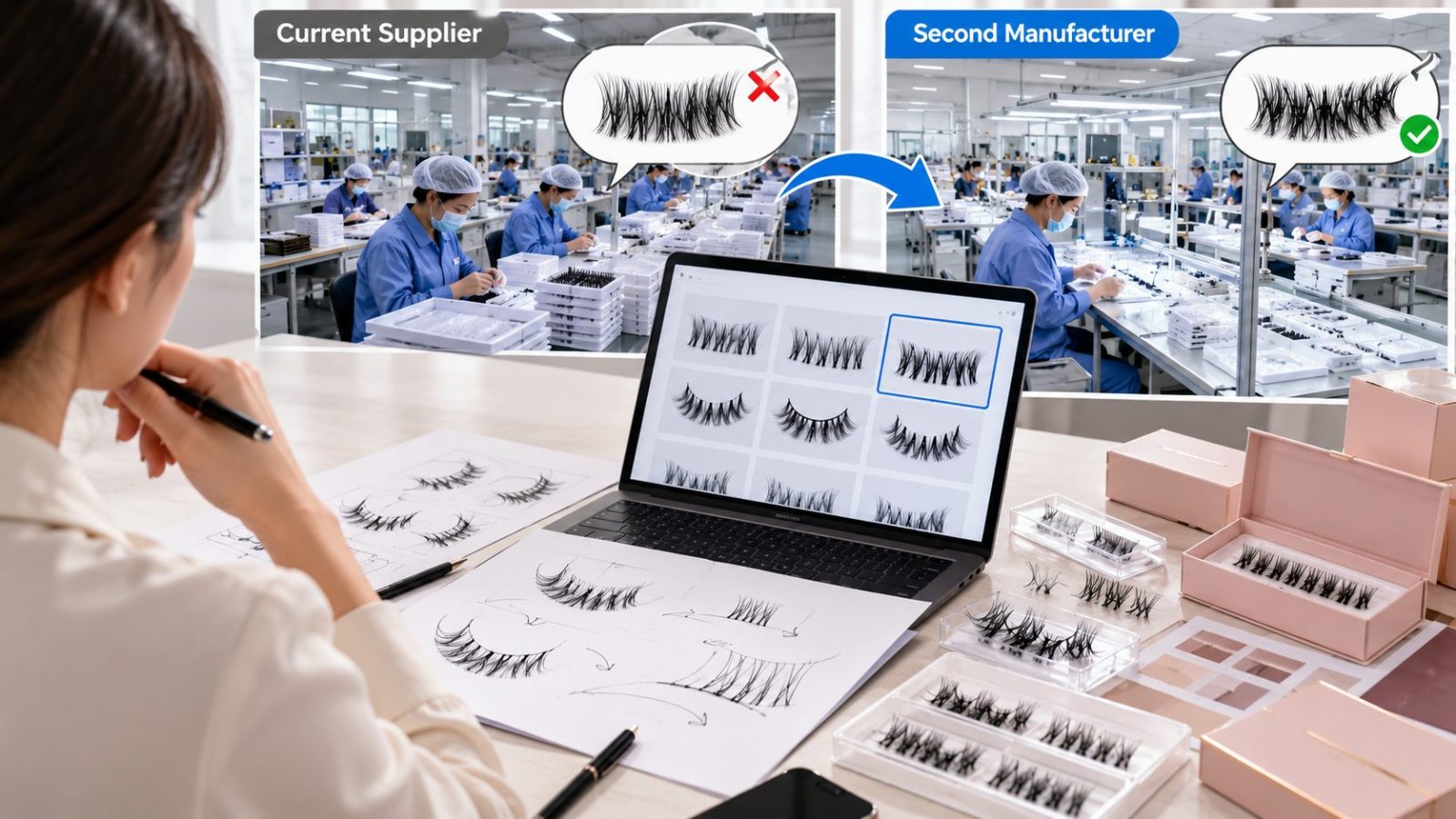
If your current lash supplier works well for most of your products but cannot make one new style you want to launch, you do not necessarily need to replace the entire supplier.
You can evaluate a second lash manufacturer for only that specific product.
For an established beauty brand, this can be a practical way to develop a new SKU without moving the rest of the existing collection immediately.
The important part is to make the new product clear from the beginning: what you want to create, what it should look like, how it should fit into your current collection, and what needs to be confirmed through samples.
Do I Have to Move My Whole Lash Collection to a New Manufacturer?
No.
If your current supplier is still suitable for your existing products, there may be no reason to move the entire collection just because they cannot support one new style.
You can keep your existing products with the current supplier and use another manufacturer for:
- one new lash style
- one new product category
- one experimental SKU
- one product your current supplier cannot develop
- one product you want to test before expanding further
This allows you to solve a specific product problem without making a large supply-chain change at the same time.
When Does Using a Second Lash Manufacturer Make Sense?
A second manufacturer may be useful when your current supplier cannot support the product direction you want.
For example:
- you found a new lash style you want to add to your collection
- you have a reference photo but your current supplier cannot make something similar
- you want to add a different lash category
- your current supplier has limited product development options
- you want to test a new product without changing your current best sellers
- you need a supplier with experience in a different type of lash product
The key question is not whether one manufacturer should make every product in your brand.
The more useful question is whether each supplier can reliably support the specific products you need.
What Should I Send to the Second Manufacturer?
You do not need to prepare a complicated sourcing document before starting the conversation.
For a new product, you can begin by sending:
- a reference photo
- a competitor or inspiration product
- photos of your current lash collection
- the style you want to develop
- the approximate quantity you are considering
- the number of new SKUs you want to test
- your logo or packaging direction if relevant
- the market where you plan to sell the product
If you already have a physical reference product, you can also send it to the new manufacturer for evaluation.
Read more about developing a lash product from a reference sample or photo.
What If I Only Have a Photo of the New Lash Style?
That is enough to start the discussion.
A photo can help communicate the visual direction of the product, including:
- overall lash shape
- density direction
- wispy or spiky texture
- mapping direction
- natural or dramatic appearance
- general product presentation
However, a photo cannot confirm every technical detail.
The final product structure, material direction, curl, length balance, base or band construction and overall feel should be confirmed through physical samples.
Can a Second Manufacturer Make the Product Exactly Like My Reference?
A reference product or photo can be used to communicate the target direction, but it is better not to assume that two manufacturers will produce a completely identical result.
Different manufacturers may use different materials, processes, components and production methods.
The practical process is:
- show the reference
- explain which features are important
- develop or select a sample
- compare the sample with your target product
- give specific feedback
- confirm the final direction before ordering
If one detail is particularly important, tell the manufacturer clearly.
For example:
- the texture must stay soft
- the lash should look more natural
- the spikes should be more defined
- the density should be lighter
- the lash mapping should be closer to the reference
- the tray presentation should fit your current brand
Should the New Product Look Similar to My Existing Collection?
Usually, yes.
Even if the new product is made by a second manufacturer, customers should still feel that it belongs to the same brand.
You may want to keep certain elements consistent, such as:
- overall quality level
- brand positioning
- visual style
- packaging direction
- product naming
- tray presentation
When contacting the second manufacturer, it can be useful to show several products from your existing collection.
This helps the manufacturer understand the type of customer your brand serves and how the new product should fit into the wider product line.
Can I Use the Same Logo and Brand with a Second Manufacturer?
Yes.
Using a second manufacturer does not mean creating a second brand.
The new product can still use your existing:
- brand name
- logo
- brand colors
- product naming system
- SKU structure
- packaging style
The important point is to confirm that the new product and tray are compatible with the packaging structure you want to use.
Can the Second Manufacturer Use My Existing Packaging?
Possibly, but this should be checked before making assumptions.
If you already have custom packaging, the new manufacturer should review details such as:
- box dimensions
- tray dimensions
- product fit
- insert structure
- label position
- artwork layout
If the new product uses a different tray or product structure, the existing packaging may need adjustment.
It is better to confirm the product and tray before finalizing packaging production.
For more information, see Can I Use My Own Packaging Design for Private Label Lashes?
Do I Need to Tell My Current Supplier That I Am Testing Another Manufacturer?
That is a commercial decision for your business.
From a product-development perspective, the second manufacturer does not need confidential information about your current supplier.
They mainly need to understand:
- the new product you want
- your target quality direction
- your branding requirements
- your estimated quantity
- what must match the rest of your collection
You do not need to provide your current supplier’s name unless you have a specific reason to do so.
Should I Start with One New Product?
For many brands, starting with one product is a practical way to evaluate a new manufacturer.
Instead of moving several products at once, you can select one new SKU and evaluate:
- communication speed
- understanding of the reference
- sample quality
- attention to feedback
- packaging coordination
- overall project management
If the first product works well, you can decide later whether the second manufacturer should support more products.
You do not need to make that decision before the first sample is tested.
What Should I Compare During Sample Testing?
When the new manufacturer’s samples arrive, evaluate the product based on the requirements that matter to your brand.
Depending on the product, this may include:
- overall appearance
- style
- density
- texture
- softness
- curl direction
- length balance
- band or base structure
- tray presentation
- consistency between samples
Do not only ask whether the sample is “good”.
Compare it against the product direction you originally requested.
Our guide on how to compare lash samples from different suppliers explains this process in more detail.
What If the First Sample Is Not Exactly Right?
That does not automatically mean the manufacturer cannot support the product.
The first sample is also a way to understand whether the manufacturer can respond to feedback.
Instead of saying only “I don’t like it,” explain the specific difference.
For example:
- the lash is too dense
- the outer section is too long
- the texture is not wispy enough
- the spikes are too strong
- the overall look is too dramatic
- the tray presentation does not match the brand
Specific feedback helps the manufacturer understand what needs to change.
Can I Keep My Best Sellers with My Existing Supplier?
Yes.
If your current supplier continues to perform well for your existing best sellers, you can keep those products where they are while testing the new product elsewhere.
This is different from a complete supplier replacement.
Your supply structure could look like this:
- Supplier A: existing core products
- Supplier B: new product or new product category
Over time, you can decide whether this arrangement works well for your business.
Is Having Two Lash Suppliers a Problem?
Not necessarily.
Some brands use more than one supplier because different manufacturers may have different strengths.
However, managing multiple suppliers requires clear product standards and organized communication.
You should keep records of:
- approved samples
- product specifications
- packaging artwork
- SKU information
- quality expectations
- supplier responsibilities
This reduces confusion when more than one manufacturer is involved.
Read more: Should Your Lash Brand Have a Second Supplier?
What If the Second Manufacturer Performs Better Than My Current Supplier?
You do not need to decide immediately whether to move more products.
First evaluate the new product.
If the second manufacturer performs well over time, you can later decide whether to:
- keep them for only the new product
- develop additional new styles with them
- use them as a backup supplier
- test one existing SKU with them
- gradually move more products if appropriate
The decision can be made step by step rather than all at once.
What Should I Send If I Want Pingdu Lashes to Evaluate a New Style?
If your current supplier cannot make the new lash style you want, you can start by sending us:
- the reference photo or product
- photos of your existing lash collection
- the specific look you want to develop
- the estimated quantity
- the number of new styles or SKUs
- your logo or packaging direction if relevant
- the country or market where you plan to sell it
If you do not know the exact technical specifications yet, that is not a problem.
The reference product and your target look can be used to start the discussion.
You Do Not Have to Replace a Good Supplier Just to Develop One New Product
If your current supplier works well for your existing collection but cannot support one new product, the decision does not have to be “stay with them” or “replace them completely.”
You can test a second manufacturer for one specific product first.
This gives you a way to explore a new lash style while keeping the rest of your supply chain stable.
The next step is simple:
Send the product photo, reference sample or new style you want to develop, together with your estimated quantity and brand requirements.
Pingdu Lashes can review the product direction and discuss suitable sample options before you decide whether the new manufacturer is right for the project.
Visit our Custom Lash Services page to discuss your new lash product.
Frequently Asked Questions
Can I use two different manufacturers for my lash brand?
Yes. A brand can keep existing products with one supplier while using another manufacturer for a new product or category. The important part is maintaining clear product standards and brand consistency.
Do I need to move all my lashes to the new manufacturer?
No. You can test the new manufacturer with one product first and decide later whether to expand the relationship.
What should I send if my current supplier cannot make a new lash style?
Send a reference photo or physical product, photos of your existing collection, your estimated quantity, the number of styles you want to develop and any branding or packaging requirements.
Can a second manufacturer match the style of my existing collection?
A manufacturer can review your existing products and develop a new product in a compatible visual direction. The final result should be confirmed through physical samples.
Can I keep using my current supplier for my best-selling products?
Yes. If the current supplier performs well for those products, you can keep them there while testing a second manufacturer for the new SKU.



