
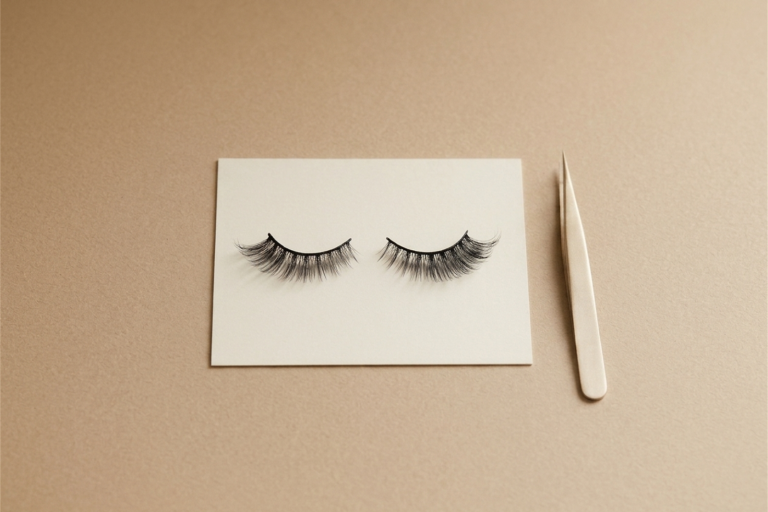

Mixing curl profiles within a single lash design allows beauty brands to separate inner-corner comfort from outer-corner lift. Instead of forcing one uniform curvature across the entire eye, a dual-curl or graduated-curl architecture pairs a lower-lift base or inner zone with a steeper mid-to-outer elevation, improving side-view dimension and reducing inner-corner band lift during wear.
Key Takeaways for Lash Product Teams
- Single-curl designs force a trade-off: High curls maximize side-view lift but can poke or lift at the inner corner; low curls blend easily but look flat in profile.
- Zone-based curl mixing solves two distinct problems: Lower curl at the inner third improves natural lash integration, while steeper curl at the outer third delivers open-eye framing.
- Curl and band stiffness interact: A sculpted curl on an overly rigid band feels heavy, making band structure selection essential during prototyping.
- Tolerance control matters more than label names: Letters like C, CC, or D vary by supplier—brands must approve physical curl-rod prototypes rather than relying on catalog letters alone.
Why Uniform Curl Profiles Often Underperform in Wear Tests
Most off-the-shelf strip lashes and cluster trays are heat-set on a single uniform rod. On a flat tray, a uniform CC or D curl looks dramatic and consistent. On a real eyelid, however, human lashes rarely grow at one uniform angle from inner canthus to outer wing.
Near the inner corner, natural lashes tend to be shorter and grow forward or slightly downward. Placing a steep curl directly over that zone often creates a visible gap between the false band and the natural lash line, or causes the inner tip to brush against the upper lid. Conversely, choosing a gentle B or J curl for comfort often leaves the outer wing looking droopy from a 45-degree side angle.
Three Ways Brands Architect Mixed-Curl Lashes
When developing custom silhouettes, product teams typically use one of three structural approaches to combine curl behaviors:
- Horizontal Zone Transition (Inner-to-Outer): A softer curl across the inner 30% of the band transitions into a lifted curl across the center and outer wing. This is well suited for almond, hooded, or close-set eye shapes.
- Dual-Layer Elevation (Base + Top Layer): A lower-curl foundational layer hugs and supports the natural lash line, while a steeper upper fiber layer creates airy shadow and side-profile lift.
- Cluster-by-Cluster Mapping: In DIY cluster assortments, pairing flatter inner-corner segments with higher-lift outer segments gives wearers modular control without requiring a single extreme curl across the whole eye.
Comparing Single-Curl vs. Mixed-Curl Architecture
| Evaluation Criterion | Single Uniform Curl | Mixed-Curl Architecture |
|---|---|---|
| Inner-Corner Blending | Can lift or feel stiff if curl is steep | Lower inner curl sits closer to natural lashes |
| 45-Degree Side-View Lift | Flat on low curls; abrupt on high curls | Graduated elevation creates sculpted profile |
| Hooded-Lid Clearance | Uniform arc may touch upper crease | Tailored apex avoids excessive lid contact |
| Prototyping Complexity | Standard single-rod heat setting | Requires transition verification and symmetry checks |
| Brand Differentiation | Easily replicated across generic catalogs | Supports recognizable signature lash silhouettes |
How Curl Geometry Interacts with Fiber Tips and Band Structure
Curl architecture cannot be evaluated in isolation. A steeper outer curl exposes more of the fiber shaft from the side, which means fiber tip taper and surface finish become much more noticeable in daylight and photography. Blunt or overly glossy fibers appear harsher when lifted into a strong C or D curve.
Similarly, the band acts as the structural anchor for the curl. If a band twists or resists curving around the eyelid, even a well-mapped dual-curl design will tilt downward at the outer corner. Testing curl geometry alongside band flexibility prevents late-stage redesigns.
Prototyping Checklist: Confirming Curl Consistency Before Bulk
Before approving a mixed-curl concept under your prototyping readiness process, verify these physical checkpoints on blank spec cards:
- 45-Degree Profile Comparison: Photograph left and right prototypes from a side angle against a matte neutral card to check whether the transition zone flows smoothly without a sudden step.
- Tray-Removal Recovery: Peel the lash gently from its tray three times to confirm the curl apex does not relax unevenly.
- Wear-Test Symmetry: Evaluate both eyes in natural window light to ensure the outer-wing lift matches without pulling at the inner corner.
Frequently Asked Questions
Does mixed-curl architecture require a completely different fiber material?
Not necessarily. Mixed-curl designs are primarily achieved through how fibers are layered, angled, and heat-set during assembly, though fiber diameter and stiffness still influence how cleanly a curl holds its shape.
Are lettered curl labels like C or D standardized across factories?
No. Curl angles vary between suppliers and production tooling. Always lock physical master samples and measure profile height rather than relying solely on letter labels in a spec sheet.
Which lash categories benefit most from mixed-curl design?
Strip lashes and modular cluster systems benefit immediately because they span multiple zones of the eye, while lash extension lines can achieve similar results through mapped multi-curl trays.
Develop Your Custom Curl Architecture
Planning a signature strip or cluster collection with tailored side-view lift? Share your target eye-shape focus and reference silhouettes with our development team to start a custom prototyping brief.