
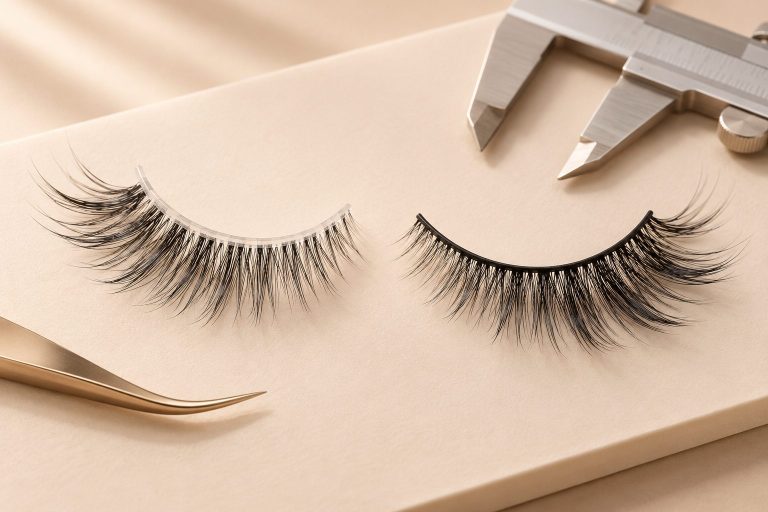

When developing a custom strip lash, beauty brands often begin with the visible design: length, curl, density, layering and overall silhouette. Yet one of the most important structural decisions sits at the base of the product: the lash band.
The lash band holds the fibers in their intended arrangement and forms the interface between the strip lash and the application area. Its appearance, dimensions, construction and response to bending all deserve attention during product development.
Choosing a transparent or black band is only the beginning. Two bands that look similar in a photograph may differ in construction, flexibility, edge finishing and how they support the proposed lash silhouette.
For beauty brands planning an original collection, the important question is not simply, “Which lash band is better?” It is: “Which band structure supports the intended design, and how can we verify that it meets our requirements?”
This guide examines the practical decisions involved in lash band development, from initial design requirements and physical samples to technical specifications, revision priorities and final approval.
Key Takeaways
- Lash band color, material, dimensions and flexibility are separate characteristics that should not be confused.
- A thinner-looking band is not automatically more flexible or better suited to every lash design.
- Band structure should be evaluated together with fiber density, silhouette, attachment and intended application.
- Physical prototypes are necessary to investigate fit, visual appearance, handling and consistency.
- Approved reference samples and written specifications provide a stronger basis for subsequent development and repeat orders.
1. Why Lash Band Development Matters
A strip lash is a complete product composed of interacting elements. The band cannot be evaluated independently of the fibers it supports.
Consider a hypothetical design with a pronounced outer-corner silhouette and several visible fiber layers.
The creative team may focus on the arrangement of the fibers, but the band must also be considered. Its dimensions, shape and construction may influence how the complete design behaves during handling and application.
Another concept may prioritize a very subtle lash-line appearance. In that case, the brand may wish to explore a less visible band. However, the required visual effect still needs to be evaluated against the structure of the proposed product.
These situations illustrate a central development principle:
The lash band should be specified as part of the complete design, not selected as an unrelated accessory after the silhouette has been approved.
2. Separate Band Appearance from Band Construction
One of the most common problems in custom product discussions is using a visual description as though it were a complete technical specification.
For example, a brand might request:
“We want a thin, invisible, comfortable lash band.”
That statement communicates an aesthetic preference, but it leaves several important questions unresolved.
What does “thin” refer to: visible width, physical thickness or both?
Does “invisible” mean transparent, low-contrast or simply less noticeable after application?
What construction is being considered?
And how will the team evaluate whether the band is suitable for the intended use?
A development-ready request should separate the relevant characteristics.
| Characteristic | What It Describes | What the Brand Should Confirm |
|---|---|---|
| Color and opacity | How visible the band appears | Transparent, translucent, black or another approved appearance |
| Material and construction | What the band is made from and how it is formed | Supplier-declared composition and construction details |
| Visible width | The extent of the band seen along the lash line | Approved visual reference or measurable requirement |
| Physical thickness | The dimension through the band structure | Measurement method and approved sample reference |
| Flexibility | How the band responds when bent | Handling and application evaluation criteria |
| Shape and curvature | The geometry of the complete band | Approved shape and left-right requirements |
| Fiber attachment | How fibers are supported along the band | Arrangement, visible finish and attachment integrity |
| Edge finishing | Condition of the inner and outer band ends | Acceptable appearance and handling characteristics |
The table provides a recommended development checklist. It does not establish universal technical tolerances or imply that Pingdu Lashes has already validated a particular proprietary band construction.
3. Clear, Black and Thread-Based Bands: What Should Be Compared?
Strip lashes are commonly marketed using descriptions such as clear band, black band or cotton-thread band.
These terms can be useful when discussing visual direction, but they are not interchangeable technical specifications.
Transparent or Less-Visible Band Directions
A clear or translucent band may be considered when a brand wants the lash fibers to remain the main visible element of the design.
Potential applications include natural-looking, minimalist or other understated makeup concepts.
However, transparency alone does not establish the band’s dimensions, material, flexibility, surface characteristics or durability.
A transparent band may still differ significantly from another transparent band in its physical construction.
Black Band Directions
A dark-colored band may contribute visible definition along the lash line.
Brands developing defined or more expressive styles may consider this appearance as part of the overall design.
However, black color does not prove that a band uses cotton thread, nor does it establish a particular degree of flexibility or thickness.
The visual description and actual construction should be confirmed separately.
Thread-Based Band Directions
Some strip lash products use thread-based constructions, including products described commercially as cotton-thread bands.
When evaluating such an option, the development team should confirm the stated material, the resulting structure and its suitability for the proposed fiber arrangement.
The words “cotton band” should not be treated as a universal guarantee of softness, flexibility or application comfort.
Those characteristics depend on the specific product and require physical evaluation.
For a buyer-focused explanation of the visual differences, see our existing article on clear band versus black band strip lashes.
The present guide takes the next step: translating the preferred appearance into development requirements.
4. Band Width and Thickness Are Not the Same Thing
Band width and physical thickness are two distinct design considerations.
The visible width can affect how prominent the base appears along the lash line.
Physical thickness is one of the characteristics that can influence how the band responds to handling and bending.
But these effects cannot be predicted reliably from a product photograph alone.
Nor should a brand assume that the thinnest possible option will always be the most suitable.
When the Band Appears Too Prominent
If an early sample looks visually heavier than intended, the team should identify the specific cause before requesting a revision.
Possible issues to investigate include:
- Visible width greater than the approved design reference.
- Band color or opacity that contrasts with the intended makeup look.
- Fiber attachment details that increase the apparent width of the base.
- A mismatch between the band appearance and the overall lash silhouette.
The corrective action should follow the observed cause rather than a vague request to “make everything thinner.”
When the Band Does Not Support the Intended Design
For a more elaborate fiber arrangement, developers may need to examine whether the proposed band construction can support the agreed design consistently.
Relevant questions include the distribution of fibers, attachment integrity, handling behavior and consistency between samples.
The goal is to find a workable relationship between the band and the entire lash composition.
There is no universal band width or thickness that is automatically optimal for all strip lash styles.
Any numerical dimensions and tolerances must be established from the specific project requirements and validated samples.
5. Flexibility, Curvature and Shape Recovery
Flexibility is an important development consideration, but the word alone is too vague for a complete specification.
Different bands may respond differently when bent, held in a curved position or released.
For development purposes, the team may investigate:
- How the strip responds to gentle bending during normal handling.
- Whether the band can be positioned as intended during application evaluation.
- How the band behaves after being released from a curved position.
- Whether the left and right samples show comparable responses when they are intended to match.
- Whether the complete lash silhouette changes noticeably during handling.
These checks should be carried out using agreed methods and conditions.
Without a defined test procedure, a statement such as “very flexible” is a subjective description rather than a verified performance result.
Why the Overall Curve Matters
A strip lash band is not simply a straight line.
Its intended geometry should be considered together with the selected lash format and the way the product is expected to be applied.
Brands should also distinguish the original shape of the band from changes made during fitting or trimming.
For example, a full strip and a shorter accent strip may require different development considerations because their overall geometries and intended applications differ.
Any claims concerning fit, comfort or ease of use require appropriate evaluation with actual samples.
6. How the Band and Fiber Arrangement Affect Each Other
The lash fibers and the band form one assembled structure.
Changing one element may alter the requirements for the other.
Before confirming a band construction, consider the proposed fiber design.
Density Distribution
If fiber density varies across the lash line, the development team should examine whether attachment remains consistent throughout the intended composition.
Areas with concentrated fibers may require particular attention during prototype evaluation.
Layered Silhouettes
Layering introduces another relationship between the visible lash design and its supporting structure.
The team should assess whether the intended layers can be arranged as specified without producing unwanted visual irregularities at the base.
Directional and Editorial Designs
For designs with pronounced focal areas, the band should be reviewed together with the overall direction of the silhouette.
If a brand explores intentional asymmetry between left and right lashes, it is especially important to distinguish approved design differences from unplanned construction variation.
Our Asymmetric Editorial Strip Lashes concept provides an example of a creative direction where the relationship between the two sides would need careful physical validation.
It remains a concept rather than evidence of a completed physical construction.
7. The Importance of Fiber Attachment and Band Ends
Band development should not focus only on the central section of the strip.
The fiber attachment points and the inner and outer ends are also relevant to sample evaluation.
During inspection, a brand may ask whether:
- Fibers are positioned according to the approved arrangement.
- The attachment area has a consistent visible finish.
- Unintended gaps or irregularities appear along the base.
- The inner and outer ends match the agreed design requirements.
- The ends have visible defects or handling characteristics requiring correction.
- Both members of the lash pair meet their approved specifications.
Particular attention should be paid to the distinction between a deliberate creative feature and a defect.
A spacing pattern included in the approved design should not be rejected simply because it is unconventional.
Conversely, an unexpected attachment gap should not be excused as an original design element when it was not part of the approved reference.
8. A Practical Lash Band Prototype Evaluation Plan
When developing a new band structure, brands should compare physical samples against predefined questions rather than relying on an overall impression.
The following framework can be adapted to an individual project.
| Evaluation Area | What to Examine | Suggested Record |
|---|---|---|
| Visual appearance | Color, opacity, visible width and surface finish | Photographs and approved visual references |
| Dimensions | Band length, width, thickness and overall geometry where relevant | Recorded measurements using an agreed method |
| Bending response | Handling, flexibility and behavior after bending | Observations under defined conditions |
| Fiber attachment | Arrangement, visible irregularities and attachment integrity | Close-up inspection notes |
| Band ends | Inner and outer end condition | Photographs and defect observations |
| Application assessment | Fit, appearance and handling in the intended use context | Documented assessment using actual samples |
| Pair consistency | Matching requirements or approved intentional differences | Side-by-side comparison records |
| Packaging interaction | Position in the tray and condition after handling or removal | Tray and packaging review notes |
This table is a suggested product development method, not a claim that every listed test has already been completed by Pingdu Lashes.
Specific test methods, sample quantities, acceptance criteria and responsibilities should be agreed for the actual project.
Compare Samples Under Consistent Conditions
A useful comparison should minimize avoidable differences in how samples are examined.
Where practical, use consistent lighting, comparable viewing angles and the same approved design references.
Do not compare a flat product image with an on-eye image as though they represent identical evaluation conditions.
Record which sample version was reviewed and which characteristics were accepted or rejected.
A clear record helps the development team understand whether a revision addressed the intended problem.
9. How to Write an Actionable Band Development Brief
Instead of sending only a photograph and asking for a comfortable clear band, a brand can prepare a more structured request.
A useful brief identifies the desired result and distinguishes confirmed requirements from characteristics still under evaluation.
| Brief Section | Information to Provide |
|---|---|
| Product concept | Target consumer, lash format and aesthetic direction |
| Band appearance | Preferred color, opacity and visual prominence |
| Construction preference | Known material requirements or options requiring supplier confirmation |
| Geometry | Target shape, band length and relevant dimensional requirements |
| Fiber design | Intended silhouette, density, layering and attachment distribution |
| Handling objectives | Specific questions concerning bending, application and shape response |
| End finishing | Required appearance and inspection concerns |
| Evaluation method | How prototype versions will be compared and reviewed |
| Pending decisions | Items that require feasibility assessment or sample confirmation |
Not all fields need final numerical values at the concept stage.
However, any requirement that is still uncertain should be identified as pending rather than described as an approved specification.
10. What If the First Lash Band Prototype Is Not Right?
A prototype that does not match expectations can still provide useful development information.
The first step is to describe the mismatch precisely.
For example, the feedback “the band feels wrong” does not identify what needs to change.
More useful observations include:
- The band looks more visible than the approved visual reference.
- The sample does not follow the intended curvature during evaluation.
- The inner end requires closer inspection for the specified application.
- The fiber attachment appears different from the approved arrangement.
- Two sample pairs show an unplanned difference in band shape.
These observations do not establish the technical cause by themselves.
They provide questions that the development team can investigate before deciding which change is appropriate.
Avoid Changing Several Unrelated Variables at Once
If a prototype has more than one concern, a revision plan should identify the priority of each issue.
Changing material, geometry, attachment and fiber density simultaneously may make it difficult to determine which adjustment produced a different result.
Where feasible, use controlled comparisons and document the differences between versions.
An illustrative revision record might include:
- Version A: Initial band and fiber design for evaluation.
- Version B: Revision addressing one agreed band characteristic.
- Version C: Further adjustment based on documented feedback.
These version names are hypothetical examples, not real Pingdu Lashes development records.
11. Approval Is More Than Choosing the Best-Looking Sample
A visually attractive prototype should not be treated as a complete approval unless the project’s other requirements have also been reviewed.
The buyer and development partner should establish what constitutes an acceptable sample.
Depending on the product, this may involve:
- Approved band appearance and geometry.
- Confirmed materials and construction.
- Agreed fiber arrangement and attachment requirements.
- Acceptable handling and application observations.
- Documented left-right consistency or intentional asymmetry.
- Confirmed packaging and tray compatibility.
- Approved reference samples and specification version.
Acceptance limits and inspection methods should be agreed rather than assumed.
For a broader view of product approval, see our article on what beauty brands should confirm before approving lash samples for bulk production.
12. Eye-Area Safety and Material Verification
Because false eyelashes are used close to the eyes, safety considerations should be part of product development.
In the United States, the FDA considers false eyelashes and their adhesives cosmetic products subject to applicable cosmetic safety and labeling requirements.
Material descriptions and marketing terms such as “soft,” “gentle” or “comfortable” are not substitutes for suitable product assessment.
Brands should review relevant materials, intended use, adhesive arrangements and applicable market requirements before making safety or performance claims.
The proposed band should also be considered together with the adhesive system intended for the product, where relevant. Compatibility must be assessed for the actual combination rather than presumed from band appearance.
For general regulatory guidance, consult the FDA’s eye cosmetic safety information.
No universal medical, irritation-free or hypoallergenic claim should be inferred from a particular lash band color or construction.
Frequently Asked Questions
Is a clear lash band always thinner than a black band?
No. Color and physical dimensions are separate specifications. A clear band and a black band may use different structures, widths and thicknesses. Actual samples should be measured and compared.
Does a cotton-thread lash band guarantee flexibility?
No. The stated material does not establish the complete handling performance of a band. Construction, dimensions and the finished product should be assessed together.
What information should a beauty brand send before developing a custom lash band?
A useful starting package includes the intended lash silhouette, band appearance, design references, construction preferences, target geometry and the questions that a physical prototype needs to answer.
Can the same band structure be used for natural and dramatic strip lashes?
Possibly, but the decision should depend on the complete product design and confirmed sample performance. Different fiber arrangements may create different structural requirements.
Should band width and thickness be included in the product specification?
Where relevant, yes. The brand and development partner should agree on measurements, methods and acceptable variation based on approved samples. Universal numerical values should not be assumed.
Can a supplier develop a custom band from a reference sample?
A reference sample can help communicate the desired appearance and handling characteristics. Whether a requested structure can be developed must be assessed according to materials, construction options and feasibility.
When is a lash band ready for bulk production?
Only after the relevant design, structural, material, application and consistency requirements have been reviewed and the necessary approval and commercial conditions have been confirmed.
Discuss Custom Lash Band Development with Pingdu Lashes
A strong custom strip lash design should consider the relationship between its visible silhouette and supporting band structure from the beginning.
For premium beauty brands, the purpose of lash band development is not to select the most fashionable material description or the least visible base at any cost.
It is to define a structure that supports the intended design and can be evaluated against clear development requirements.
Pingdu Lashes welcomes design-led discussions with beauty brands exploring original strip lash products and private label development.
Share your sketches, reference samples, preferred band appearance and development questions to begin a project-specific feasibility discussion.
Actual customization options, sample availability, technical specifications, MOQ, costs and lead times must be confirmed for each project.