
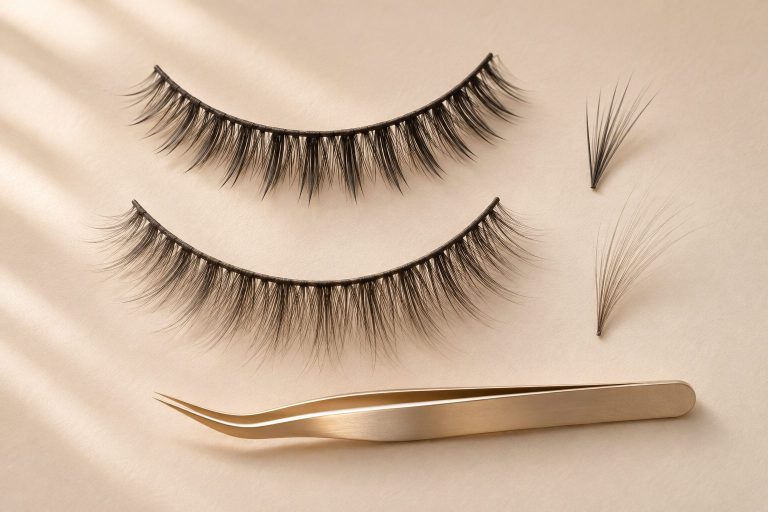

When developing a premium false eyelash collection, beauty brands often begin with length, curl, density and color. However, one of the smallest details in a lash design can also influence its overall visual character: the shape of each individual fiber tip.
Two lash designs may have the same nominal fiber diameter, length and curl, yet create noticeably different impressions because their fibers become narrower at different points along their length.
Lash fiber tip design deserves consideration as an independent variable in false eyelash development. It offers beauty brands another way to explore visual softness, definition, texture and differentiation without relying exclusively on changes in length or density.
What Is a Tapered Lash Fiber?
A tapered lash fiber is a strand that gradually becomes narrower toward its free end. Instead of maintaining the same cross-sectional dimensions throughout its entire length, the fiber transitions toward a finer tip.
The taper is not simply the final point of the fiber. Its starting position, transition profile and terminal shape can all contribute to the way the fiber appears within a finished lash design.
For product development purposes, a fiber tip profile can be described through several independent characteristics:
- Nominal fiber diameter or cross-sectional dimensions.
- The position where the fiber begins to narrow.
- The length of the tapered section.
- The gradual or concentrated nature of the transition.
- The final shape and dimensions of the tip.
- Consistency between individual fibers.
These characteristics should be considered alongside curl, material, surface finish and fiber arrangement when defining a new lash specification.
Short Taper vs. Long Taper Lash Fibers
A relatively short taper preserves more of the fiber’s original thickness before narrowing near the tip. A longer taper introduces the narrowing transition earlier along the strand.
When other design variables are comparable, these two approaches may produce different distributions of visual weight.
| Design Characteristic | Shorter Taper | Longer Taper |
|---|---|---|
| Thickness Distribution | More of the strand retains its original thickness | The fiber begins narrowing earlier |
| Visual Impression | Potentially more defined | Potentially more delicate |
| Upper Fiber Appearance | More visible individual strands | Finer visual transitions toward the ends |
| Design Applications | Defined, graphic and sculptural looks | Feathered, natural and softly textured looks |
| Development Priority | Control of definition and tip consistency | Control of taper progression and uniformity |
Neither taper profile is inherently superior. The appropriate choice depends on the intended aesthetic, fiber construction and complete lash architecture.
There is also no universal taper-length classification that should be assumed across all suppliers. Beauty brands should define the required profile through measurable specifications and approved reference samples.
Fiber Thickness and Visual Weight Are Not the Same
Nominal fiber diameter is an important specification, but it does not fully describe the appearance of a tapered strand.
Consider two fibers with identical nominal diameters and total lengths. If one begins narrowing earlier, it may present a finer upper section than the other.
This difference can influence how individual strands appear against the skin, how clearly their tips remain visible and how the overall silhouette is perceived.
Visual weight refers here to the perceived intensity and prominence of the fibers, rather than their measured physical mass.
The actual mass of a fiber also depends on its material density, length and cross-sectional profile. Precise weight differences should therefore be measured rather than inferred from appearance alone.
Four Design Directions for Lash Fiber Tips
The following profiles are proposed design directions that beauty brands can explore during product development. They are not standardized product classifications or verified performance specifications.
1. Fine-Taper Profile
A gradually narrowing fiber profile can be explored for understated, natural-looking designs where the individual tips should appear delicate rather than visually heavy.
Potential applications include everyday strip lashes, refined half-strip designs and natural makeup collections.
2. Defined-Tip Profile
A more concentrated taper may help preserve the visual presence of the upper fiber before it reaches its final point.
This approach can be considered for graphic lash silhouettes, editorial makeup and designs that require clearly distinguishable strands.
3. Mixed-Taper Architecture
A lash design could combine fibers with different taper profiles to create variation in texture and visual hierarchy.
For example, selected strands could provide stronger visual definition while surrounding fibers create a finer transition between the main design elements.
The feasibility and consistency of this arrangement would need to be confirmed through physical samples.
4. Directional Tip Architecture
Tip design can also be considered in combination with fiber orientation, curl and placement.
A design may explore outward-pointing, vertically emphasized or multidirectional fibers to develop a particular visual rhythm. The taper profile would then be selected to complement the intended silhouette.
For a broader discussion of developing recognizable lash aesthetics, see our guide to signature lash design.
How Fiber Tips Interact with the Complete Lash Structure
Fiber tip design should not be developed in isolation.
A complete false eyelash combines several structural and visual elements:
- Fiber length: Defines the overall reach and proportions of the design.
- Curl: Influences the side profile and direction of the strands.
- Density: Determines the number and distribution of fibers.
- Taper: Contributes to the distribution of thickness along individual strands.
- Fiber orientation: Influences the rhythm and directional character of the design.
- Band architecture: Provides the foundation for fiber placement and support.
- Color and finish: Affect the perceived contrast and surface appearance.
A finer tip does not automatically create a natural-looking lash if the overall design remains excessively dense or strongly layered. Similarly, a more defined fiber does not necessarily produce a dramatic appearance when used selectively.
The objective is to develop a coordinated relationship between individual fiber geometry and the complete lash silhouette.
Explore our article on lash band development to understand how the supporting structure can be considered alongside fiber design.
How Beauty Brands Can Define Fiber Tip Specifications
Descriptions such as soft tips, ultra-fine fibers or natural-looking ends may communicate a general aesthetic preference, but they are not sufficient as complete production specifications.
A proposed development brief should distinguish the desired visual result from the technical characteristics that need to be confirmed.
| Specification | Development Question |
|---|---|
| Fiber Material | Which material is suitable for the intended design and construction? |
| Nominal Diameter | What are the required cross-sectional dimensions before tapering? |
| Taper Length | At what point along the fiber should narrowing begin? |
| Taper Profile | Should the transition be gradual or more concentrated? |
| Terminal Tip | What final tip shape is acceptable? |
| Fiber Arrangement | Should all fibers use the same profile or a controlled combination? |
| Consistency | What variation is acceptable between strands and finished samples? |
Exact dimensions, tolerances and material specifications should be agreed after assessing available fiber options and physical prototypes.
Evaluating Tapered Lash Fibers Through Physical Samples
Product photographs can communicate the intended aesthetic, but they are not sufficient to establish the geometry or consistency of individual fiber tips.
A controlled sample comparison may help brands evaluate different taper profiles more effectively.
- Select a reference lash design with a defined visual objective.
- Prepare fiber samples with different taper profiles while keeping other variables as consistent as possible.
- Examine individual fibers using suitable magnification and calibrated measurement where required.
- Compare the finished lashes under consistent lighting and viewing angles.
- Assess tip uniformity, visual texture and the complete silhouette.
- Review any relevant handling, flexibility and durability characteristics through appropriate tests.
- Confirm manufacturing feasibility and approve a physical reference sample.
Claims concerning comfort, durability, retention or improved performance require appropriate testing. They should not be inferred from taper length or promotional photographs alone.
For a more detailed approach to approving physical samples, see our lash sample approval guide.
Why Fiber Tip Design Matters for Private Label Brands
Many lash collections differentiate their products through familiar categories such as natural, wispy, cat-eye and dramatic. These categories remain useful, but they describe the overall visual result rather than the individual design decisions behind it.
By considering fiber tip architecture, beauty brands can explore a more detailed product development language.
Instead of asking only for a softer or more dramatic lash, a development team can investigate how taper progression, fiber placement and structural relationships contribute to the desired appearance.
This approach may help translate a creative concept into a clearer development brief and a more meaningful sample comparison.
Developing Your Next Lash Collection with Pingdu Lashes
At Pingdu Lashes, we believe that a considered lash design begins with understanding the relationship between its individual components and the finished aesthetic.
Whether your brand is exploring a delicate natural collection, a sculptural editorial style or a differentiated private label concept, fiber tip design can become one of the variables considered during product development.
We welcome discussions with beauty brands interested in exploring fiber profiles, lash silhouettes, structural specifications and sample development.
Discover our custom lash design and private label development services, or contact Pingdu Lashes to discuss your next product concept.
Frequently Asked Questions
What are tapered lash fibers?
Tapered lash fibers are strands that gradually narrow toward their free ends. Their taper profile can influence the visual character of a finished false eyelash.
Are longer tapered lash fibers always better?
No. A longer taper may suit certain delicate aesthetics, while a shorter taper may be more appropriate for defined or graphic designs. The complete structure and intended visual result should guide the selection.
Can two lash fibers with the same nominal diameter look different?
Yes. Differences in taper, cross-sectional geometry, color, finish and curl can contribute to different visual impressions even when the nominal diameter is identical.
Can different taper profiles be combined within one lash design?
This is a potential design direction. Material compatibility, fiber placement, manufacturing consistency and the resulting appearance should be evaluated through physical prototypes.
Can fiber tip quality be evaluated from product photographs?
Photographs are useful for reviewing general appearance. However, detailed fiber geometry, consistency and performance require physical samples and suitable evaluation methods.